How do RFID tags work? An RFID tag works by exchanging radio energy with a reader. The reader transmits a radio wave; a passive tag harvests that energy and replies by backscatter, reflecting the wave back with its data encoded in it. Active tags transmit their own signal from an onboard battery. No line of sight is needed.
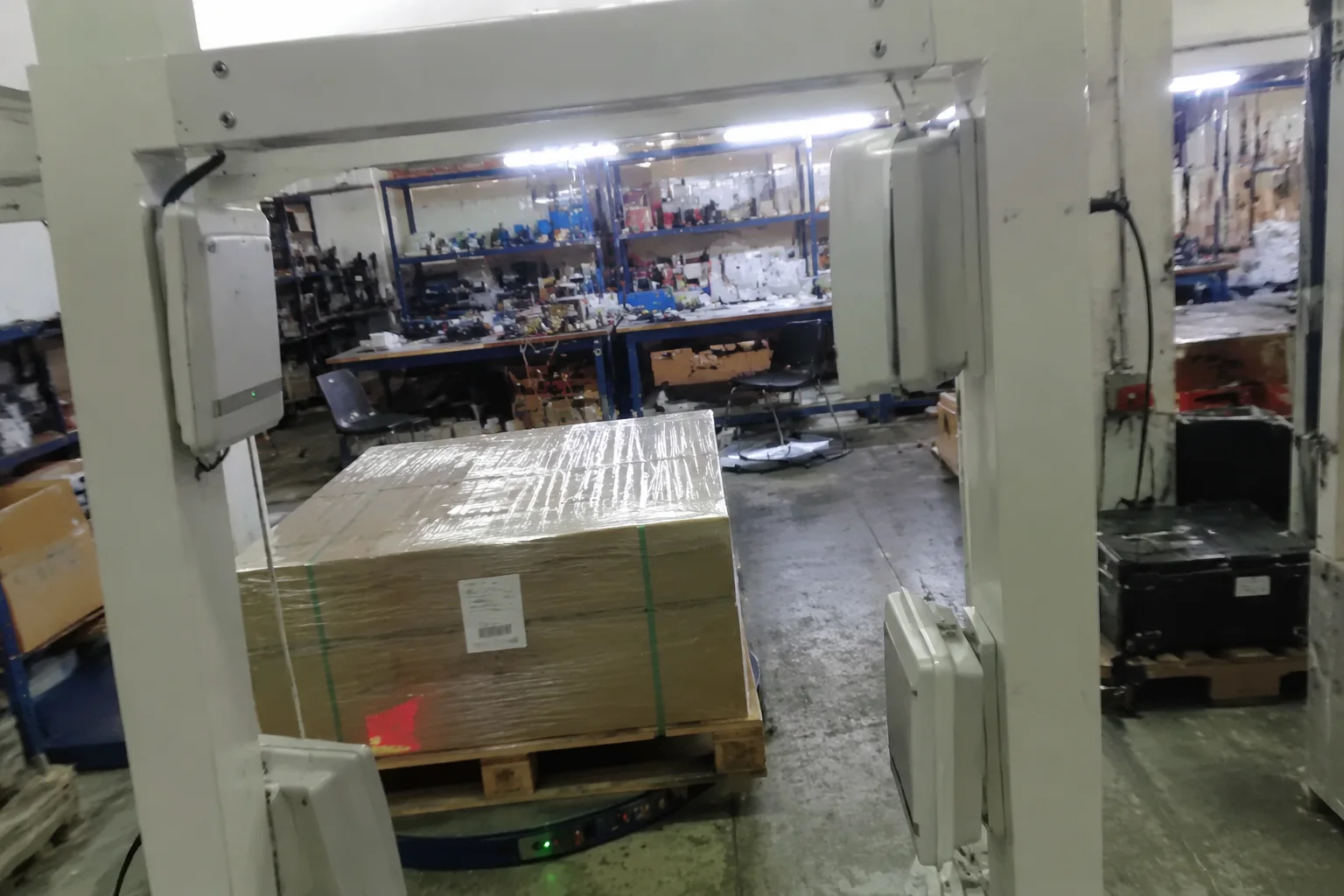
Most buyers learn the textbook version and still ship a broken pilot. In 2024 a warehouse integrator brought us a failed deployment: standard UHF tags on liquid-filled drums, read rates so low the dock door portal was effectively blind. Water absorbs 860 to 960 MHz energy, so the tags never harvested enough power to reply. The tags were fine. Nobody had checked what the drums were full of.
RFID is easy to buy and hard to deploy. If you need the system-level view first, covering readers, antennas, and middleware, start with what RFID technology is. Below we cover what happens when a tag answers a reader, how the tag classes and frequency bands differ, and the integration mistakes that kill pilots. One thing worth saying up front: in our lab the failure is almost never the silicon. It is coupling, antenna sensitivity, or an environment nobody tested.
If you are still choosing hardware, our RFID reader buying guide lays out the framework we use with integrators before they commit.
Key Takeaways
- Passive tags reply by backscatter: they reflect the reader's own radio wave while switching their load to encode data. No battery, no generated power.
- Range is set by two link budgets, forward (reader to tag) and reverse (tag to reader). Both must close; a sensitive reader cannot save a detuned tag.
- UHF reads fastest and farthest but fails near metal and liquid. LF and HF survive those environments at the cost of range and speed.
- EPC Gen2 anti-collision lets one antenna read up to about 1,000 tags per second through randomized slotted ALOHA, not raw transmit power.
- Most deployment failures trace to an untested site. A real survey measures read zones with the product you actually ship, at the height it actually passes.
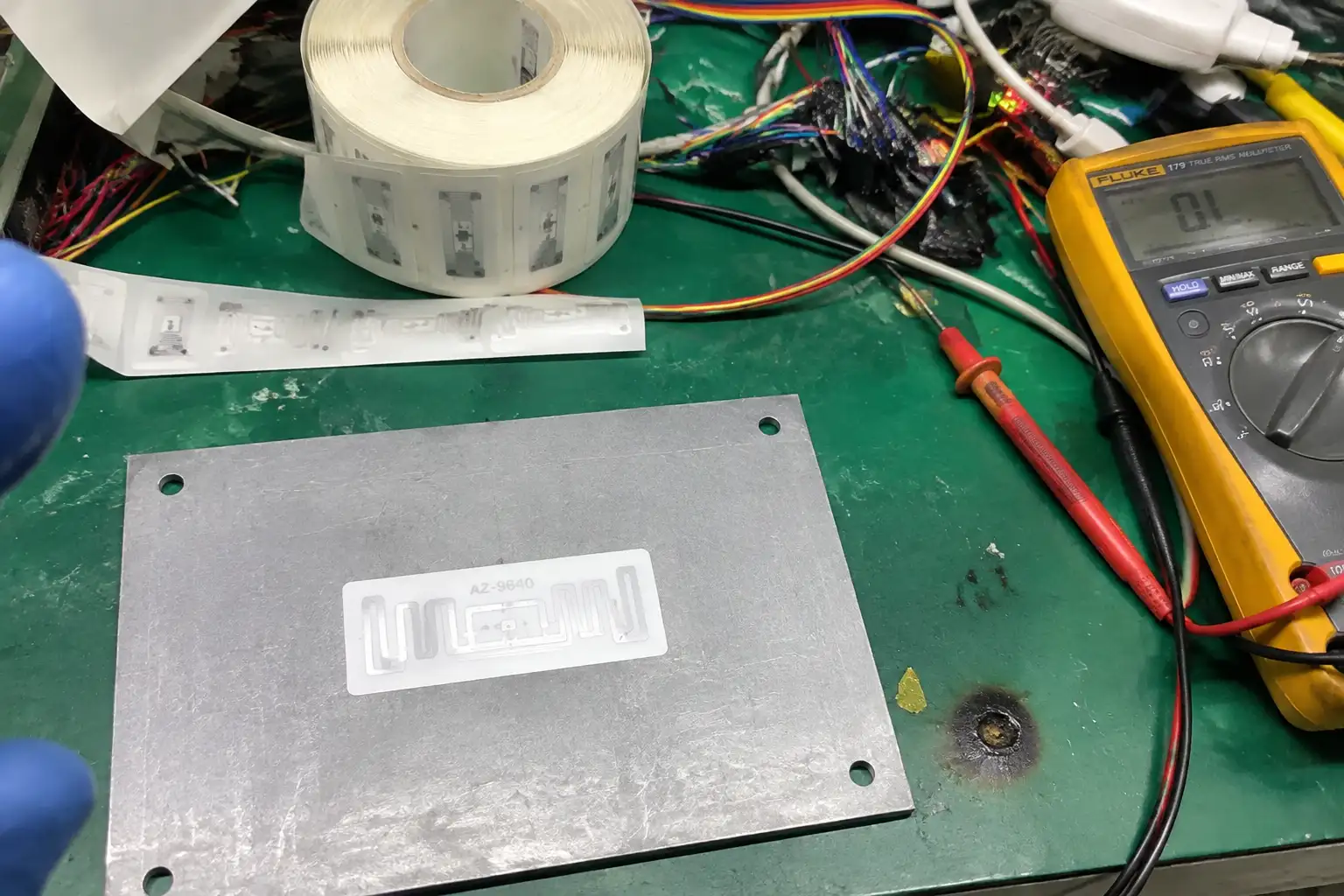
How an RFID Tag Works: The Five-Step Read Cycle
- Energize. The reader antenna radiates a continuous RF wave in its licensed band, 860 to 960 MHz for UHF.
- Wake. The tag antenna captures that energy. A rectifier converts it to DC and boots the chip once the field clears tag sensitivity, roughly -18 dBm to -24 dBm.
- Command. The reader modulates a Query onto the same carrier. The tag demodulates it and pulls its EPC out of non-volatile memory.
- Reply by backscatter. The chip switches its antenna load, changing the reflection coefficient. That modulated reflection carries the EPC back. The tag never generates RF power of its own.
- Decode. The reader detects amplitude and phase shifts down to about -80 dBm, decodes the EPC, and hands a timestamped read event to middleware.
That -80 dBm in step 5 is a real design target, not a round number: our U8 module is graded to that receive sensitivity with a peak read rate of 500 tags per second, and a cheaper receiver that hears less will miss a tag that was never actually absent.
Steps 2 and 4 are where deployments fail. If the tag cannot harvest enough power, or the reader cannot hear the reflection, no amount of software fixes the read.
How Passive, Active, and BAP RFID Tags Work
What are the three types of RFID tags? Passive tags have no battery and reply using the reader's energy, costing cents per unit. Active tags carry a battery and transmit their own signal past 100 meters. Battery-assisted passive tags use a battery to wake the chip but still reply by backscatter.
"Tag" covers three very different products. Which one fits comes down to read range, the environment, and what you can afford per unit.
Passive RFID Tags
Passive tags carry no battery. They wake when the reader's field reaches them and die the moment it stops. No battery means no shelf-life decay and a unit cost below a dime at volume. It also means the tag can only reply with energy the reader gives it, so read range tops out where the forward link budget closes.
Backscatter is how a passive RFID tag replies. The reader emits a continuous radio wave. The tag chip switches its antenna load on and off, changing how much of that wave is reflected. The reader decodes those amplitude and phase changes as data. The reader does the transmitting; the tag only shapes the reflection it sends back.
So what physically happens in the half-millisecond a tag answers? The chip sits across an antenna, and each load switch changes its reflection coefficient. The reader reads the serial number out of that wobble. The tag is borrowing the reader's energy, which is why read range collapses the moment the forward link stops closing.
At LF and HF the mechanism is different. Those bands use near-field inductive coupling: the reader builds a magnetic field and the tag coil draws power like a transformer secondary. There is no far-field backscatter at 125 kHz or 13.56 MHz, which changes how you size the antenna and predict read range.
For a deeper technical breakdown of passive tag electronics, our guide on passive tag chip selection and antenna tuning goes further into inlay design, rectifier behaviour, and detuning.
Active RFID Tags
Active tags carry a battery that powers both the chip and a transmitter. Because they broadcast their own signal, read range extends past 100 meters and punches through environments that would blind a passive tag. The cost is real: five to thirty dollars per unit, a physical footprint that will never fit a garment label, and a battery that ages out in three to seven years.
Active tags come in two behaviours. A beacon transmits on a fixed interval whether or not a reader is listening, which suits yard, trailer, and container tracking where you want a continuous heartbeat from every asset. A transponder stays asleep until an exciter wakes it, which conserves battery in gated zones such as a single yard entrance.
Cold weather is the quiet killer, and the cell chemistry decides how bad it gets. Li-MnO2 cells fall off below -20 C. Bobbin Li-SOCl2 holds most of its capacity to -40 C but passivates while idle, so the first transmit pulse after a cold soak can sag below the radio's operating voltage. Either way, a tag that beacons every two seconds at room temperature can go quiet on a frozen dock. Active still makes sense on high-value assets spread over a big footprint, where the per-tag cost disappears into the value of the thing being tracked. For high-volume item tagging, active is the wrong tool.
Battery-Assisted Passive (BAP) Tags
BAP is the middle road. A small battery wakes the chip and often drives a sensor, but the tag still replies by backscatter once the reader calls it. The battery removes the hardest constraint on passive designs, harvesting enough energy in a tough field, which buys longer, more reliable reads near metal or at a zone edge, at one to five dollars per tag.
We reach for BAP in cold-chain logging and medical-equipment tracking, where a missed read is expensive and the environment is unforgiving. The trade is shelf life: a BAP tag ages from the day it is made.
The three RFID tag classes compare as follows on power source, read range, cost, and how they typically fail.
| Tag Type | Power Source | Typical Chip | Read Range | Read Rate | Unit Cost (volume) | Typical Failure Mode |
|---|---|---|---|---|---|---|
| Passive | Reader field (no battery) | Impinj Monza, NXP UCODE | 3 to 10 m typical; up to ~25 m best case | Up to about 1,000 tags/s (Gen2) | $0.05 to $0.15 | Detuning near metal/liquid, ESD damage |
| Active | Internal battery + TX | MCU with RF transmitter | 100 m and beyond | 10 to 100 per second | $5 to $30 | Battery depletion, cold-weather fade |
| BAP | Internal battery assists, backscatter reply | Monza with sensor hub | 15 to 30 m typical | Hundreds per second | $1 to $5 | Battery shelf life, larger form factor |
Still weighing active against passive? Our active vs passive RFID comparison puts numbers on the trade-offs.
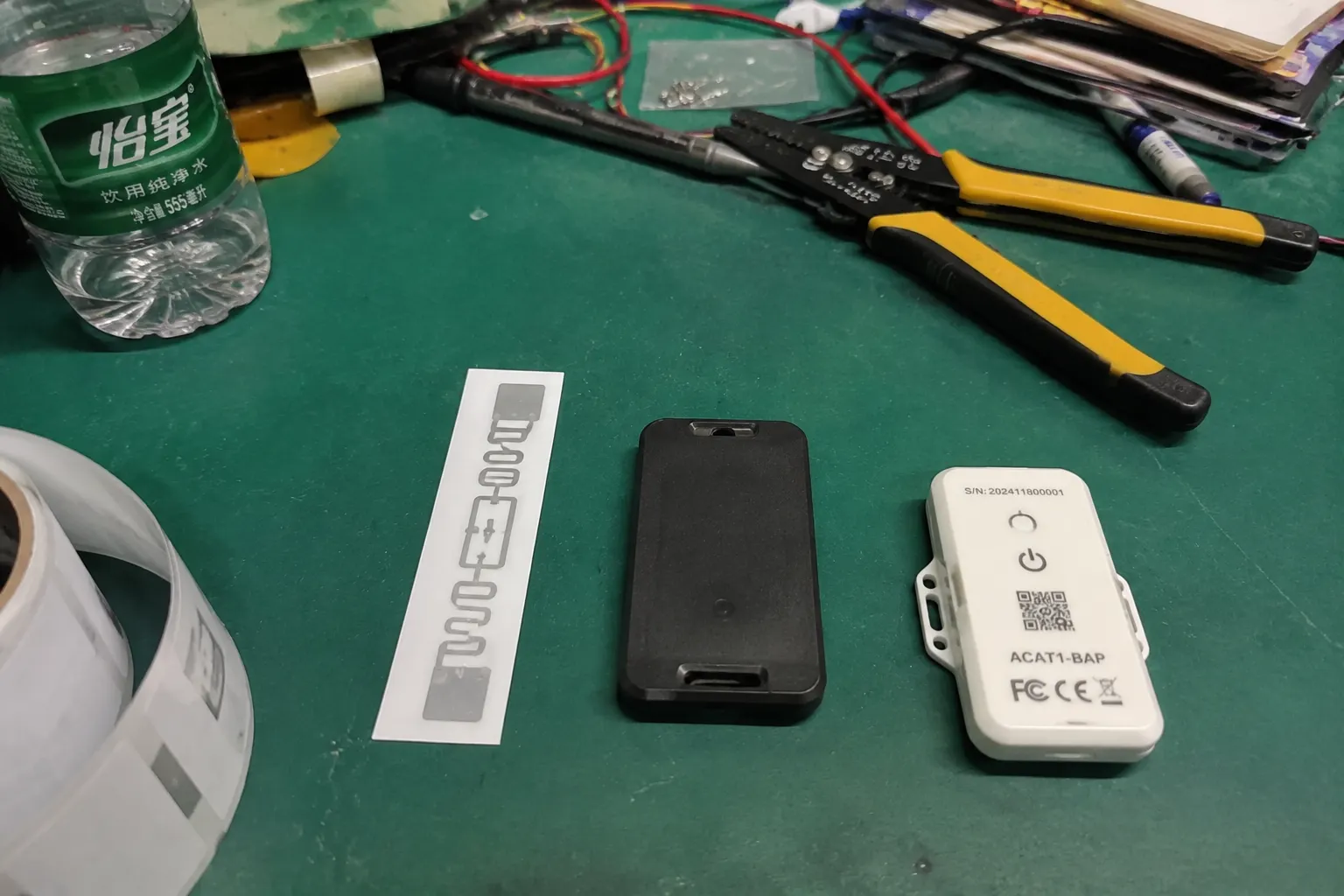
How RFID Frequency Bands Work: LF, HF, and UHF
RFID tags work at three frequency bands. LF at 125 to 134 kHz reads under 10 cm but survives metal and liquid. HF at 13.56 MHz reaches about 1 meter and powers NFC. UHF at 860 to 960 MHz reads fastest and farthest, 3 to 10 meters in a real warehouse and up to about 25 meters with a high-gain antenna, but degrades near metal and liquid.
Frequency decides range, speed, and whether your signal survives the environment at all. In practice the material the tag sits on picks the band long before anyone opens a price list. For how this plays out in a working warehouse, see RFID in warehouse and logistics operations.
Low Frequency (LF)
LF runs at 125 to 134 kHz. Read range is short, often under 10 centimeters, and data rates are slow enough that reading more than one tag at a time is impractical. The payoff is stubborn reliability near water and metal, because near-field magnetic coupling barely notices either.
That is why LF still owns animal ID, car key fobs, and tool-checkout bins in machine shops. Livestock and pet tagging follows ISO 11784 and ISO 11785 at 134.2 kHz, which fix both the code structure and the transmission protocol, so a reader from one vendor still reads a tag implanted a decade earlier. The limits are real too: no meaningful anti-collision, tiny memory, and an antenna that has to be almost touching the tag. If your tag lives against steel or in a wet spot and you read one item at a time, LF is the boring choice that works.
High Frequency (HF)
HF runs at 13.56 MHz and reaches roughly a meter. It is the band behind NFC, contactless payment cards, transit passes, and library circulation. HF sits in a sweet spot: enough range for a hand-presented item, and strong enough anti-collision to read a stack of books without separating them.
Separate band capability from the hardware you actually buy. A meter of range needs a large vicinity antenna and an ISO 15693 tag; most HF hardware in circulation is proximity-class. Our own HF desktop readers run ISO 14443A at 13.56 MHz, rated under 5 centimeters and -20 to 60 C. Our U6 UHF desktop reader is rated -40 to 70 C. Check that temperature line as carefully as the band.
Memory is the other reason HF wins where it wins. Both ISO 15693 and ISO 14443 tags carry kilobits of rewritable memory. The security split matters: ISO 14443 supports full cryptographic authentication, AES-128 in parts such as MIFARE DESFire and NTAG 424 DNA, which is why payment and access control sit there. ISO 15693 offers password protection and privacy flags, not native crypto, which is why it lands in libraries and asset tracking instead. The trade is throughput: an HF reader handles a few tags on a shelf, never a pallet moving through a portal at walking speed.
Pharma authentication, document tracking, and any tap-to-read workflow are where HF usually wins, especially when the environment is hostile to UHF.
Ultra-High Frequency (UHF)
UHF spans 860 to 960 MHz and is the workhorse of supply chain and retail. It reads farthest, fastest, and cheapest per tagged item: 3 to 10 meters through a standard portal, up to about 25 meters with a high-gain antenna at maximum legal power, and up to roughly 1,000 tags per second through one antenna in FCC-band conditions. The catch is physics: UHF backscatter degrades hard near metal and liquid.
RAIN RFID is the UHF ecosystem most logistics teams mean when they say "RFID," and the RAIN RFID standard covers both the specification and the brand behind it. The industry body behind the name is the RAIN Alliance, which issues the company ID numbers used when you encode tags.
One thing buyers miss: UHF bands differ by region. Europe runs a lower band at 865 to 868 MHz capped at 2 W ERP, and an upper band at 915 to 921 MHz at 4 W ERP, both under ETSI EN 302 208, though upper-band availability varies by country. The US allows 902 to 928 MHz at 1 W conducted, up to 4 W EIRP with a 6 dBi antenna, under 47 CFR §15.247. Watch the units when you compare: 2 W ERP is about 3.28 W EIRP, so the European lower band is closer to the US ceiling than the headline numbers suggest. Our RFID frequency regulations by country map keeps a multi-region deployment legal and on-air.
Here is how the three RFID frequency bands compare on read range, data rate, cost, and metal or liquid tolerance.
| Frequency | Band | Standard | Read Range | Data Rate | Tag Cost | Metal / Liquid | Best For |
|---|---|---|---|---|---|---|---|
| LF | 125 to 134 kHz | ISO 11784/11785, ISO/IEC 18000-2 | Under 10 cm | Slow (kbps) | Low | Excellent | Animal ID, key fobs, tool bins |
| HF | 13.56 MHz | ISO 14443, 15693, NFC | Up to 1 m | 1.65 to 26.5 kbps (15693); 106 to 848 kbps (14443) | Low to mid | Good | Payments, libraries, pharma |
| UHF | 860 to 960 MHz | EPC Gen2 / ISO 18000-63 | 3 to 10 m typical; ~25 m best case | 100+ kbps, ~1,000 tags/s | Low per tag | Poor | Warehouse, retail, logistics |
One note on the standards column: the UHF air interface lives in the ISO/IEC 18000-6 family, and the current edition is ISO/IEC 18000-6:2025, published 27 October 2025 as Edition 4. The older 2013 text was withdrawn in October 2025, so any tender written against it no longer matches what a supplier can certify to.
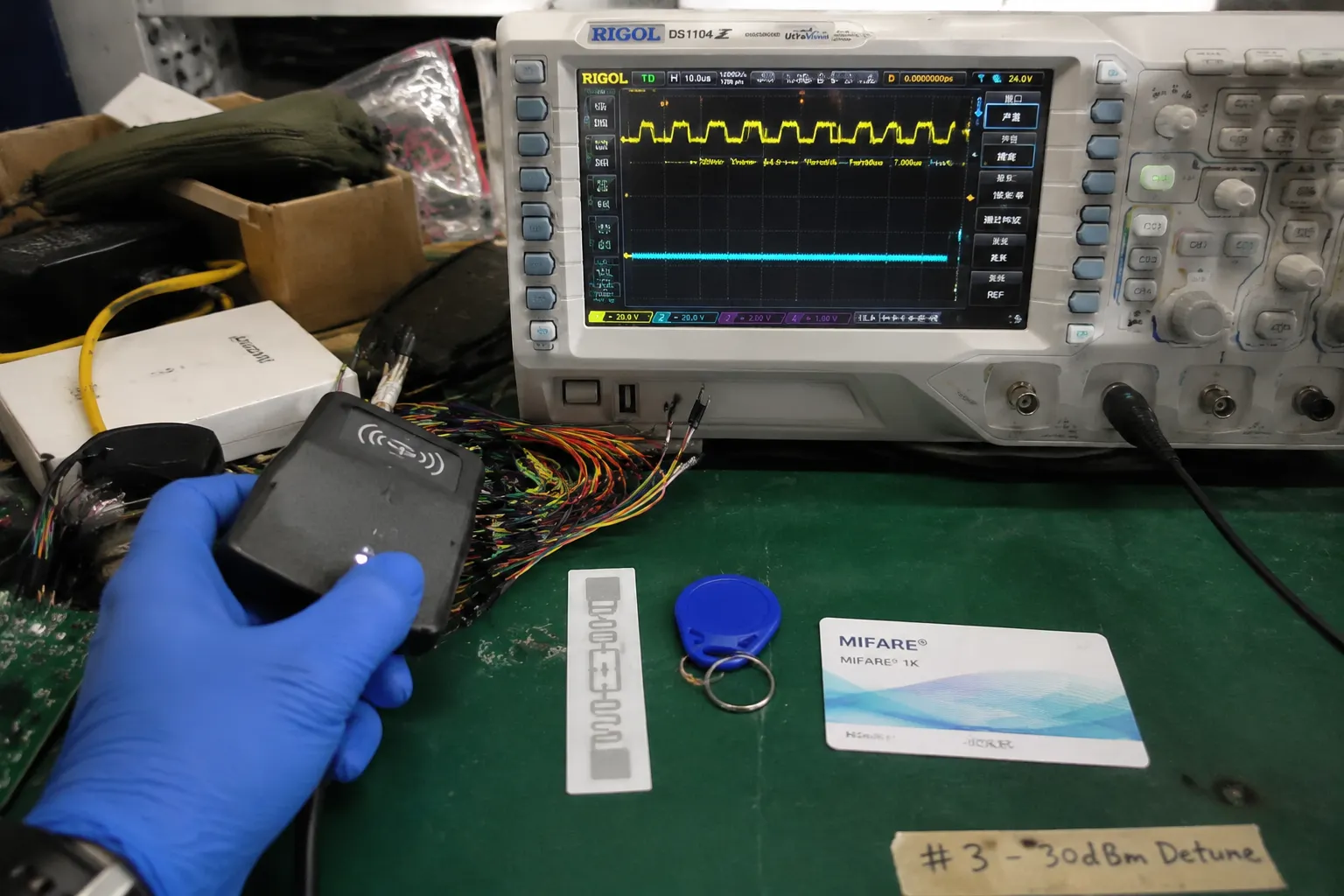
How RFID Readers Set Range and Read Many Tags at Once
How far can an RFID tag be read? A passive UHF tag typically reads at 3 to 10 meters in a working environment, and up to roughly 25 meters with a high-gain antenna at maximum legal power. HF reaches about a meter, LF under 10 centimeters, and battery-powered active tags exceed 100 meters.
Frequency picks the playing field. Two other variables decide whether a read actually lands: how the reader arbitrates a crowd of tags, and whether both halves of the radio link close at the same spot on your floor.
How EPC Gen2 Reads 1,000+ RFID Tags at Once
An EPC Gen2 reader reads many RFID tags at once using randomized slotted ALOHA. The reader sends a Query telling every tag to pick a random slot out of 2^Q. Tags in the winning slot reply; colliding tags retry in later rounds. The protocol allows up to about 1,000 tags per second in favorable FCC-band conditions.
When a pallet of tagged cartons passes a dock door, dozens of tags wake together. If they all replied at once the reader would hear noise, so the Q algorithm spreads them across slots and adapts as the crowd thins. The GS1 UHF Air Interface Protocol defines the mechanism in full; the current release is Gen2v3 (version 3.0.1, February 2026).
The buying lesson is simple. A reader's anti-collision efficiency matters as much as its raw output power, and cheap readers stall past a few dozen tags no matter how hard they transmit.
Reader Sensitivity and Tag Sensitivity Must Both Close
RFID read range is set by two link budgets. The forward link is reader to tag: the chip must harvest enough power to wake, bounded by tag sensitivity of about -18 dBm to -24 dBm. The reverse link is tag to reader, bounded by reader sensitivity near -80 dBm. Both must close.
Buyers watch the forward link and forget the reverse one. Tag sensitivity shifts with the surface the tag sits on, well away from the datasheet number, and a competent UHF reader has to hear that reply down at -80 dBm or -90 dBm. Both links must close at the same spot on your floor, or you get a tag that wakes and never gets heard.
When we spec a deployment, we match reader and tag sensitivity against the real environment. Datasheet range is measured in open air against a reference tag, and your dock door is neither. Sensitivity is the number we grade our own RFID reader modules on, and every unit is tested against reference tags before it ships.
That grading is a ladder, visible in the catalog: -67 dBm on the small 20 dBm modules, -76 dBm mid-range, -80 dBm on the U8. Antenna gain moves the same budget from the other end. Two of our integrated readers are listed with the same -80 dBm receiver and the same 250 tags per second peak, and differ on antenna: 4 dBi rated up to about 4 m, 8 dBi up to about 8 m. Treat that doubling as a rounded manufacturer rating rather than a link-budget result: +4 dBi is worth about 1.6x range in free space, not 2x. The receiver did not change.
RFID Integration Challenges: Where Good Pilots Die
Buying a tag and a reader is the easy part. Making them read reliably on a live line or in a busy warehouse is where projects stall. Almost every stalled pilot we get called into breaks in one of the same few places.
Environmental Interference: Metal and Liquid
Radio behaves badly around certain materials. Metal reflects UHF and carves nulls in the read zone; liquid absorbs it. Both shrink range or create blind spots you cannot see until product starts going missing.
An automotive supplier running our UHF portals hit this tracking steel engine blocks on a conveyor. Standard labels read intermittently at best, because the block acted as a mirror.
Three fixes, in the order we usually try them.
First, on-metal tags. A grounded plane or ferrite layer isolates the antenna from the surface, so the tag tunes the way it was designed to. These are the on-metal and on-liquid tags we build and test in house.
You are paying for a ground plane, so here is what it does. Our FR-4 on-metal line, is a printed antenna on a rigid PCB substrate 2 to 3 mm thick, with a ground plane between the antenna and the mounting surface. That plane terminates the near field underneath, so the steel below stops being part of the antenna's environment and starts behaving like a reflector. Aperture then buys range, which is why the line scales by size rather than by chip: the same M830 chip is catalog-rated above 2 m on the 13 x 7 mm part and above 15 m on the 80 x 20 mm part. Those are manufacturer ratings under ideal conditions, not field results. On your steel, at your angle, expect less.
Second, antenna placement and polarization. Circular-polarized antennas cope with random tag orientation. Linear ones read edge-on tags badly.
Third, power tuning inside the legal EIRP ceiling. Push past that point and you just raise multipath noise, and you break the law while doing it.
For liquid-filled containers, the honest answer is to leave UHF behind and move to HF or a purpose-built on-liquid tag.
Worth saying plainly: our own standard UHF label is the wrong part for a steel surface. Customers try it anyway to save four cents a tag, and we end up telling them to stop and re-spec. On-metal tags cost more because that substrate and ground plane cost more than a paper face and an adhesive backing. There is no version of this where you get on-metal performance at label prices.
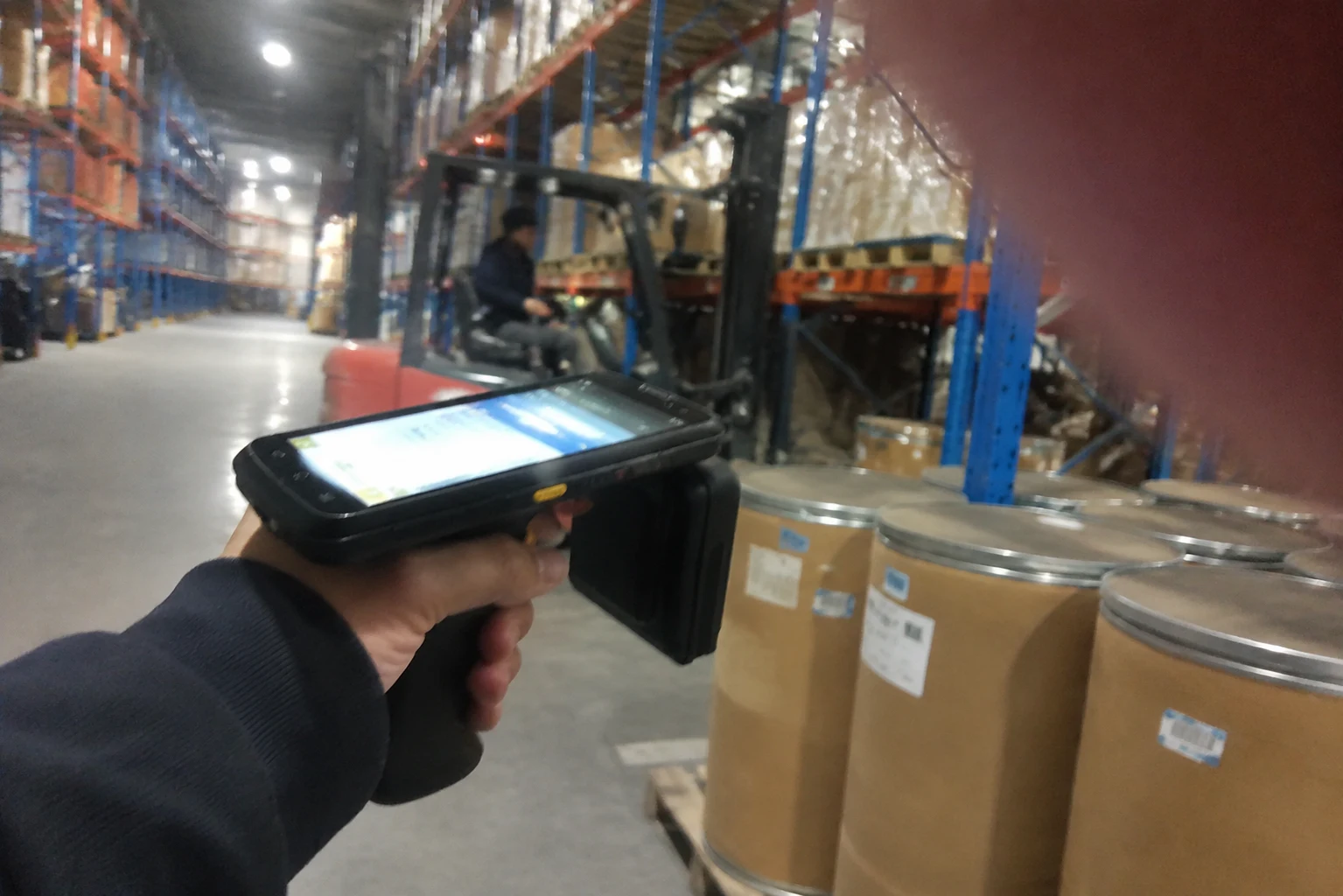
Hardware Mismatches
You cannot mix bands. A UHF reader will not see an HF tag, and a tag antenna tuned for a cardboard box detunes on a metal shelf. Getting where to place a Gen 2 tag on the product right removes a whole class of these failures before the first roll ships.
The reader antenna must cover the zone from a realistic height, and the tag must match the surface it sits on. A mismatch looks like a software bug but is pure physics. We resolve most of these at the spec stage, before a single tag is applied.
RFID Software and Data Management
An RFID reader produces a firehose of EPC reads, duplicate hits, and ghost tags spawned by multipath. RFID middleware has to filter and dedupe that stream into clean, timestamped events before your host system ever sees it. A single pallet crossing a UHF portal can generate hundreds of raw reads of the same few dozen tags, and every one of them arrives as a separate event on the SDK stream.
Deduplication comes first, collapsing repeated reads of one EPC inside a time window into a single arrival event. Then comes mapping, resolving the EPC, commonly 96 or 128 bits, into an EPC to SKU or EPC to serial lookup, because no ERP wants to reason about raw hex.
Upstream of all of that, you also have to encode and initialize tag data before rollout, or the clean events point at the wrong records.
One retail client's team burned most of a sprint because the SDK examples assumed a different middleware stack. We shipped working integration code and put a developer on direct support until the read event pipeline was clean. A clear SDK and reachable support is the difference between a smooth rollout and a stalled one.
These are the three RFID integration failures we see most often, and what we do about each.
| Challenge | Description | How Fongwah Helps |
|---|---|---|
| Environmental Interference | Signals reflected by metal or absorbed by liquid, creating blind spots and dropped reads. | We run site surveys and specify on-metal or on-liquid tags, antenna polarization, and legal power tuning. |
| Hardware Mismatches | Tag, reader, and antenna not matched to band and surface, causing partial or zero reads. | We review the environment and match every component at the quoting stage, while changes are still free. |
| Software and Data Management | Middleware cannot filter duplicate reads or integrate with the host system. | We ship a clear SDK with working examples and give your developers direct engineering support. |
What a Real RFID Site Survey Measures
A site survey is not a formality. We measure read zones at the actual mounting height with the actual tagged product, never calibration tags, and we sweep for ambient interferers: WiFi, neighboring readers, variable-frequency motor drives.
We rotate tags through real orientations, because a linearly polarized system reads edge-on tags poorly, then map reflections with a handheld and mark dead zones on the floor plan. That data prevents most failures that trace back to an untested environment, the step integrators skip most often.
Frequently Asked Questions
Q: How do RFID tags work?
A: A tag stores a unique ID in its chip and uses its antenna to exchange data with a reader; a passive tag is powered by the reader's signal, while an active tag uses its own battery.
Q: What is the difference between passive and active RFID tags?
A: Passive tags have no battery and are powered by the reader, suiting high-volume low-cost tracking; active tags carry a battery for longer range and periodic broadcasting.
Q: How far can an RFID tag be read?
A: Passive LF reads under 10 cm, HF up to about 1 m, and UHF several metres; active tags can reach tens of metres depending on power and environment.
Q: Can RFID tags be read through metal or liquid?
A: Radio passes through cardboard and plastic easily, but metal reflects UHF energy and liquid absorbs it; use on-metal tags or HF near those materials.
Q: Are RFID tags reusable?
A: Durable active and rugged passive tags on returnable assets are reused; low-cost disposable labels are typically single-use and stay with the shipped item.
Q: How much does an RFID tag cost?
A: Passive UHF labels can be a few cents each at volume; HF and LF cost more, and rugged or on-metal tags carry a premium for durability.
Conclusion: How RFID Tags Work in a Real Deployment
So, how do RFID tags work in practice? A passive RFID tag backscatters the reader wave, an active tag transmits its own, and read range only holds when both link budgets close. Match tag class, frequency band, and antenna to a surveyed environment before the first case ships.
When that sequence is followed, the numbers show up: one apparel program we supported cut apparel out-of-stocks by half with item-level RFID.
If you only do one thing before you buy, tag ten of your actual products and read them at your actual dock door height. That afternoon tells you more than any datasheet.
If you want to run that test yourself, our sample program ships qualified integrators up to 30 RFID label or tag samples at no charge — you cover the freight. Reader and device units aren't included; they're too high-value for us to hand out, so those stay on the quote. Tell us what you're tagging and the surface it sits on, and we'll point you at the parts worth trying first.
If your pilot is stalling or you are scoping hardware, talk to our engineering team. Send us your floor plan, your product, and where you need the read points, and we will spec the reader, module, tag, and card around that.
A note on sources. The performance figures on this page, tag and reader sensitivity, read rates, power limits, and band allocations, come from published chip datasheets and from the GS1, ISO/IEC, ETSI, and FCC documents cited above, and we sanity-check them on our own bench before we quote them to a customer. Figures attributed to specific Fongwah parts, such as module sensitivity, peak read rate, antenna gain, rated read distance, and operating temperature range, are manufacturer ratings from our current product catalogues under ideal conditions, not measured results for your site. The failure cases are generalized from integration work Fongwah has supported while building RFID readers, modules, tags, and cards; customer names and identifying details are withheld.
Related guides in this series: what an RFID reader does, how RFID works and what it tracks, what RFID technology is, and RFID vs NFC.