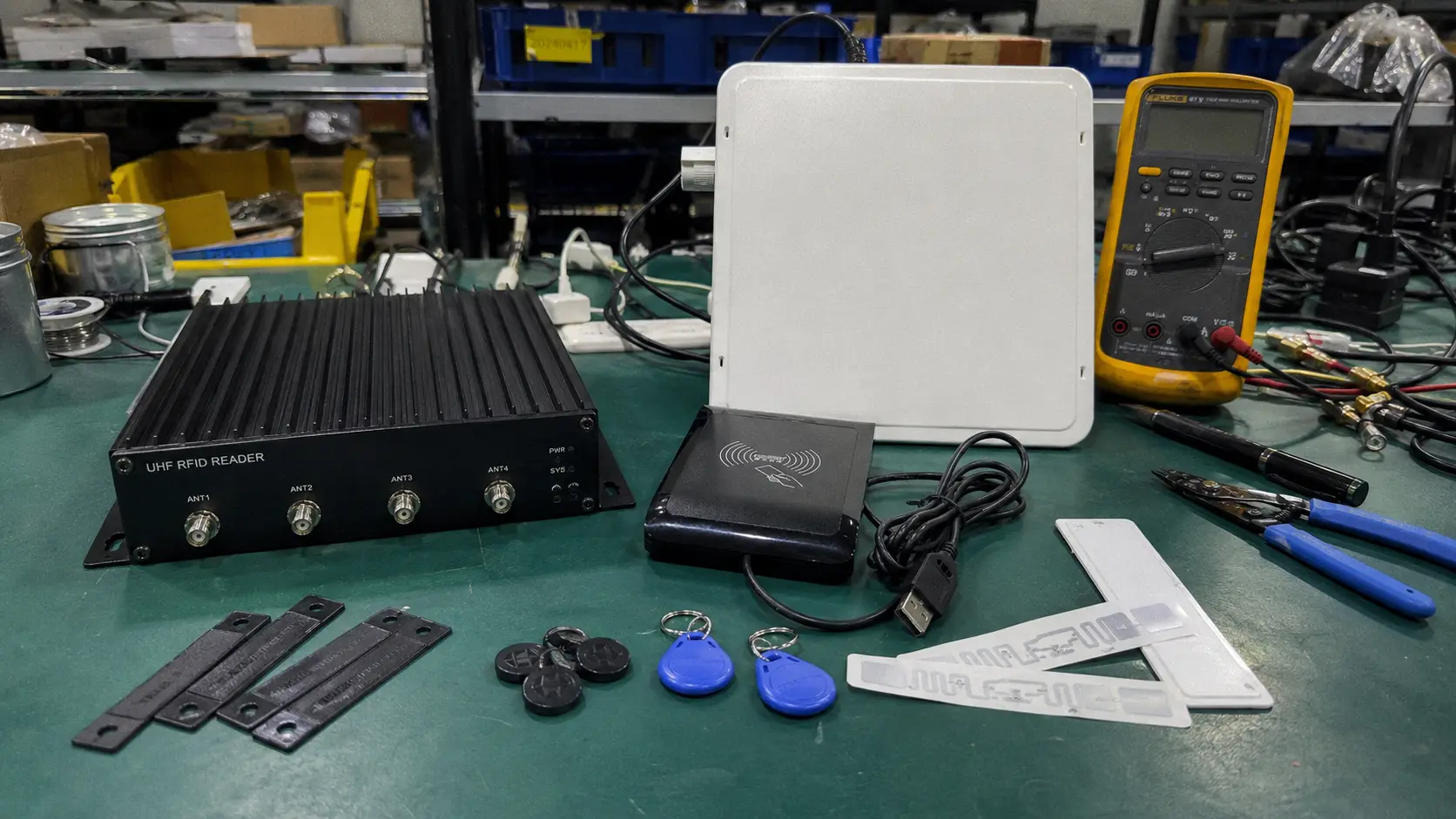
RFID is a wireless data-capture method that identifies objects without line of sight by reading a unique ID stored on a tag. A complete system has three parts: a tag that carries the ID, an antenna that carries the radio signal, and a reader that powers the tag and processes the returned data. Most industrial and supply-chain deployments use passive UHF tags, which have no battery and draw energy from the reader through backscatter. The technology works, but only when the frequency band, tag surface, and regional standard match the operating environment—getting any of these wrong is the fastest way to sink a rollout.
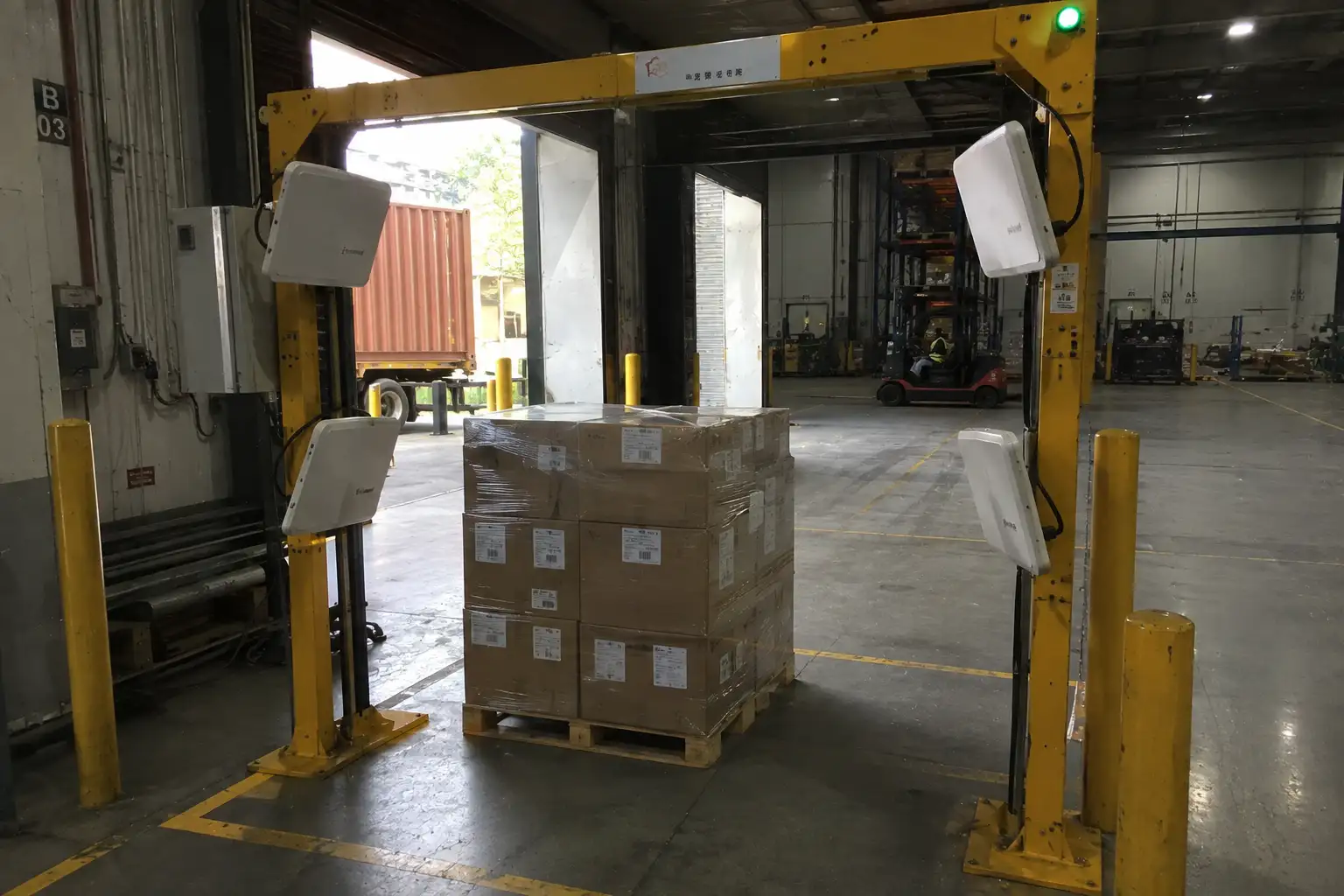
What RFID Actually Does in a B2B Operation
What RFID Does: Automatic Data Capture
RFID is a tool for collecting identifiers automatically. A reader emits a radio field; a tag within range responds with its stored number; the reader passes that number to a host system. The value is in removing manual scanning, tolerating orientation, and reading many items at once. It is not a locator by itself—knowing an ID is present is different from knowing exactly where it is, and read rate, not range alone, determines whether the system is useful.
For a plain-language walkthrough of the whole system, see how RFID tags work.
What you can track with RFID
RFID tracks anything that carries a tagged asset, container, or product. Tagging granularity runs from pallet-level (one tag per load) to item-level (one tag per unit); UHF supports both, while HF and LF are usually applied at item or credential level. Common B2B cases include:
- Pallets and cases moving through a dock door
- Reusable transport items such as totes and racks
- Work-in-process units on a production line
- Library and document collections
- Access credentials and livestock identification
The tag does not describe the object. It carries a key that your software maps to a record. Tracking quality rides on the read rate, which in turn depends on the physics explained below.
The Three Core Hardware Components of an RFID System
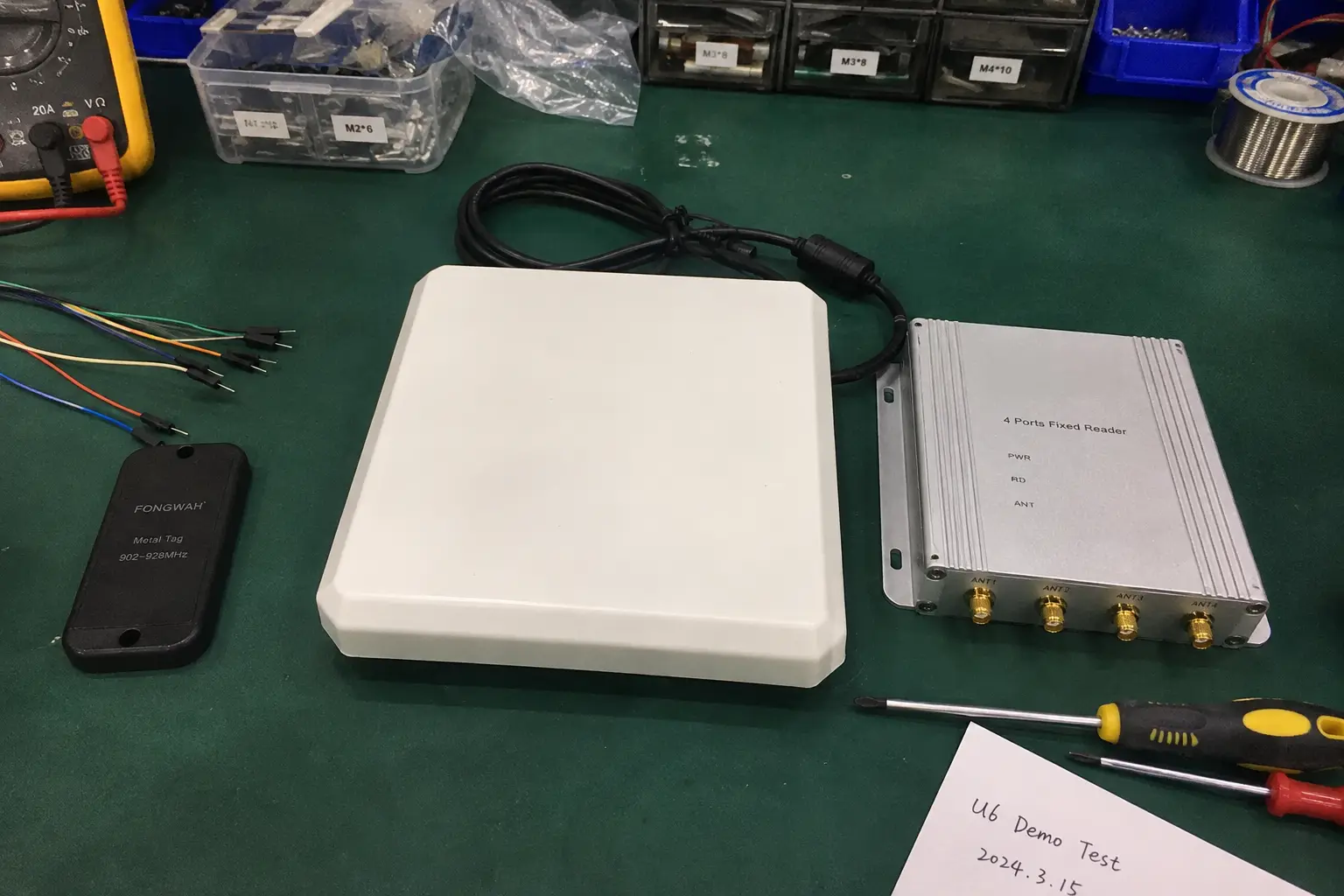
RFID Tags: Chip and Antenna
A tag is an integrated circuit bonded to an antenna, usually on a thin substrate. The chip stores a unique identifier and, on many models, a small user-memory block. The antenna is what couples to the reader's field. A passive tag has no battery; the chip wakes only when energy arrives from the reader.
Tag memory is organized into banks. The EPC bank holds the Electronic Product Code—the unique identifier, typically 96 or 128 bits. The TID bank is factory-written by the chip maker and often encodes the manufacturer and model. The User bank is optional, application-writable memory for supplementary data. Matching the memory layout to your software is part of tag selection, not an afterthought.
RFID Antennas: The Bridge Between Tag and Reader
The antenna is the physical interface that broadcasts the reader's signal and receives the tag's reply. Gain, polarization, and placement decide the read zone. A poorly placed antenna leaves dead spots that no amount of software tuning will fix, so site layout matters as much as the hardware spec.
RFID Readers: Power Source and Data Processor
The reader generates the RF energy, listens for backscattered replies, and decodes the tag data into a format a backend can use. Fixed readers serve portals and conveyors; handheld readers serve audits and exceptions. Transmit power and antenna gain together set the practical read distance, inside the limits of what a passive tag can harvest and reflect.
How Passive RFID Moves Energy and Data
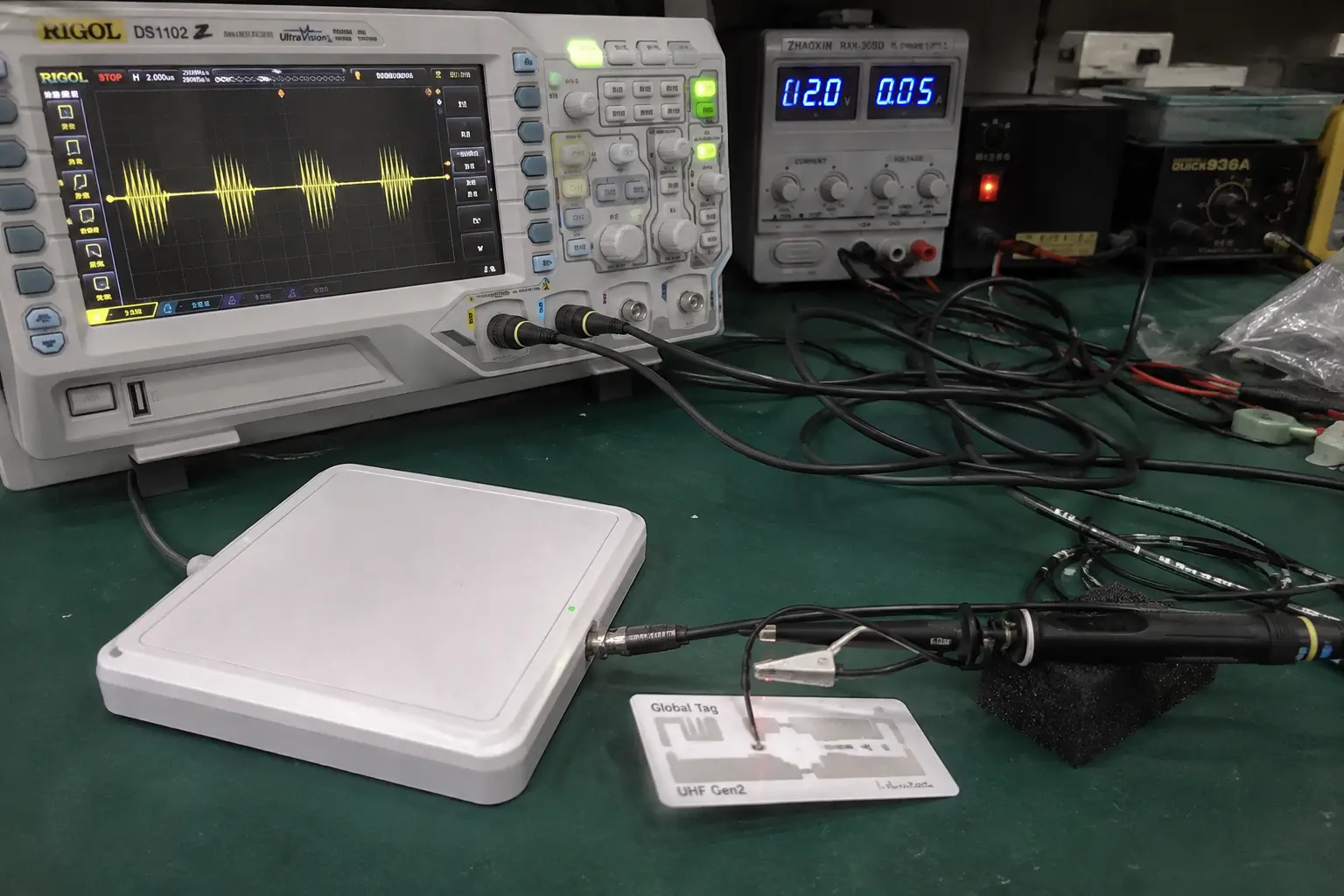
A passive tag has no internal power source. When the reader's field reaches it, the tag's circuitry harvests enough energy to power the chip. The chip then replies by changing how it reflects that same field—a method called backscatter. The reader picks up those reflections as data. This is why passive range is bounded: the tag can only return what the reader's own energy illuminates.
For a deeper walkthrough of how passive tags harvest and reflect energy, see how passive RFID tags work.
Active RFID Tags: Battery-Powered
Active tags carry their own battery and can initiate transmission over longer distances, often tens of meters, without relying on reader energy. That range and autonomy come at a cost: a higher per-tag price and a finite service life that requires battery replacement. Passive remains the default for high-volume supply-chain and retail use because the tag is cheap and maintenance-free, but active is the pragmatic choice when range or autonomous signaling outweighs unit cost.
Frequency Bands and Where They Fit
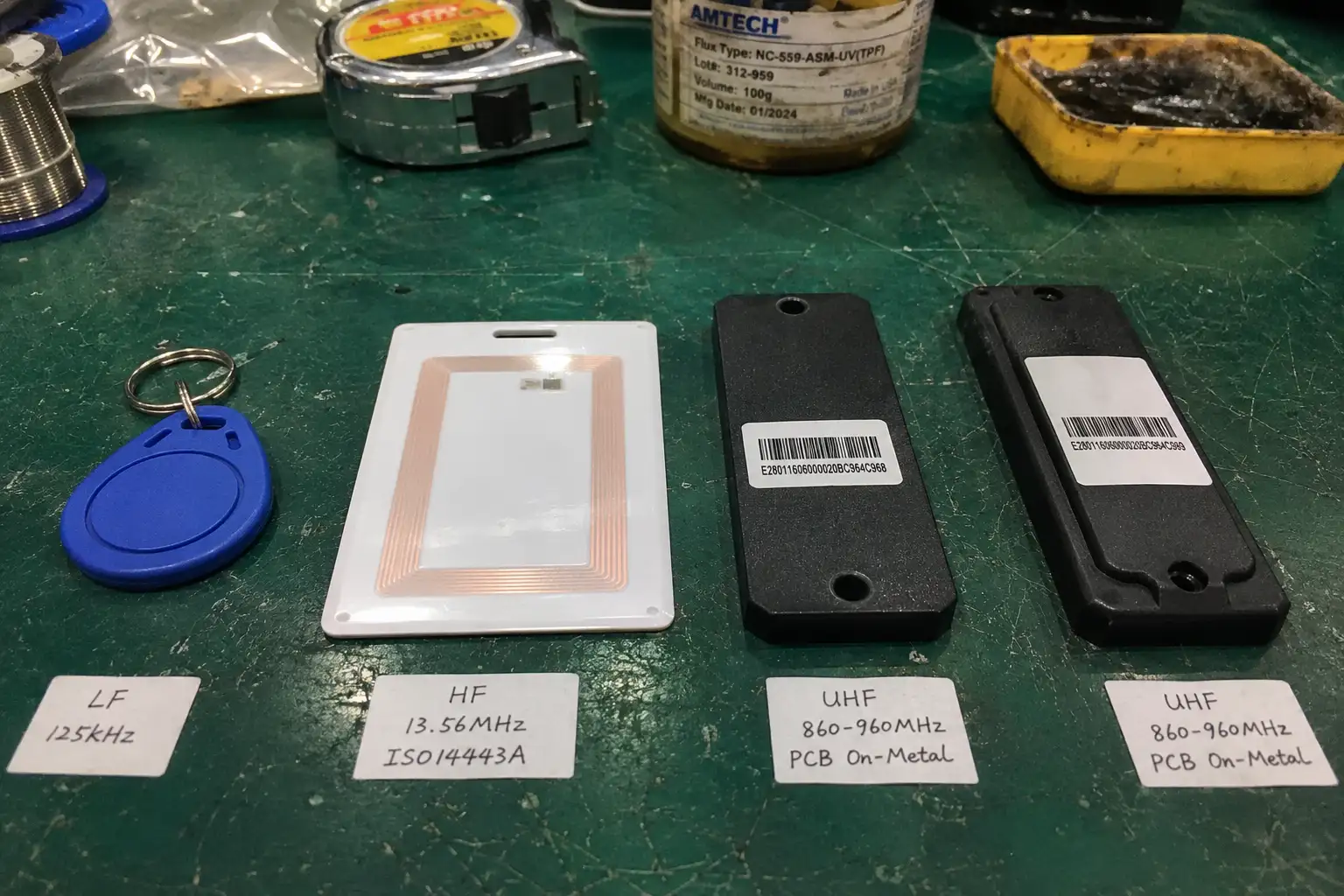
RFID is not one frequency. The band you choose sets the read distance, the speed, and the materials you can work near.
Low Frequency (LF): 125–134 kHz
LF reads at under 10 cm and tolerates metal and liquid better than any other band. That tolerance is why it dominates animal identification and many access-control credentials, where the tag sits close to the reader and may be near metal fittings or a wet environment. The trade-off is slow data rates and short range.
High Frequency and NFC (HF): 13.56 MHz
At 13.56 MHz, HF reaches about a meter. It underpins contactless payment, transit cards, and library systems. The relevant standards are ISO 14443A (ISO/IEC 14443) for close-proximity cards and ISO 15693 (ISO/IEC 15693) for slightly longer-range item tagging. HF is a sound choice when reads happen at a counter or a smart shelf rather than across a warehouse.
For a head-to-head on how RFID and NFC compare and which to choose, including where each fits in a B2B rollout, see our dedicated guide.
Ultra-High Frequency (UHF): 860–960 MHz
UHF runs roughly 860–960 MHz and delivers the longest passive range, commonly 3–12 meters or more, at the highest read speeds. This is the band behind retail inventory and logistics. At high volumes, UHF relies on anti-collision protocols so many tags can reply without permanently blocking each other. Metal reflects the signal and liquids absorb it, so a tag on a metal drum or a liquid-filled bottle reads far worse than the same tag on cardboard.
UHF Regional Splits: ETSI vs FCC
UHF is not a single global allocation. Europe uses ETSI bands around 865–868 MHz (ETSI EN 302 208) with power limits; the United States uses FCC bands around 902–928 MHz (FCC Part 15, 47 CFR) with different limits. A reader certified for one region may be non-compliant in another. If you ship readers or tagged goods across regions, confirm the frequency plan before you buy, because the hardware is region-locked by regulation rather than by choice.
If you need the country-by-country breakdown, see RFID frequency regulations by country.
Standards You Will Encounter
UHF Passive: EPC Gen2 and ISO 18000-63
Most UHF passive systems speak the EPC Gen2 air interface (GS1 EPC Gen2), standardized as ISO 18000-63 (ISO/IEC 18000-63). EPC Gen2 defines how tags modulate, encode, and anti-collide; ISO 18000-63 is the international harmonization of that same physical and link layer. In procurement terms, "Gen2" and "ISO 18000-63 compliant" describe the same UHF passive behavior from two labeling traditions.
HF: ISO 14443A and ISO 15693
For HF, ISO 14443A covers proximity smart cards, while ISO 15693 covers vicinity cards that read from farther away. Both run on 13.56 MHz. Matching your reader and tag to the same standard is non-negotiable—mismatched standards mean no read, regardless of how strong the hardware looks on paper.
RFID vs Barcode
RFID is often compared with printed barcodes, but they solve different problems. The table below summarizes the practical differences a buyer should weigh.
| Attribute | RFID | Barcode |
|---|---|---|
| Line of sight | Not required | Required |
| Reading many at once | Yes, hundreds per second | One at a time |
| Durability | Survives dirt, paint, embedding | Fails when torn, smudged, or worn |
| Rewritable | Some tags are writable | Printed once |
| Typical range | LF <10 cm; HF ~1 m; UHF 3–12 m | A few centimeters to the scanner |
| Unit cost | Passive UHF cents; HF/LF higher | Fractions of a cent |
Barcodes win on label cost and universality; RFID wins on automation, orientation tolerance, and multi-tag throughput. Most operations use both, with RFID at chokepoints and barcodes elsewhere.
Why Selection Errors Break Projects
Frequency and Surface Mismatch
The most common failure is picking a band without testing the real surface. A UHF tag specified on a cardboard test bench can collapse to near-zero range on a metal asset or a liquid container. For the engineering detail on why, see what materials block RFID and why. LF or a specialized on-metal tag is often the honest answer, even though it means shorter range. Specifications on paper do not survive contact with the production floor, so pilot testing on the actual asset is the only reliable check.
Total Cost of Ownership and Implementation Risk
Tag price is the smallest line in the budget. The real cost is readers, antennas, cabling, middleware, integration, and the labor to tune read zones. A deployment that needs a high read rate at a dock door may need more antennas and site surveys than the sticker price suggests. Model the total cost of ownership and the implementation risk before committing, and pilot on your actual floor rather than in a vendor demo room.
For a hard-numbers comparison, see RFID's total cost of ownership.
For a UHF deployment, request free samples or contact the Fongwah engineering team to test tag, surface, and regional-frequency fit on your own floor before committing capital.
Frequently Asked Questions
Q: How much does UHF read distance drop near metal or liquid?
A: On a metal surface or a liquid-filled container, a standard passive UHF tag can lose most of its free-space range, often falling from several meters to a few centimeters or failing to read at all. Use on-metal tags or drop to LF where the asset is consistently metallic or wet.
Q: What is the relationship between EPC Gen2 and ISO 18000-63?
A: They describe the same UHF passive air interface from two standards traditions. EPC Gen2 is the GS1 specification; ISO 18000-63 is the international standard that harmonizes it. A tag or reader compliant with one is functionally compliant with the other.
Q: When should I choose passive instead of active RFID?
A: Choose passive when you need very low tag cost, no battery maintenance, and reads within a few meters at high volume, such as retail or logistics. Choose active when you need longer range or autonomous signaling and can absorb higher tag cost and battery replacement.
Q: How do reader transmit power and antenna gain affect read distance?
A: Read distance grows with reader transmit power and antenna gain, but only up to regulatory limits and within the energy the tag can harvest and reflect back. More power is not a cure for a dead spot caused by metal or poor antenna placement.
Q: What causes missed reads when many tags are present, and how is it handled?
A: When many tags reply at once they collide. UHF Gen2 uses anti-collision (a randomized slot scheme) so the reader can serialize replies, but real-world reliability still depends on reader density and tag spacing.
Q: Do I need different RFID hardware for the US and Europe?
A: Yes, for UHF. The United States allows FCC bands around 902–928 MHz and Europe uses ETSI bands around 865–868 MHz with different power rules. Use region-certified readers and antennas, or a multiregion unit configured per market.
Q: Can RFID read through cardboard, plastic, and other non-conductive materials?
A: Yes, passive UHF reads well through cardboard, plastic, and most non-conductive packaging, which is why it suits case and pallet tagging. Performance degrades mainly at conductors such as metal and at materials with high water content.
Q: What is the read range of RFID?
A: It depends on the band. LF reads under 10 cm, HF reaches about 1 meter, and passive UHF commonly reaches 3–12 meters or more. Range is a function of frequency, reader power, antenna gain, and the tagged surface—not a single fixed number.
Q: What does an RFID system cost, and what is the total cost of ownership?
A: The tag is the cheapest component, often cents for passive UHF. The real cost is readers, antennas, cabling, middleware, integration, and the labor to tune read zones. Budget for total cost of ownership and a site survey, not just the price per tag, before committing.
Q: Is RFID a tracking system or a real-time location system?
A: RFID is a data-capture tool, not a locator by itself. It confirms that a tagged object passed a read point, but it does not continuously report position the way a real-time location system does. Knowing an ID was read is different from knowing exactly where the object is at all times.
Conclusion
RFID is not a single product but a system: a tag, an antenna, and a reader trading energy and data by radio. The band you choose—LF for metal and liquid tolerance, HF for counters and cards, UHF for high-volume logistics—sets what you can track and how far. Standards such as EPC Gen2 and ISO 18000-63, and regional rules like ETSI versus FCC, decide whether your hardware is even legal to run where you operate. Most rollout failures trace back to one avoidable mistake: choosing a band or tag on paper without testing it on the real asset. Pilot on your actual floor, model the full cost of ownership, and the automation payoff—reading many items at once, without line of sight—shows up where it matters most: receiving speed and order accuracy. To see how the pieces fit your operation, start with our walkthrough of how RFID tags work, or request free samples to test tag, surface, and frequency fit on your own floor.