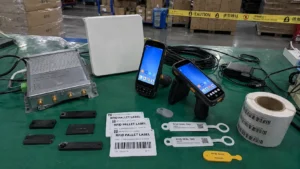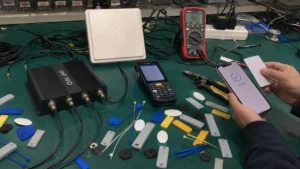
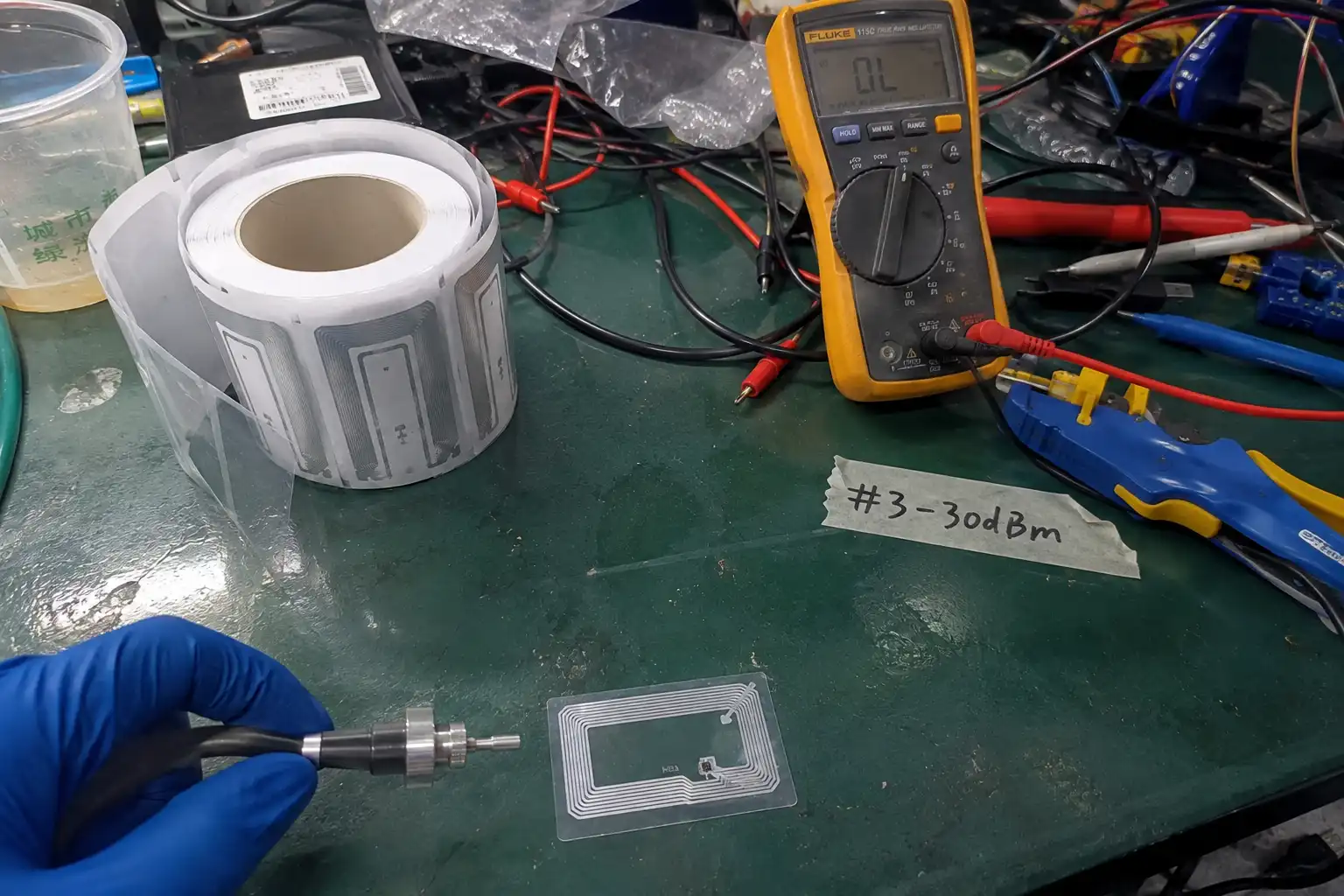
Choosing the wrong RFID tag quietly drains a project's budget. A tag that cannot harvest enough energy from the reader, or that drops reads near metal and liquid, turns a "simple" deployment into a service ticket factory. Before you spec a tag, you need to understand the physics that governs every passive tag — because the buyer's decision is really a signal-integrity decision.
A passive RFID tag has no battery. It draws all operating power from the reader's radio field, then returns its data by reflecting that same field back. That single fact — no battery, energy harvested on demand — dictates everything about read range, environmental sensitivity, and cost. This guide breaks the tag down the way our Fongwah hardware engineers brief a distributor: component by component, frequency by frequency, deployment constraint by deployment constraint. For the broader mechanics of how RFID tags work, the pillar guide covers passive and active systems side by side.
What Is Inside a Passive RFID Tag?
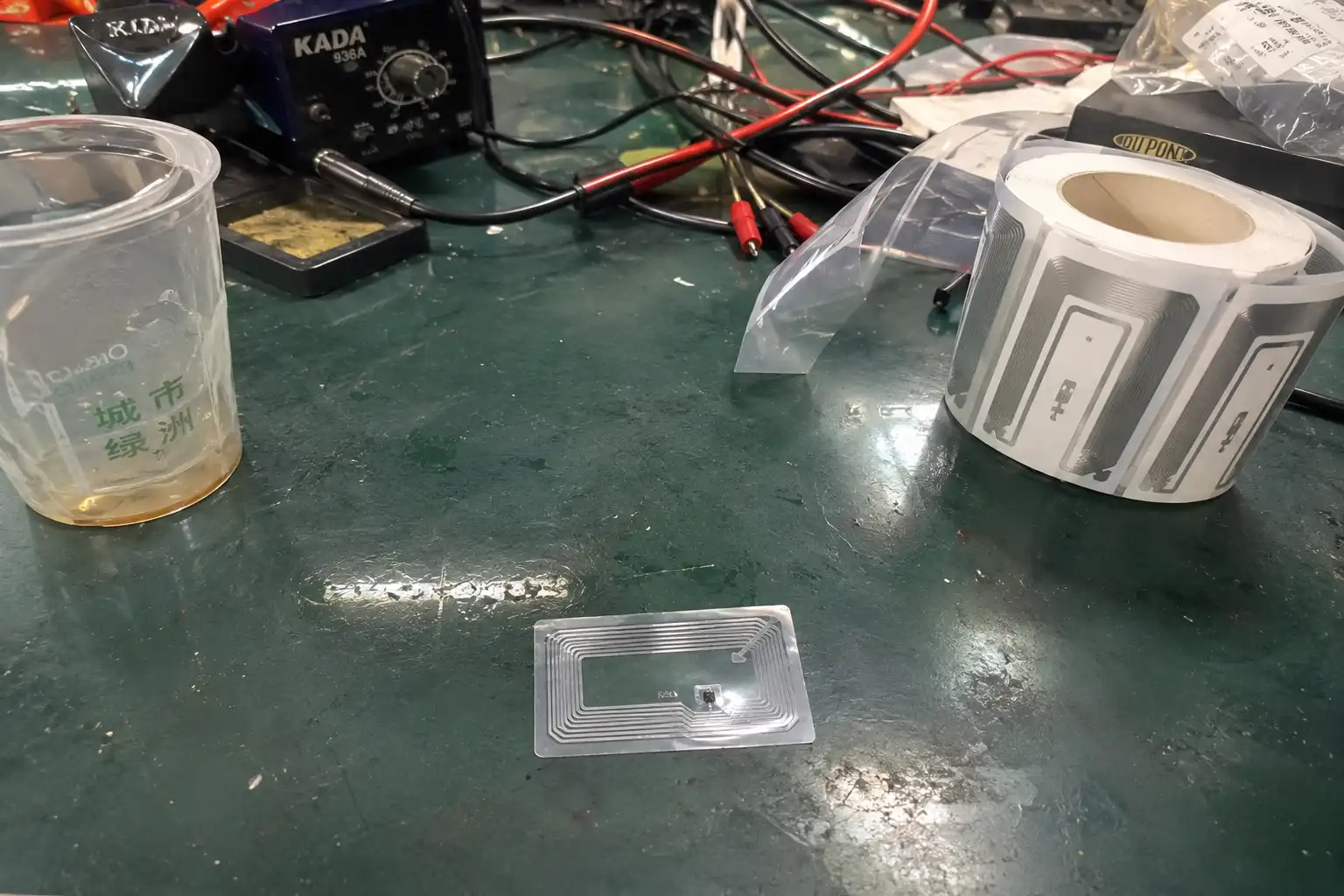
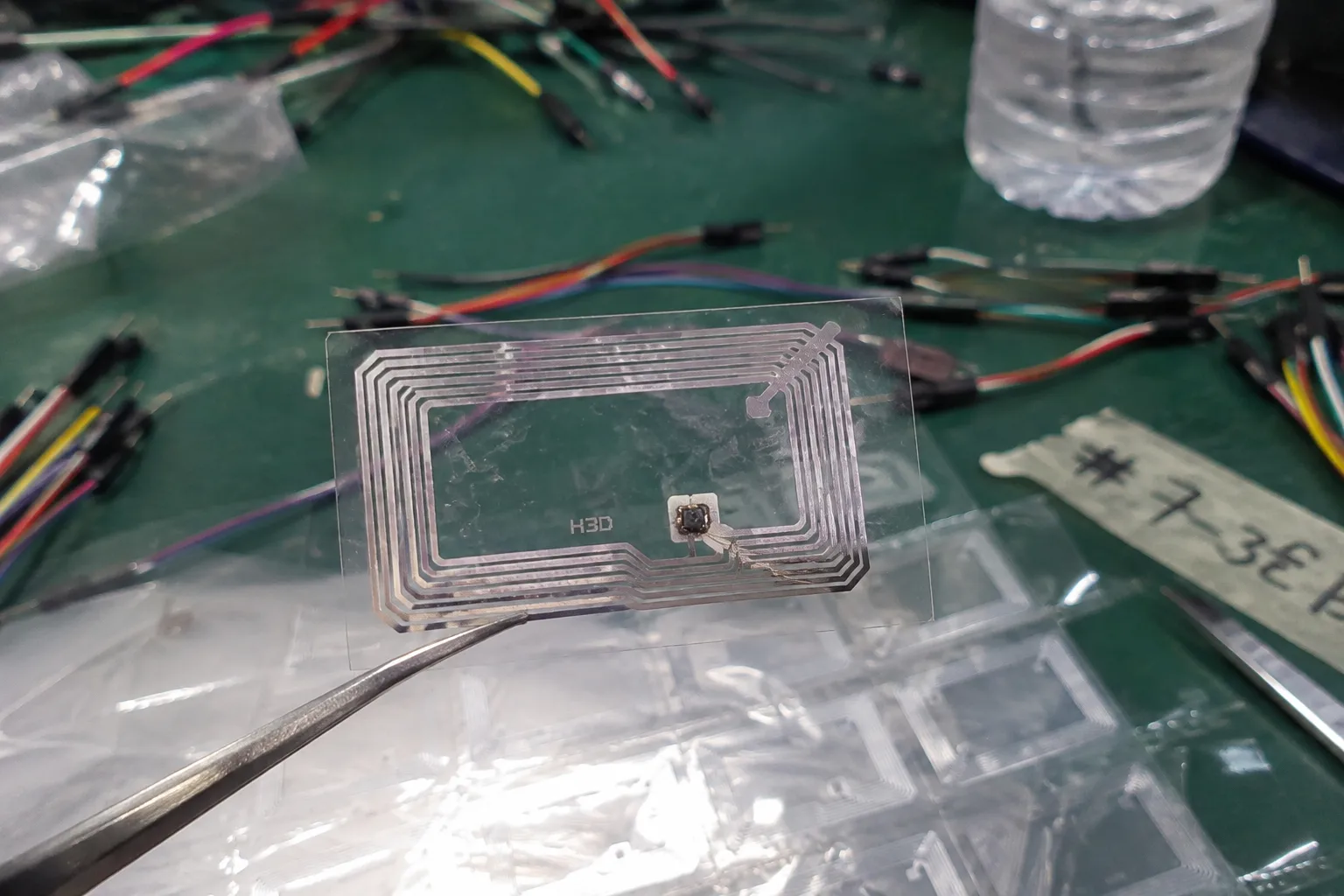
A passive tag is deceptively simple, and that simplicity is exactly where quality control matters. A micro-crack in the antenna etch or a weak die-attach to the chip is enough to drop a tag from the reader's inventory. There are three structural elements you are actually buying:
A passive RFID tag consists of a microchip (IC), an antenna, and a substrate that carries both. The chip stores the ID and data; the antenna both harvests reader energy and backscatters the reply; the substrate and outer housing protect that bond in your operating environment.
The Chip (Integrated Circuit)
The IC is the data store. Memory classes matter for your application:
- Read-Only (RO) — factory-locked UID, tamper-evident, lowest cost.
- Write-Once (WORM) — you encode it once in your line, then lock.
- Read-Write (RW) — repeatedly updated in the field (EPC, counters, status bytes).
For item-level retail or asset tracking you typically want EPC Gen2 (ISO 18000-6C) RW memory so the serialized EPC can be written at source tagging and later associated with your backend record.
The Antenna
The antenna is both the power inlet and the transmit path. It is a precisely etched conductor — usually aluminum or copper on a thin PET film. Its geometry sets the tag's resonant frequency and read range, and determines whether it survives near metal or liquid. A "on-metal" or "on-liquid" tag is not a different chip; it is a different antenna design (often a grounded cavity or a tuned loop) that isolates the radiating element from the hostile surface.
The Substrate and Inlay
The chip + antenna form the inlay, mounted on a substrate (PET, paper, or specialty film). The final form factor — pressure-sensitive label, rigid token, epoxy disc, or woven laundry tag — is what actually meets your environment. When you specify a tag, the housing material is a durability line item, not an afterthought.
| Component | Function | Buyer's Specification Question |
|---|---|---|
| Chip (IC) | Stores the tag's data (UID / EPC / user memory). | RO, WORM, or RW? What memory size and air-interface standard (EPC Gen2 / ISO 15693)? |
| Antenna | Harvests energy and backscatters the reply. | Required read range? On-metal or on-liquid rated? |
| Substrate / Housing | Carries and protects the inlay. | Operating temperature, moisture, impact, and chemical exposure? |
How the Reader Powers the Tag and Reads Its Data
Your system fails when the reader and tag do not handshake cleanly — and that handshake is pure RF physics, not firmware. Understanding it lets you debug the two failures distributors call us about most: "reads drop with distance" and "reads drop in batches."
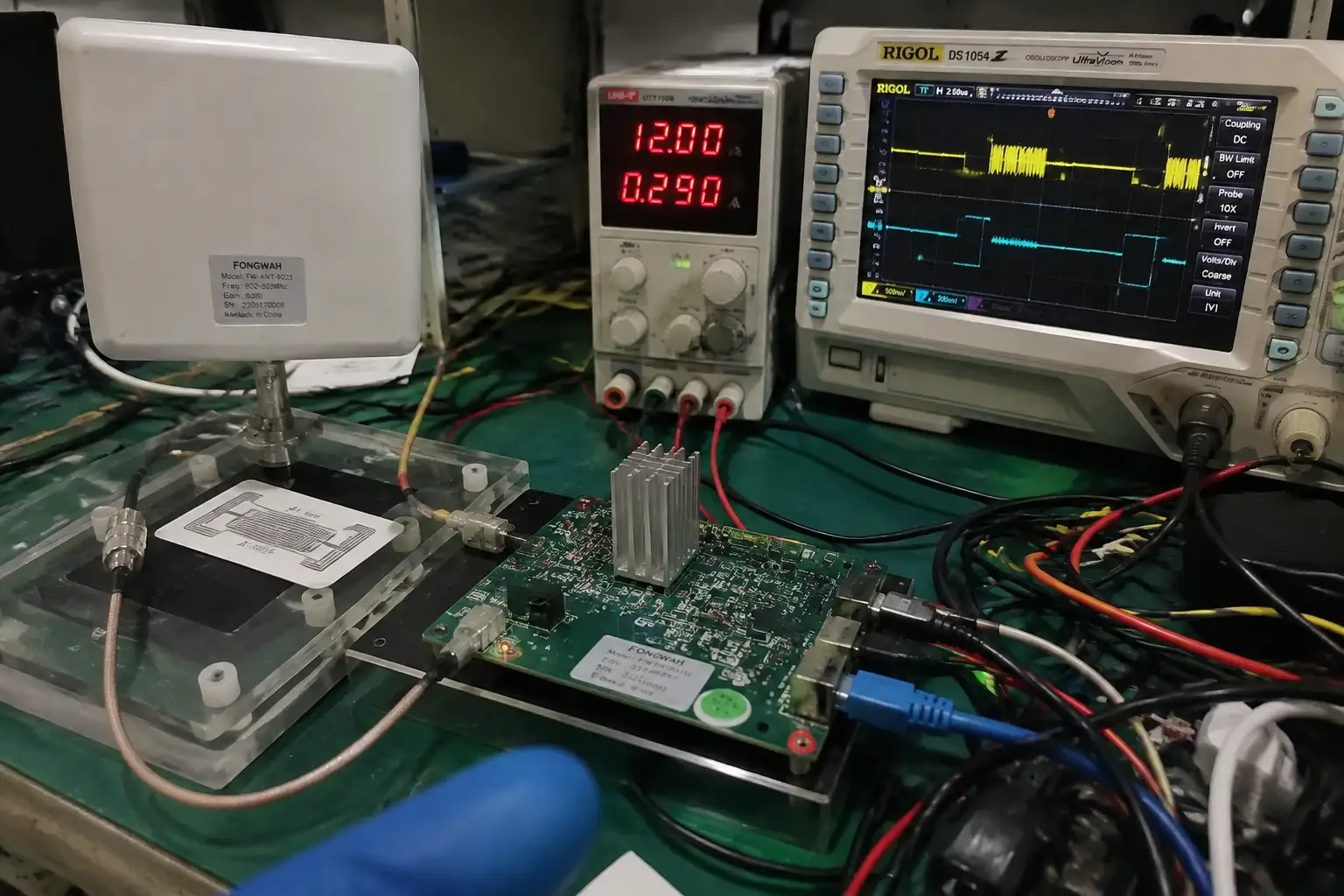
The reader radiates an RF field; the tag's antenna rectifies that energy to wake the chip; the chip modulates its antenna load to backscatter the reply; the reader's sensitive front end detects the modulated reflection and decodes it. The whole exchange completes in milliseconds and scales to hundreds of tags per second under a good anti-collision scheme.
Energy Harvesting (the Power-Up)
The reader's antenna emits a continuous wave in its band. When a passive tag enters the field, its antenna couples energy and feeds a rectifier on the chip. The chip wakes only when the harvested voltage clears its turn-on threshold — which is why read range is a function of both reader transmit power (ERP/EIRP) and the tag's antenna gain, not a fixed number on a datasheet.
Backscatter (the Data Return)
A passive tag has no transmitter. It "talks" by changing the load on its antenna — a technique called backscatter modulation — so the reflected wave carries a coded pattern. The reader's receiver, listening underneath its own transmitted carrier, extracts that pattern. Think of tilting a mirror to flash sunlight: the tag does not generate light, it modulates the reader's.
The Reader's Role
The reader's receiver sensitivity and anti-collision algorithm rate decide how many tags you can resolve in one dwell window. High-volume applications ( dock doors, apparel racks) need a reader that sustains a high tags/sec rate without collapsing the backscatter window — exactly the multiport, phase-coherent reader architecture we design into Fongwah modules.
| Coupling Method | Frequency Band | Mechanism | When the Buyer Uses It |
|---|---|---|---|
| Inductive Coupling | LF, HF | Reader coil induces current in the tag coil (transformer action). | Very short range — access fobs, animal ID, NFC payments. |
| Backscatter Coupling | UHF | Tag reflects and modulates the reader's far-field signal. | Long range, high throughput — warehouse, retail, logistics. |
Why Frequency Band Decides Performance
Frequency is the single biggest lever on range, speed, and environmental behavior. The three bands are not interchangeable, and the "UHF didn't work" calls we get are almost always a band-vs-environment mismatch, not a bad tag.
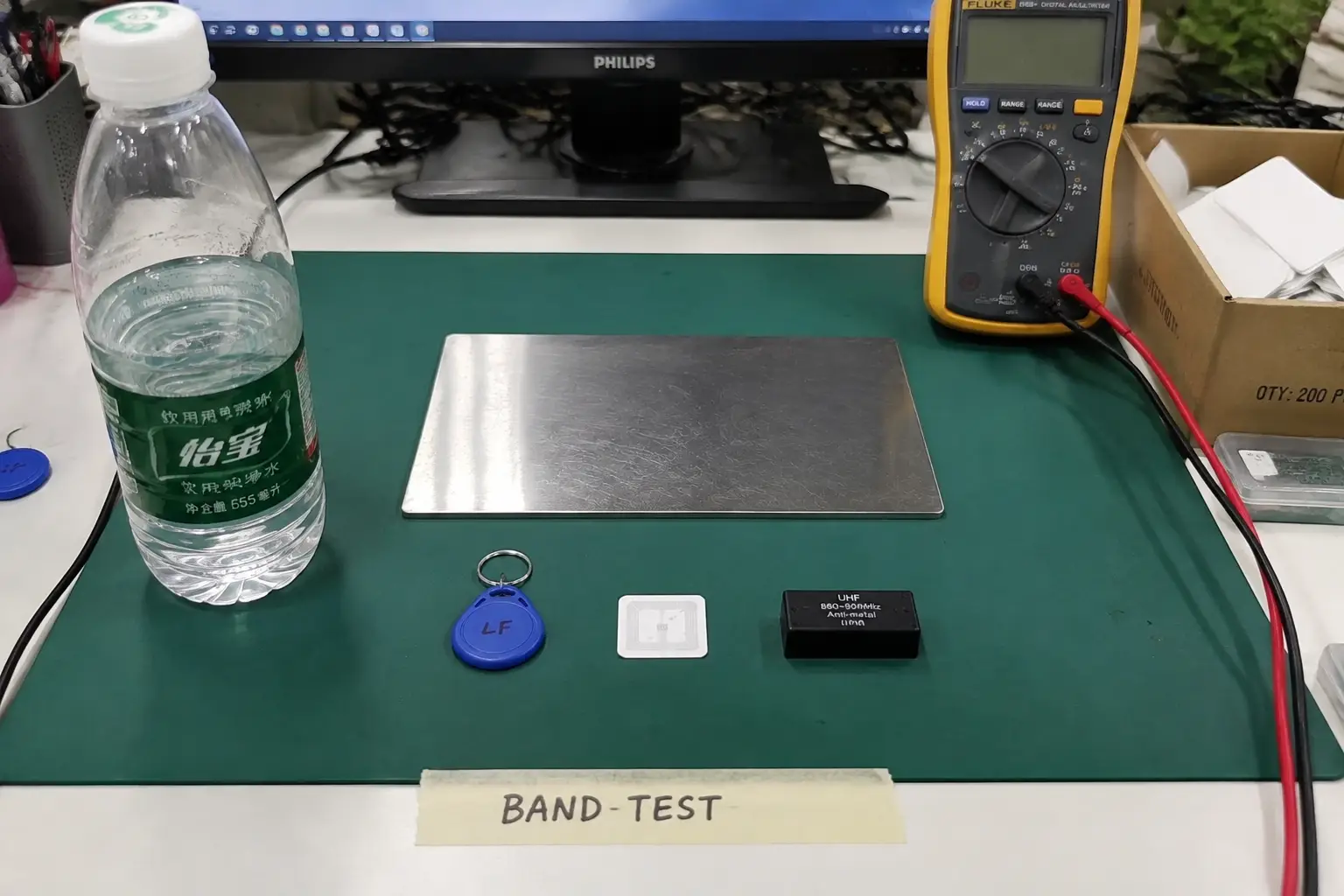
LF (125–134 kHz), HF/NFC (13.56 MHz, ISO 14443A / ISO 15693), and UHF (860–960 MHz, EPC Gen2 / ISO 18000-6C) trade range and speed against environmental tolerance. LF and HF tolerate water and metal far better than UHF; UHF delivers the longest range and fastest multi-tag reads but is absorbed by liquid and reflected by metal.
Low Frequency (LF) — 125–134 kHz
Short range (typically < 10 cm) and modest data rate, but the field passes through water, tissue, and soil with little attenuation. Specify LF for animal ID, embedded tool tags, and access fobs where reliability at point-blank range beats distance.
High Frequency (HF) / NFC — 13.56 MHz
Mid range (up to ~1 m line-of-sight dependent), governed by mature global standards (ISO 14443A for NFC, ISO 15693 for vicinity cards). HF is the right call for library books, event tickets, and item-level Pharma/healthcare tracking where standards interoperability and liquid tolerance matter more than range.
Ultra-High Frequency (UHF) — 860–960 MHz
Longest range (up to 10+ m in free space) and fastest throughput — the band that makes reading hundreds of tags per second practical. The catch: UHF is absorbed by water and reflected by metal. Region splits matter too — ETSI 865–868 MHz (Europe) vs FCC 902–928 MHz (North America) — so a global deployment needs region-locked firmware or a dual-band module. Choose UHF for retail inventory, supply-chain, and logistics where speed and range dominate.
| Band | Read Range | Key Standard | Best Buyer Use Case |
|---|---|---|---|
| LF (125–134 kHz) | < 10 cm | — | Animal ID, tool embedding, access fobs. |
| HF / NFC (13.56 MHz) | Up to ~1 m | ISO 14443A, ISO 15693 | Library, ticketing, pharma, payments. |
| UHF (860–960 MHz) | Up to 10+ m | EPC Gen2 (ISO 18000-6C) | Warehouse, retail, supply chain. |
Deployment Reality: Metal, Liquid, and Tag Density
Spec sheets show range in free space. Your site is never free space. Three constraints decide whether a tag deployment actually performs:
- Metal interference. A metal surface shorts the antenna's near field and detunes the tag. Use explicitly on-metal tuned tags (cavity-backed inlays) and keep spacing above the coupling radius. See our guidance on optimizing UHF read range in metallic environments before committing to a layout.
- Liquid attenuation. Water loads the antenna and pulls resonance; a UHF tag on a liquid-filled bottle or a damp garment stack loses range fast. Where the item is liquid-dominant, drop to HF or use a UHF tag engineered for high-permittivity surfaces.
- Multi-tag density & RSSI tuning. Stacked or closely packed tags couple inductively and depress each other's RSSI below the reader's sensitivity floor. You manage this with antenna gain (dBi), per-port TX power, and RSSI threshold tuning on the reader — not by raising TX blindly, which only worsens reflection and VSWR.
Thermal and humidity exposure round out the spec: outdoor or wash-cycle tags need rated housing (epoxy, PPS, or laundry-grade textile) so the inlay bond survives the duty cycle.
Matching Tags to Your Reader and Host System
A tag is half the system. The reader side must match on air interface, power, and — often overlooked — the host interface your software stack expects:
- Air interface: confirm the reader supports your tag's band and standard (EPC Gen2 for UHF; ISO 15693 for HF).
- Host interfaces: USB, UART, RS232, TCP/IP, and Wiegand cover most integrations — from a benchtop encoder to a PLC-fed dock door. Match the physical port to your controller before purchase.
- Polling interval & anti-collision: set the reader's polling interval and anti-collision rate to your throughput target so dense populations resolve without duplicate or missed reads.
- Module vs reader: for OEM builds, start from a Fongwah embedded RFID reader module and design the antenna/ housing around your enclosure, rather than bolting on a finished reader.
For a full buyer's framework across reader types, our RFID reader buying guide maps module, fixed, and handheld options to deployment scenarios — including the apparel stockout problem we documented in the retail RFID inventory accuracy guide.
Fongwah OEM/ODM: From Sample to Production
Specifying the right passive tag is repeatable when you work with a manufacturer that controls the variables. Fongwah supplies OEM/ODM customization — die selection, antenna etch, substrate, and housing tuned to your surface and read-distance target — with:
- Full SDK support across C++, C#, Java, Python, and Android, so your integration team wires the tag + reader into your WMS/ERP without a middleware rewrite.
- Free sample evaluation — we ship tagged references (on-metal, on-liquid, laundry-grade) so you can validate read rate in your real environment before committing volume.
- Factory-direct quality control — every inlay is electrically tested, because a 0.1% dead-on-arrival rate becomes a 5% field failure once tags are encapsulated and deployed.
If you are scoping a tag + reader build, our tag and card catalog lists inlays and finished tags by band and form factor, and our engineers will help you match the antenna to your reader's TX profile.
Buyer's Checklist
Before you purchase, confirm four things: (1) the band and standard match your reader and region; (2) the antenna is rated for your surface — metal, liquid, or free space; (3) the memory class (RO/WORM/RW) fits your data model; (4) the housing survives your temperature, moisture, and impact profile. Get those right and the "simple" tag becomes the most reliable component in your system.
Frequently Asked Questions
Q: How does a passive RFID tag get power without a battery?
A: A passive tag has no battery. Its antenna harvests energy from the reader's radio field, rectifies it on the chip, and wakes only once the voltage clears the turn-on threshold. It then reflects that same field back to send its data, so the reader supplies both the power and the return trip.
Q: What is the difference between passive and active RFID tags?
A: Passive tags borrow power from the reader and are small, cheap, and maintenance-free, which suits item-level tracking. Active tags carry their own battery and transmit over longer range, often tens of meters, but cost more and need servicing. Most Fongwah OEM/ODM volume is passive UHF.
Q: Can passive RFID tags work near metal or liquid?
A: Standard UHF tags struggle near metal and liquid because metal reflects the signal and water absorbs it. For metal surfaces use on-metal, cavity-backed tags. For liquid-dominant items drop to HF or choose a UHF tag engineered for high-permittivity surfaces. Always pilot in the real environment.
Q: How far can a passive RFID tag be read?
A: Read range is not a fixed number. It depends on reader transmit power, antenna gain, tag antenna design, and surroundings. Passive UHF reaches up to 10+ m in free space, LF is under 10 cm, and HF reaches about 1 m. Metal and liquid shorten every band.
Q: What does EPC Gen2 mean, and why does it matter for my tags?
A: EPC Gen2, also called ISO 18000-6C, is the global air-interface standard for passive UHF RFID. Specifying Gen2 means your tags, readers, and middleware interoperate across vendors, which is essential if you source hardware from more than one supplier or plan a global deployment.
Q: Can I rewrite the data on a passive RFID tag?
A: It depends on the chip's memory class. Read-Only (RO) tags are factory-locked, Write-Once (WORM) encode once then lock, and Read-Write (RW) tags like EPC Gen2 can be updated in the field. For item-level retail or asset tracking, RW memory lets you write the serialized EPC at source tagging.
Ready to validate a tag in your own environment? Initiate a direct factory RFQ and request free samples with the Fongwah technical team.