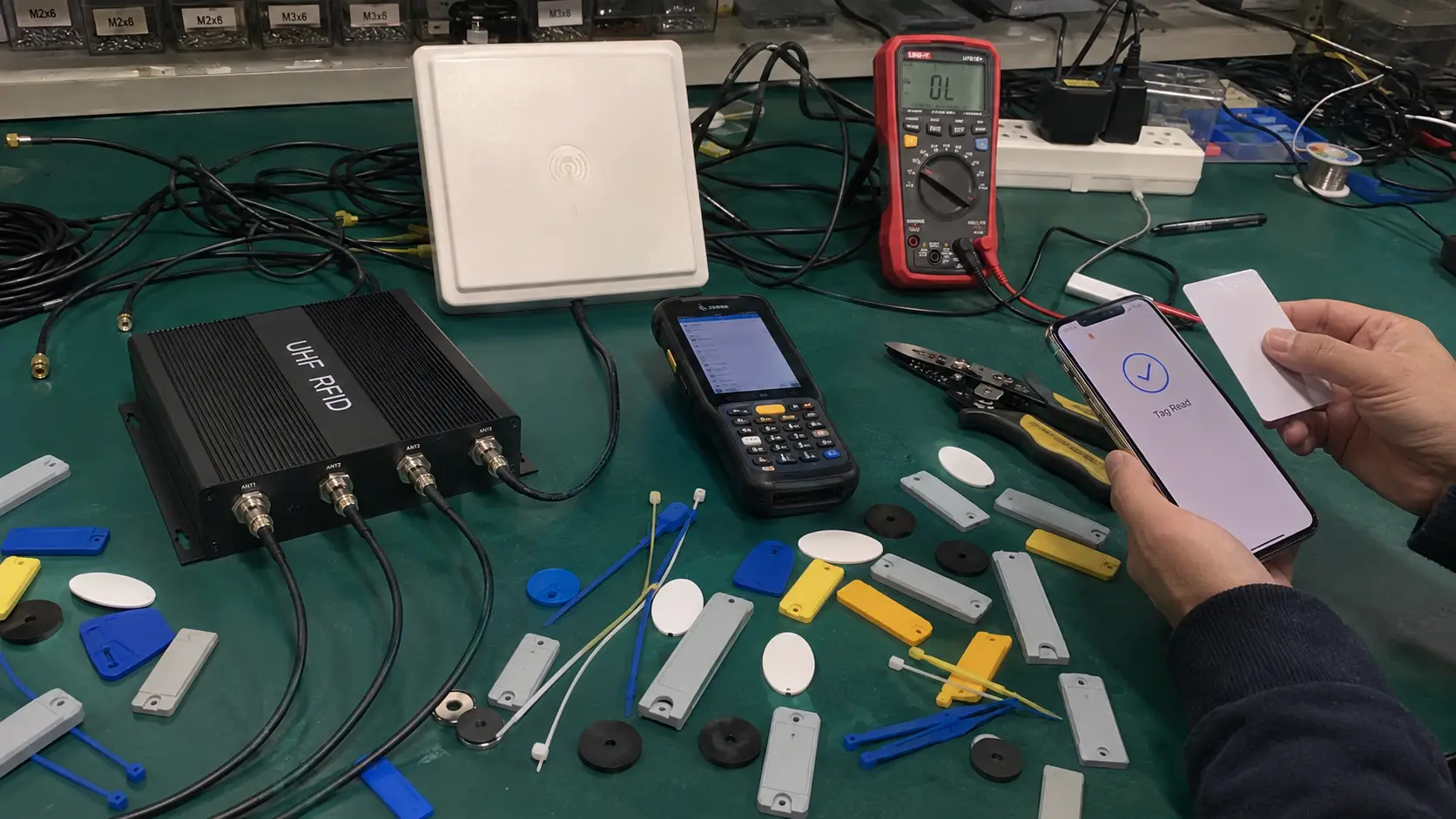
In short: UHF RFID reads many tags at once from about one to twelve metres and is built for bulk tracking; NFC needs a deliberate tap within roughly 4 cm and adds two-way, secure handshakes for phone-based interaction. Choose RFID when distance and throughput matter, NFC when a person taps one object to authenticate, pay, or open data.
RFID and NFC look alike on paper, yet they solve different operational problems. In this comparison, RFID means UHF passive RFID — the high-volume tier people usually set against NFC — while NFC is the short-range tap protocol on 13.56 MHz HF radio. The rule we apply is simple: pick UHF RFID when you must identify many items at a distance and at speed; pick NFC when someone taps one object to pay, authenticate, or open data. The mechanics below show why, and a close look at how RFID tags work shows exactly where the two part ways. This guide sets them side by side on specifications, business scenarios, and a decision matrix, so buyers can commit budget on evidence rather than hunches.
RFID is an umbrella term covering low frequency (125 to 134 kHz), high frequency (13.56 MHz), and ultra high frequency (860 to 960 MHz). NFC is a specialised HF implementation with a tighter range and a peer-to-peer mode. For bulk tracking, the tier that matters is UHF passive — which is why this article sets it against NFC, not LF or general HF.
What Are the Core Technical Differences?
Frequency and range are where they split most obviously. UHF passive RFID operates in the 860 to 960 MHz band, with regional allocations governed by ETSI EN 302 208 in Europe and FCC Part 15 in the United States. A fixed reader paired with a suitable antenna reads tags from roughly one to twelve metres. NFC runs at 13.56 MHz under ISO/IEC 14443, and its effective range stays under 10 cm, usually about 4 cm. The short span is deliberate — it keeps taps intentional and limits stray reads in a crowded space.
The other sharp divide is communication mode. UHF RFID is predominantly one-directional: the reader energises a passive tag and receives its identifier through backscatter. NFC is fully bidirectional and supports peer-to-peer exchange under ISO/IEC 18092 (NFCIP-1), which lets two devices negotiate and share data securely. NFC also draws on the ISO/IEC 15693 vicinity standard for slightly longer HF reads, but tapping is still what NFC is built to do.
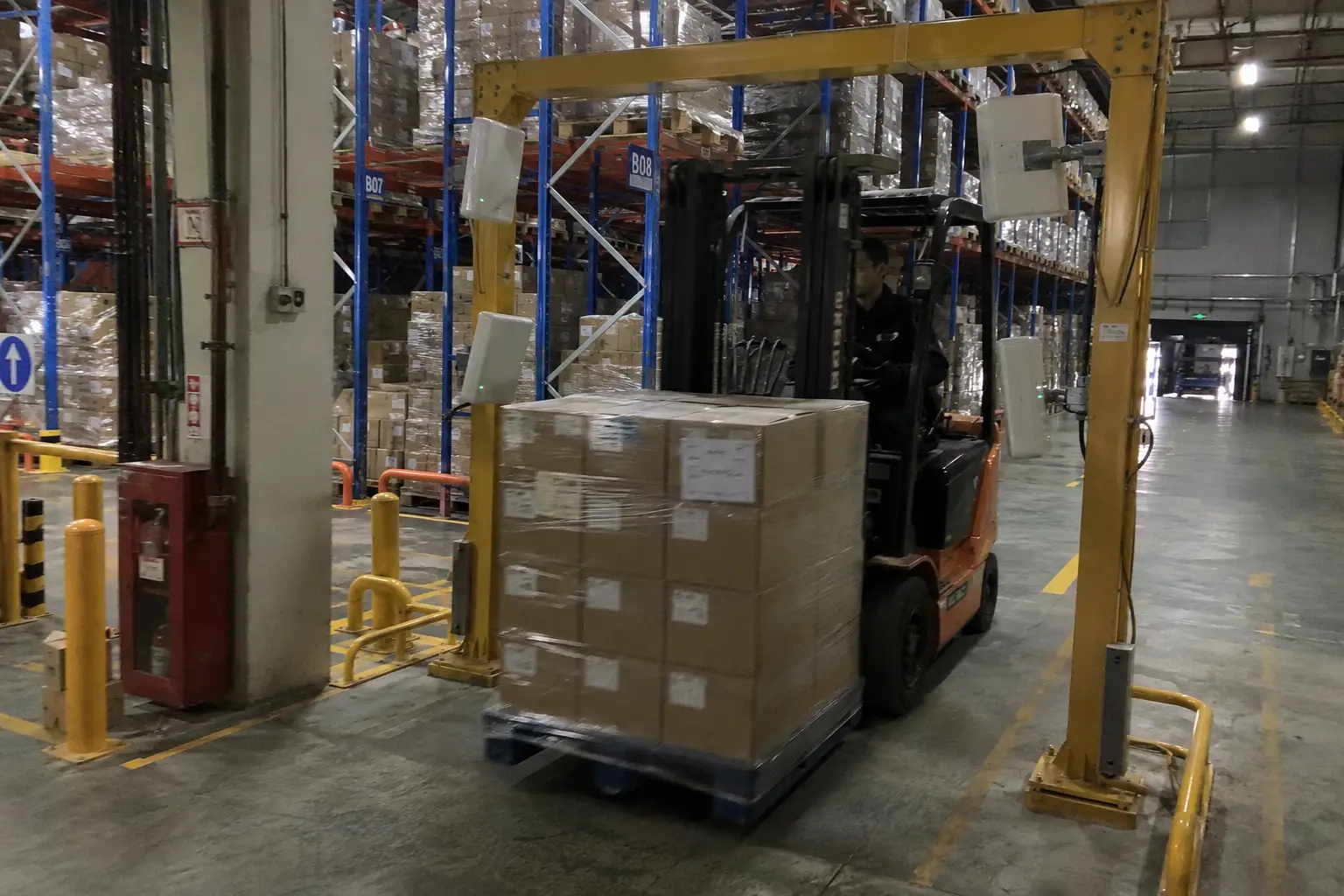
Those same traits drive throughput. UHF RFID reads hundreds of tags per second through a portal, which is why it dominates logistics and warehouse cycles. NFC reads one object per tap and prioritises a verified handshake over raw speed. Environment is where UHF gets tricky: its signals attenuate near metal and liquids, so tag placement and antenna design take planning, whereas NFC's short coupling is far less sensitive to those effects at the point of tap. For the material physics behind that behaviour, see what materials block RFID and why.
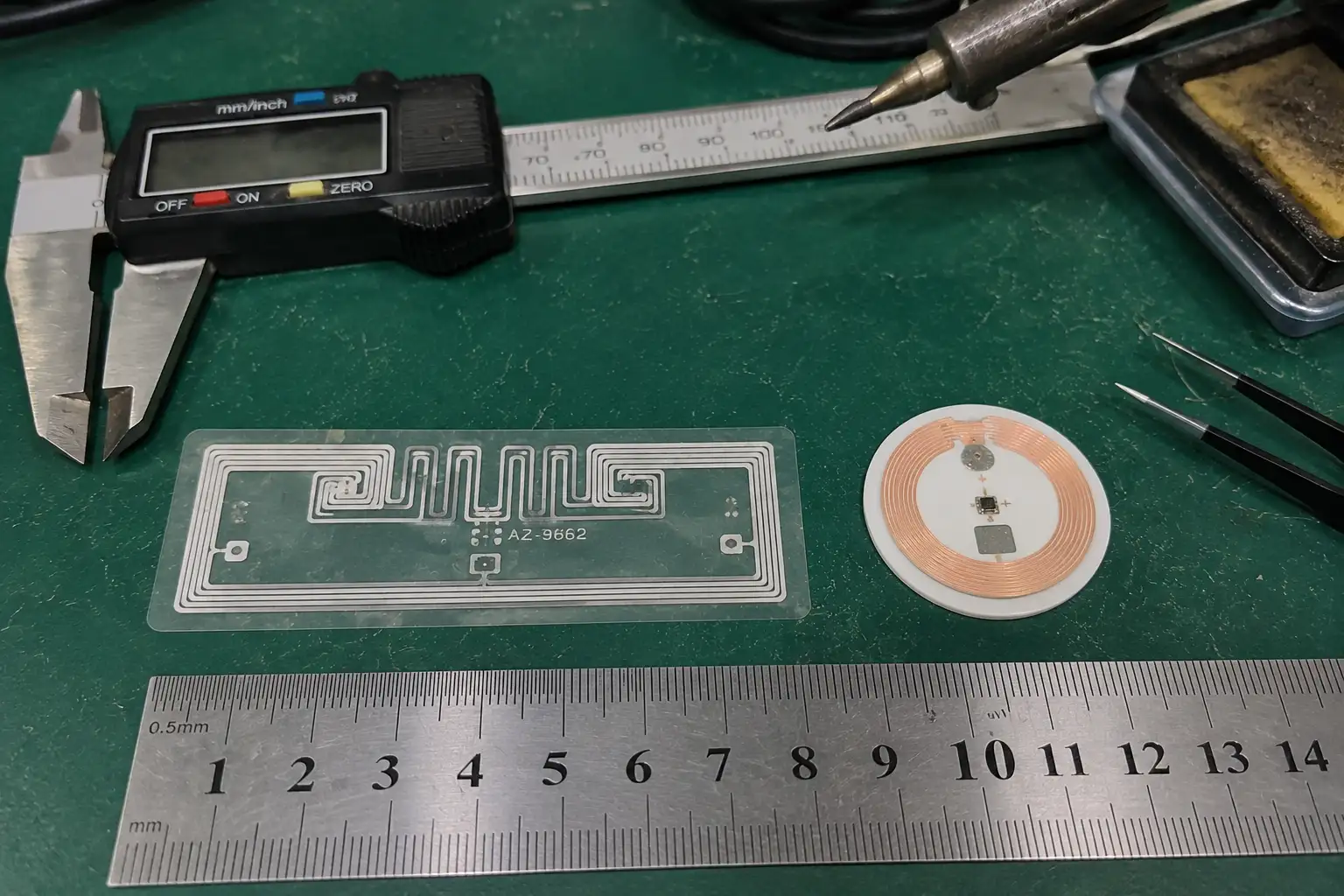
The tags are built differently too. UHF passive labels are produced as printed inlays on adhesive substrates and scale to a very low cost per unit at volume, which suits disposable carton and apparel tags. NFC tags are commonly packaged as stickers, cards, or embedded modules with slightly higher per-unit cost but easy phone compatibility.
| Parameter | RFID (UHF Passive) | NFC |
|---|---|---|
| Frequency band | 860 to 960 MHz (regional) | 13.56 MHz |
| Typical read range | ~1 to 12 m | < 10 cm (typical ~4 cm) |
| Communication mode | Predominantly one-directional read (backscatter) | Fully bidirectional / peer-to-peer |
| Multi-tag reading | Yes, hundreds per second | Limited, usually one at a time |
| Data rate | ~40 to 640 kbps (EPC Gen2) | ~106 to 848 kbps (ISO/IEC 14443) |
| Key standards | ISO/IEC 18000-63, GS1 EPC Gen2 | ISO/IEC 14443, ISO/IEC 15693, ISO/IEC 18092 |
| Tag power source | Passive (reader field) | Passive (initiator field) |
| Relative tag cost at volume | Very low | Low, often higher per unit than UHF |
| Primary strength | Bulk tracking at distance | Secure tap and authentication |
Which Business Scenarios Fit Each Technology?
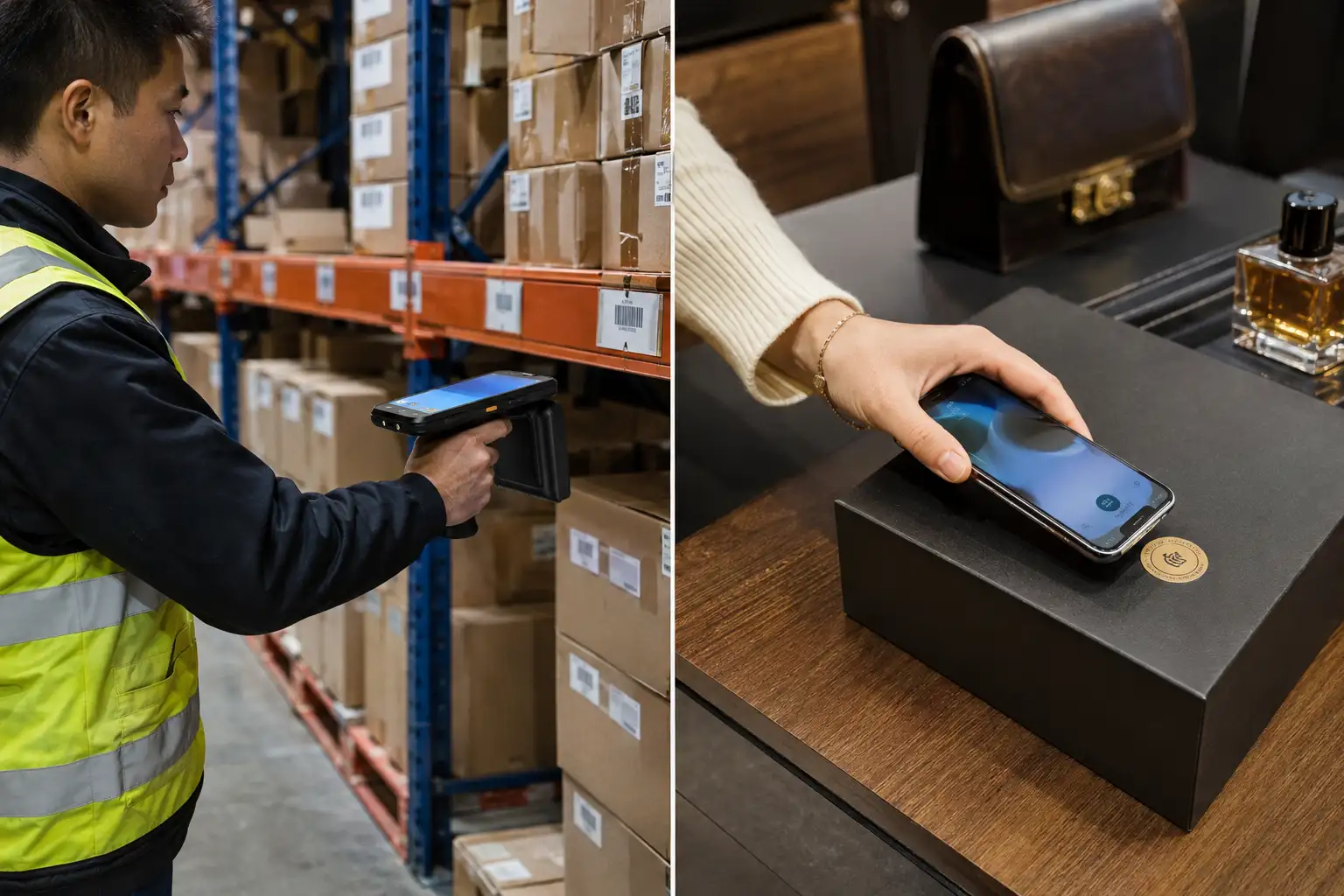
Match the technology to the workflow and the choice gets obvious. UHF RFID fits any process where items move through a read zone and must be counted without line of sight. NFC fits the moments when a person deliberately interacts with one item using a phone or terminal. The table below shows where each tends to win.
Mixing the two up is an expensive mistake. Put NFC where UHF belongs and you'll be tapping items one by one, giving up the speed you bought the system for. Send UHF after a secure phone tap and you've stood up reader infrastructure nobody asked for. The scenario table below heads both off.
| Business scenario | Best fit | Why it fits |
|---|---|---|
| Warehouse pallet and carton counts | UHF RFID | Reads many tags across a pallet in seconds |
| Retail backroom replenishment | UHF RFID | Bulk reads without opening boxes |
| Logistics and supply-chain tracking | UHF RFID | Gate and portal reads; see how RFID is used in logistics |
| Cross-site asset management | UHF RFID | Long range and durable tags; see how an RFID asset-tracking system works |
| Product authentication | NFC | A phone tap verifies the item |
| Contactless payment and access | NFC | Built-in secure short-range handshake |
| Consumer engagement | NFC | Tap to open a URL or app |
| Industrial tool check-in | Either, usually UHF | Depends on required range |
Procurement teams weighing what RFID technology is against NFC should start from the physical interaction. Does the item need to be found at a distance, or tapped by hand? Distance means UHF RFID; a hand tap means NFC. Organisations tracking movable equipment will find that how RFID tracks assets in business lays out the operational gains in detail, from cycle-count time saved to shrinkage reduction.
How Do You Make the Final Decision?
A decision matrix turns the comparison into a checklist. Score each factor against your deployment, then total the column that wins. The matrix below covers the factors that most often decide a rollout.
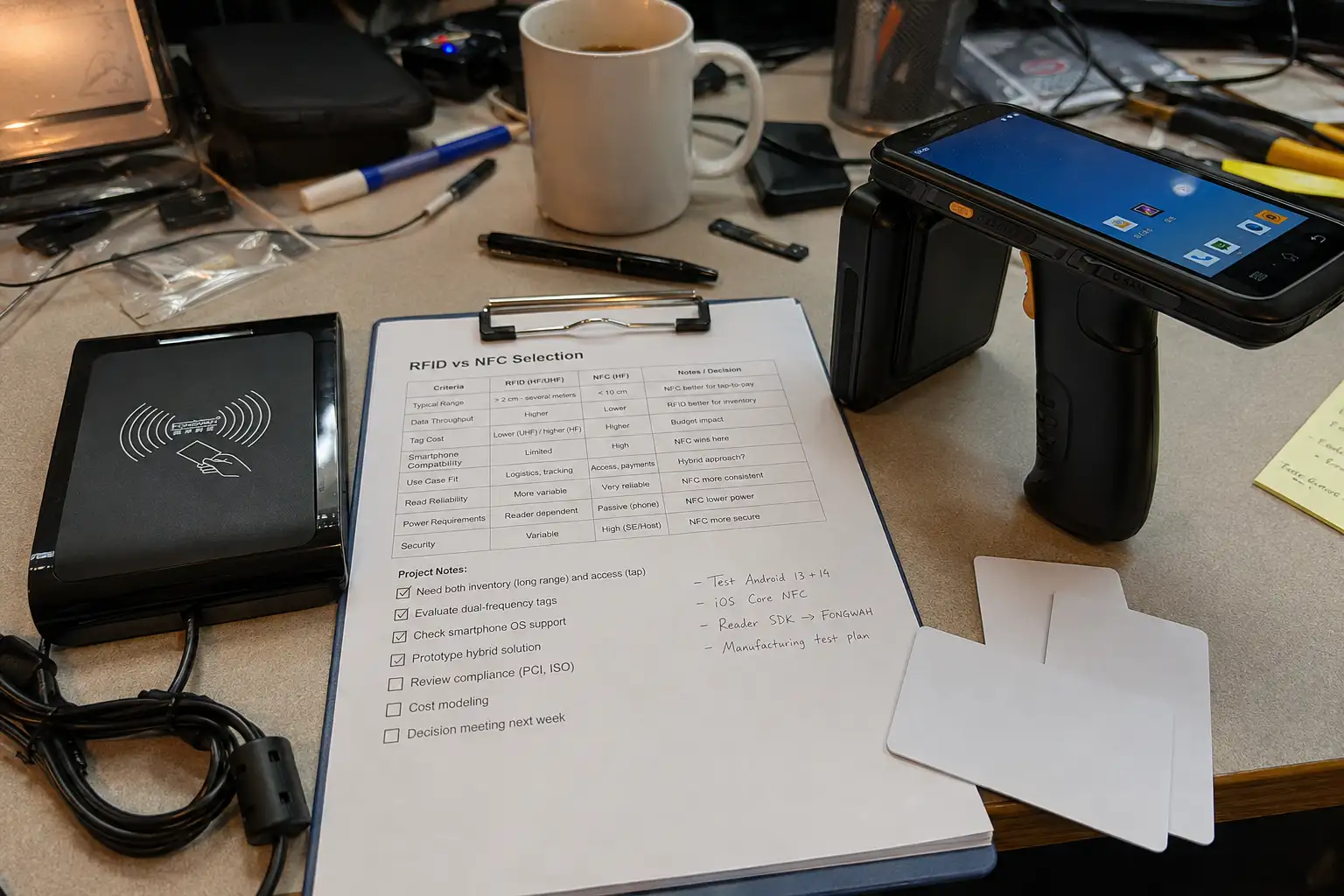
| Decision factor | Choose UHF RFID if… | Choose NFC if… |
|---|---|---|
| Read volume | You must read many items fast | You verify one item per tap |
| Read range | Items pass through gates or portals | A user taps at the point of use |
| Operating environment | Warehouse, yard, supply chain | Counter, kiosk, or phone-based |
| Security model | Identify and track at distance | Mutual authentication on tap |
| Required infrastructure | Fixed readers and antennas | Existing consumer smartphones |
| Cost per tag at scale | Needs to be minimal | Moderate cost is acceptable |
What settles the decision is the practical side. UHF RFID needs fixed readers, antennas, and often middleware that integrates with a WMS or ERP, so budget for infrastructure and a pilot on a representative stock profile. NFC leans on hardware most buyers already own — the smartphone — which lowers entry cost but limits range and throughput. A short pilot on one product line or one dock door usually settles any remaining doubt, because real read rates and interference behave differently from specification sheets.
Neither rules the other out. A distribution operation can run UHF RFID through its warehouse and NFC on the consumer-facing package so a shopper taps for provenance. Vendors such as Fongwah supply both tiers, which lets a single supplier cover the full journey from dock to shelf to customer.
Conclusion
RFID and NFC are two radios built for different jobs — different ranges, different ways of talking, different cost math. For bulk tracking, UHF RFID is the call: it reaches farther, reads faster, and costs less per tag. NFC owns the secure, deliberate tap from a phone. A clear decision matrix, built on read volume, range, environment, and infrastructure, tells most buyers which to deploy first. Where both touchpoints exist, running them in series is often the most complete answer. For the deeper mechanics of either technology, see how RFID tags work.
Q: What is the difference between RFID and NFC?
A: RFID is a broad family of radio identification technologies. In this comparison it means UHF passive RFID, which reads many tags at distances up to roughly 12 metres. NFC is a short-range HF protocol at 13.56 MHz that requires a tap within about 4 cm and supports two-way communication. RFID is built for bulk tracking; NFC is built for secure, person-to-object interaction.
Q: Can NFC be read from a distance like RFID?
A: No. NFC is designed for a range under 10 cm, typically around 4 cm, so it cannot be read across a room or through a portal the way UHF RFID can. The short range is deliberate, which keeps stray or unauthorised reads to a minimum.
Q: Is RFID more secure than NFC?
A: Not by default. UHF RFID is mostly a one-way identifier read, which is efficient but offers little built-in authentication. NFC supports mutual authentication and secure handshakes on tap, making it stronger for payment, access, and anti-counterfeit use. Security depends on the implementation, not the radio alone.
Q: Which is better for inventory counting: RFID or NFC?
A: UHF RFID is better for inventory counting because it reads hundreds of tags per second through a portal without line of sight. NFC reads one item per tap, which is too slow for pallet or shelf counts but ideal for verifying a single product.
Q: Does my smartphone read RFID or only NFC?
A: Most consumer smartphones read NFC natively and do not read UHF RFID without an external reader or specialised case. To read UHF RFID tags, businesses use dedicated fixed or handheld RFID readers. Phone NFC works directly with ISO/IEC 14443 tags.
Q: When should I choose NFC instead of RFID?
A: Choose NFC when a person needs to tap a single item to authenticate, pay, unlock, or open digital content with a phone. If the priority is counting or locating many items at a distance, UHF RFID is the better fit.
Q: Can RFID and NFC be used together?
A: Yes. Many operations use UHF RFID for warehouse and logistics tracking and NFC for the consumer-facing interaction, such as tapping a product for provenance. Using both covers the journey from bulk handling to individual engagement.
Q: What frequency does NFC use?
A: NFC operates at 13.56 MHz and is defined by ISO/IEC 14443, with ISO/IEC 15693 covering vicinity applications. This places NFC in the HF band, distinct from UHF RFID's 860 to 960 MHz operation.
Q: What standards apply to UHF RFID in this comparison?
A: UHF passive RFID in this context follows ISO/IEC 18000-63 and the GS1 EPC Gen2 air interface, with regional spectrum rules from ETSI EN 302 208 in Europe and FCC Part 15 in the United States.
Q: Is RFID only UHF?
A: No. RFID spans LF (125 to 134 kHz), HF (13.56 MHz), and UHF (860 to 960 MHz). NFC is a form of HF RFID. This article uses "RFID" to mean UHF passive RFID because that is the tier most often compared with NFC for high-volume tracking.
Q: Is NFC a type of RFID?
A: Yes, technically. NFC is a specialised implementation of HF RFID at 13.56 MHz that adds peer-to-peer mode and secure tap behaviours most RFID tags lack. So NFC sits inside the RFID family rather than being a separate radio technology — the practical difference is what each is optimised to do.
Q: Can UHF RFID read through metal and liquids?
A: Poorly. UHF signals reflect off metal and are absorbed by water-based materials, which can collapse read range on a metal drum or liquid-filled container. Use on-metal tags or drop to LF where the asset is consistently metallic or wet; the material physics are explained in what materials block RFID and why.