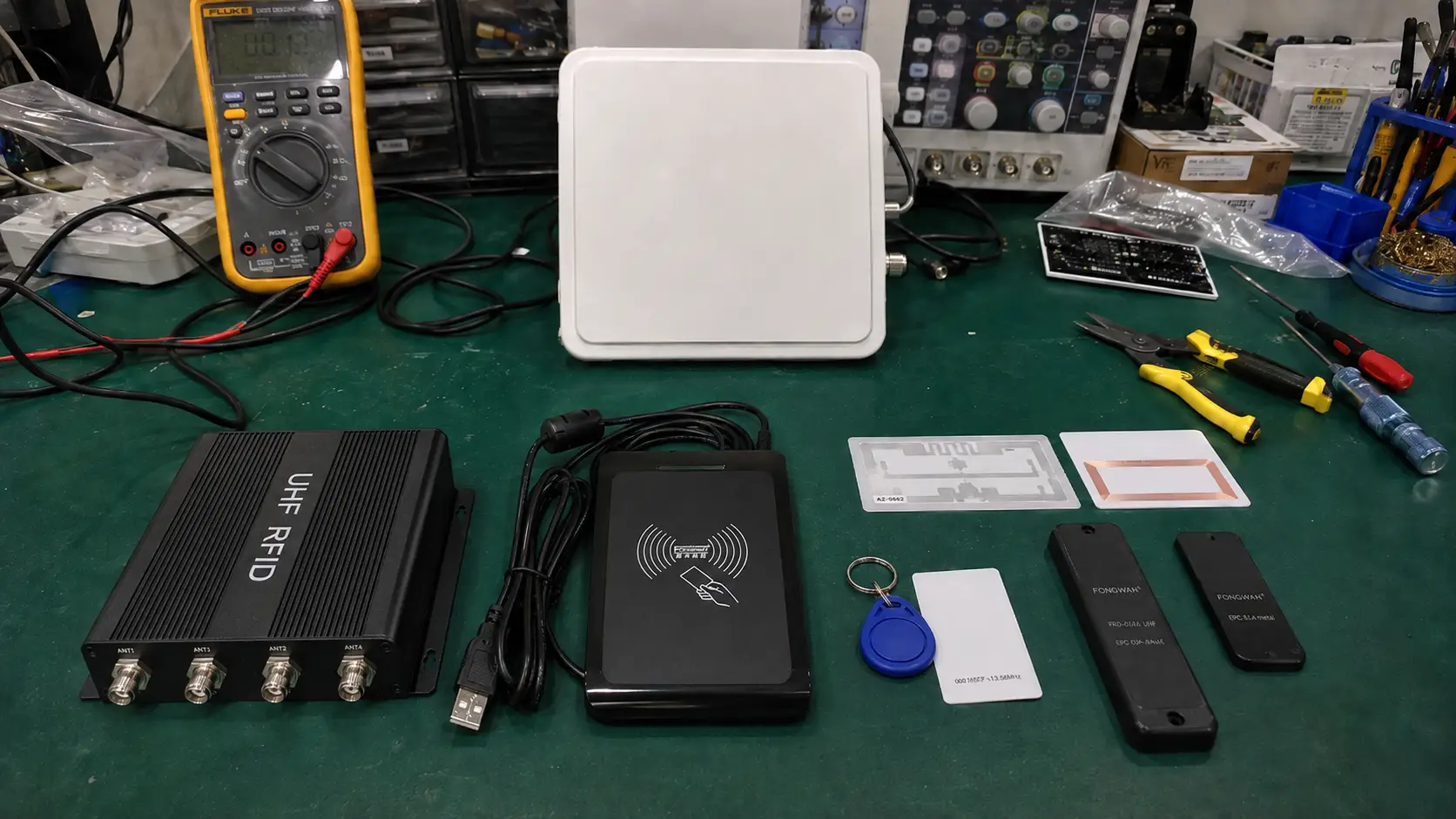
A tag stuck to an item carries a unique ID. A reader pulls that ID out of the air with radio waves — no line of sight, no aiming at a label. That's RFID, or Radio Frequency Identification, in one sentence. For an operations team the payoff is throughput: dozens of items counted, located, and tracked in seconds, with none of the barcode-by-barcode scanning.
Receiving a truck, verifying a shipment, hunting an asset on a busy floor — those are the moments manual tracking falls behind. Barcodes beat pen and paper, but every label still needs a clear view and a separate scan. RFID drops both constraints. One pass of a reader registers dozens, sometimes hundreds, of tags, and it works through cardboard and plastic. For exporters, distributors, and high-volume manufacturers, that single fact is what changes the math.
We'll keep this at the definitional level: what RFID is, the parts of a system, the frequency bands in use, and where businesses actually apply it. For the mechanics of how a tag returns its signal, how RFID tags work walks the read cycle step by step.
How Does an RFID System Work?
Every RFID system does the same thing: get data from a tagged item into a software backend. Three hardware pieces handle it, and the system only works when all three are pulling their weight.
The first is the tag. It carries a unique number in memory. Some hold only a fixed serial burned in at the factory; others add writable memory for user data — a batch code, lot number, or expiry date. Tags come in many shapes, from thin adhesive labels to rigid industrial discs, and they go on the items, cartons, or assets being tracked. Shape and material follow the item's surface and where it lives.
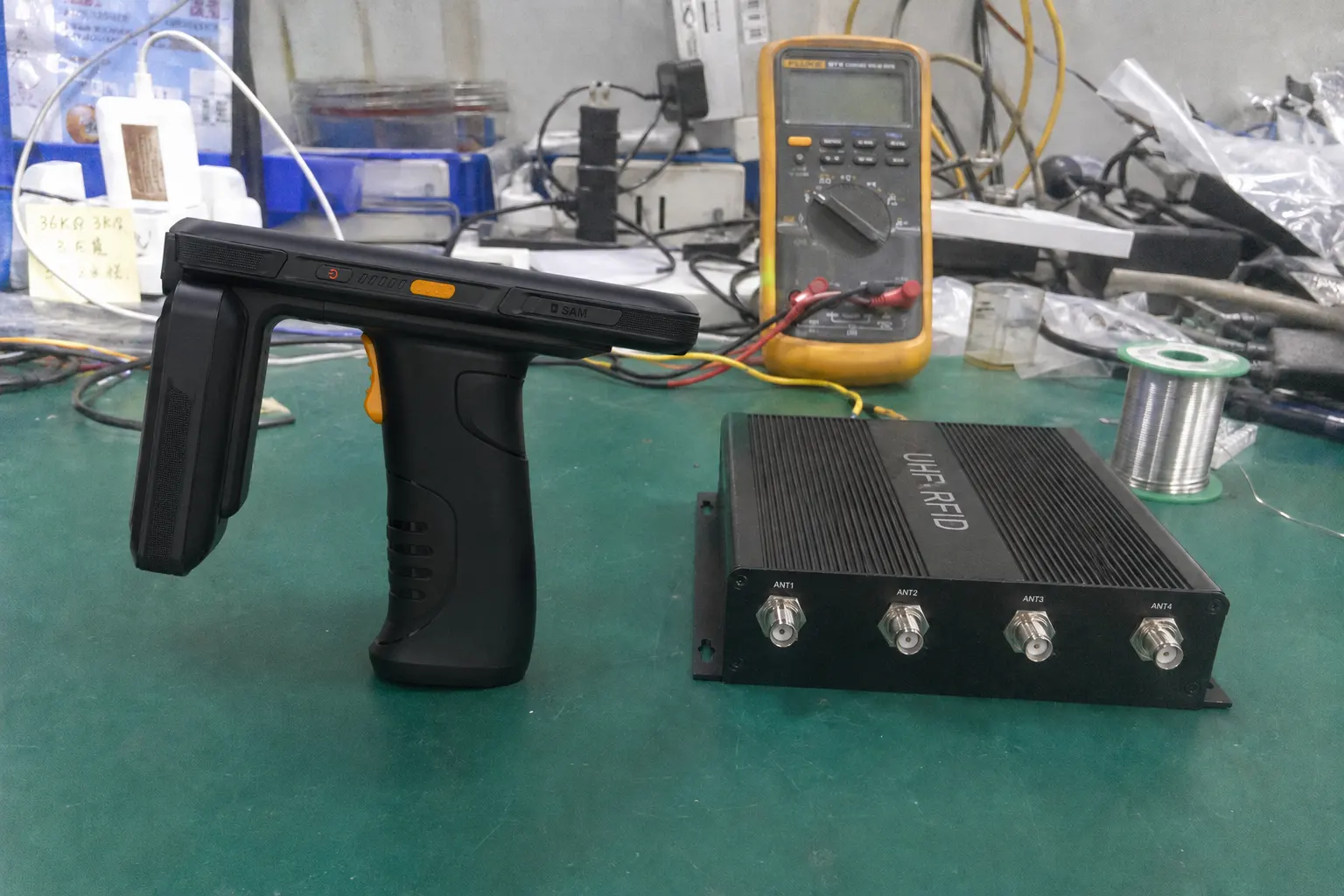
The second is the reader. It generates radio energy and listens for tags answering inside its field, then decodes their IDs and hands the data to middleware or a host system that turns raw reads into records. A reader might be a handheld unit about the size of a phone or a fixed portal built into a dock door, a conveyor line, or a gateway.
The third is the antenna. It shapes and steers the radio field between reader and tags. In many compact readers the antenna hides in the same box; for longer range they're separate, so you can position the antenna for coverage and fewer dead zones.
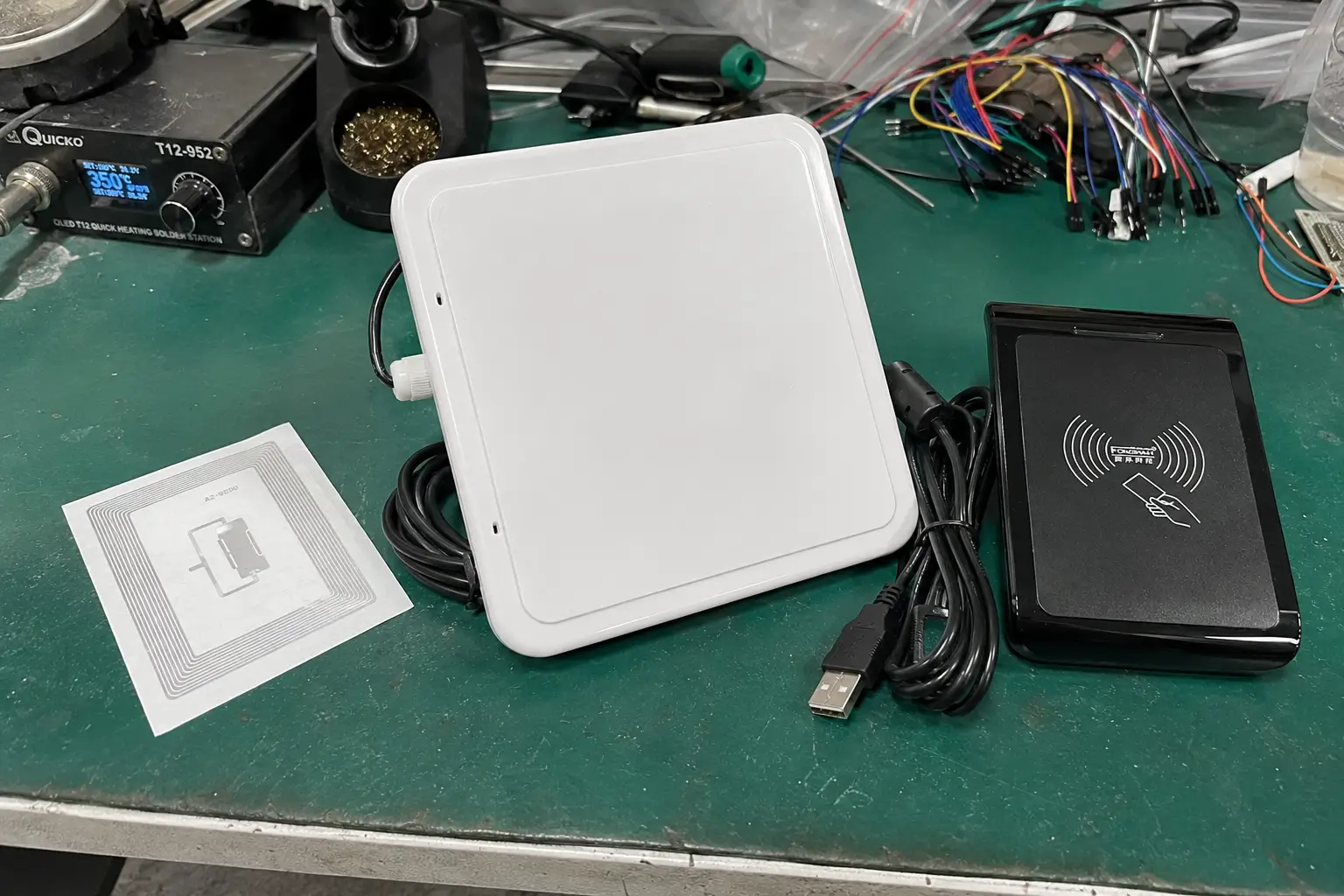
In a normal read the reader throws out energy, nearby tags answer with their stored IDs, and the reader collects those replies before sending them upstream. The whole exchange runs in a fraction of a second and keeps cycling as long as tags stay in range.
The table below maps each component to its function and the point that matters most when a buyer specifies a system.
| Component | Function | Buyer note |
|---|---|---|
| Tag | Stores a unique identifier and, on some types, user data | Match tag material and attachment to the item and its environment |
| Reader | Powers the field and captures tag replies | Fixed versus handheld depends on whether tracking happens at a point or on the move |
| Antenna | Directs radio energy between reader and tag | Placement and polarization affect read range and coverage |
The property that really sets RFID apart from barcodes is the missing line of sight. Radio waves carry the read, not visible light, so a reader grabs many tags at once, packaging and all. That's why it fits high-volume receiving and shipping the way barcodes never quite manage.
What Are the Main Types of RFID Tags?
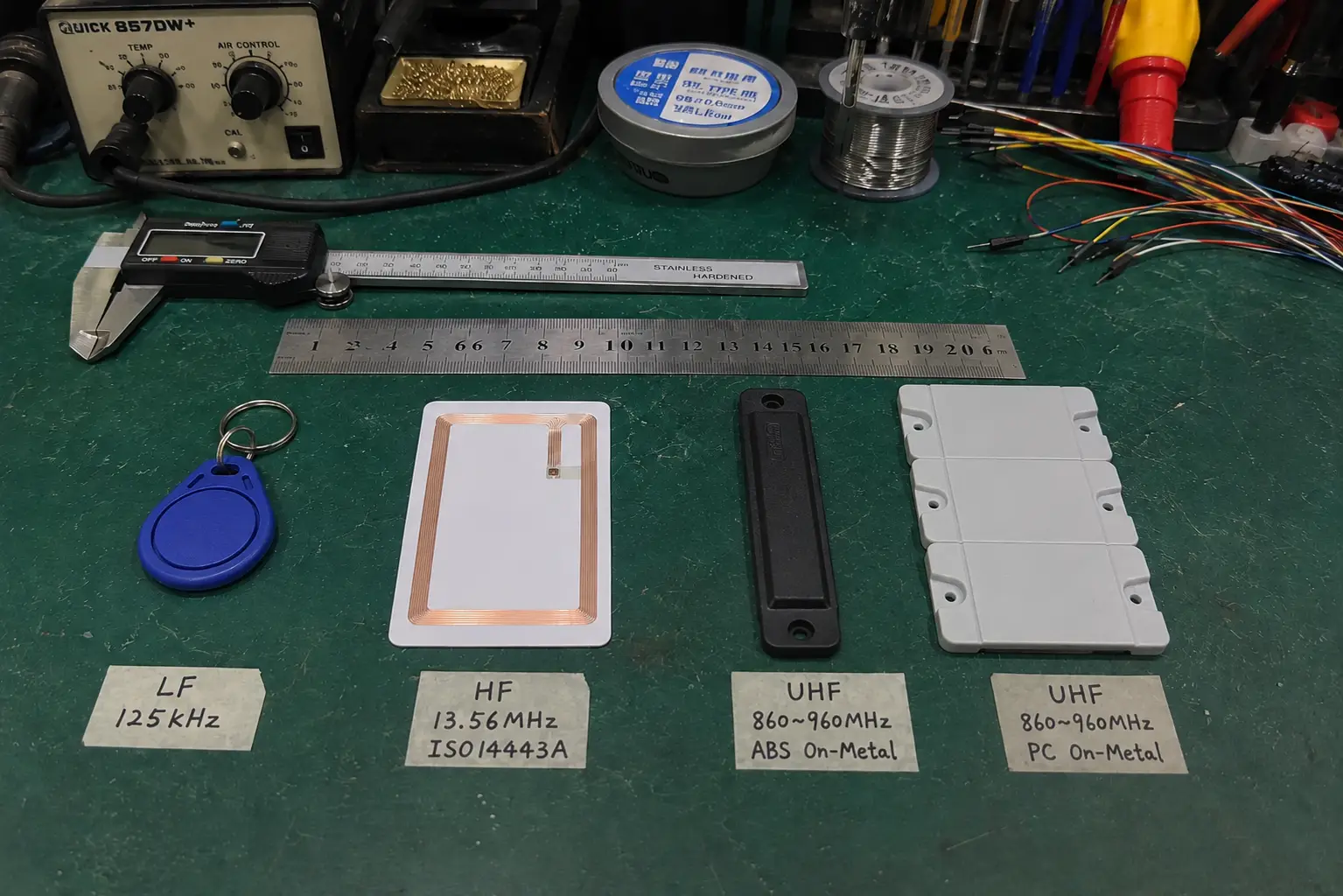
RFID is usually sorted by operating frequency. The three bands below account for almost every commercial and industrial deployment. The band decides three things at once: how far you can read, what each tag costs, and how the signal behaves around metal or liquid.
Low Frequency (LF) runs at 125–134 kHz. Range is short — under 10 cm — but it holds up near metal and in dirty, wet conditions. You'll find it on animal IDs, tool tracking, and access control, where a close-up read is fine.
High Frequency (HF) sits at 13.56 MHz and reaches about 10 cm to 1 m. It backs NFC, so it turns up in contactless payments, library loans, pharma authentication, and item-level tracking that wants a short, controlled interaction. The relevant standards are ISO/IEC 14443 (ISO/IEC 14443) for proximity cards and ISO/IEC 15693 (ISO/IEC 15693) for vicinity cards.
Ultra-High Frequency (UHF) covers 860–960 MHz and is the workhorse of the three. Longest range — often several metres — and it reads many tags at once, fast. Its throughput and cheap per-tag cost are exactly why logistics, retail inventory, and manufacturing run on it. Most UHF passive systems speak the EPC Gen2 air interface (GS1 EPC Gen2), standardized as ISO/IEC 18000-63 (ISO/IEC 18000-63).
Here's the same picture side by side.
| Band | Frequency | Typical read range | Common use |
|---|---|---|---|
| LF | 125–134 kHz | Under 10 cm | Animal ID, access control, tools |
| HF | 13.56 MHz | 10 cm – 1 m | NFC payments, libraries, pharma |
| UHF | 860–960 MHz | Up to several metres | Logistics, retail, manufacturing |
Passive and Active Tags
Most tags are passive — no battery, they scavenge the energy they need from the reader's signal. They're cheap and they outlast the item they're stuck to. A smaller group, active tags, carries its own battery, which is what supports the longer range on large assets, vehicles, and containers crossing an open yard. The battery-free trick is explained properly on how passive RFID tags work.
Frequency permissions aren't global, so the band you deploy has to match local law — and that law also caps how far you can legally read. Europe uses ETSI bands around 865–868 MHz (ETSI EN 302 208); the United States uses FCC bands around 902–928 MHz under FCC Part 15, 47 CFR (FCC Part 15, 47 CFR). The guide to RFID frequency regulations by country lists the permitted bands, market by market.
What Can RFID Track in a Business?
RFID fits wherever items need identifying, counting, or locating without someone handling them. The table below lists where most B2B buyers start.
| Area | What gets tracked | Operational gain |
|---|---|---|
| Supply chain | Cartons, pallets, returnable containers | Faster receiving and shipment verification |
| Retail | Items, shelves, fitting rooms | Real-time stock accuracy and replenishment |
| Manufacturing | Work-in-process, tools, components | Line visibility and traceability |
| Access control | Badges, vehicles | Hands-free entry and audit logs |
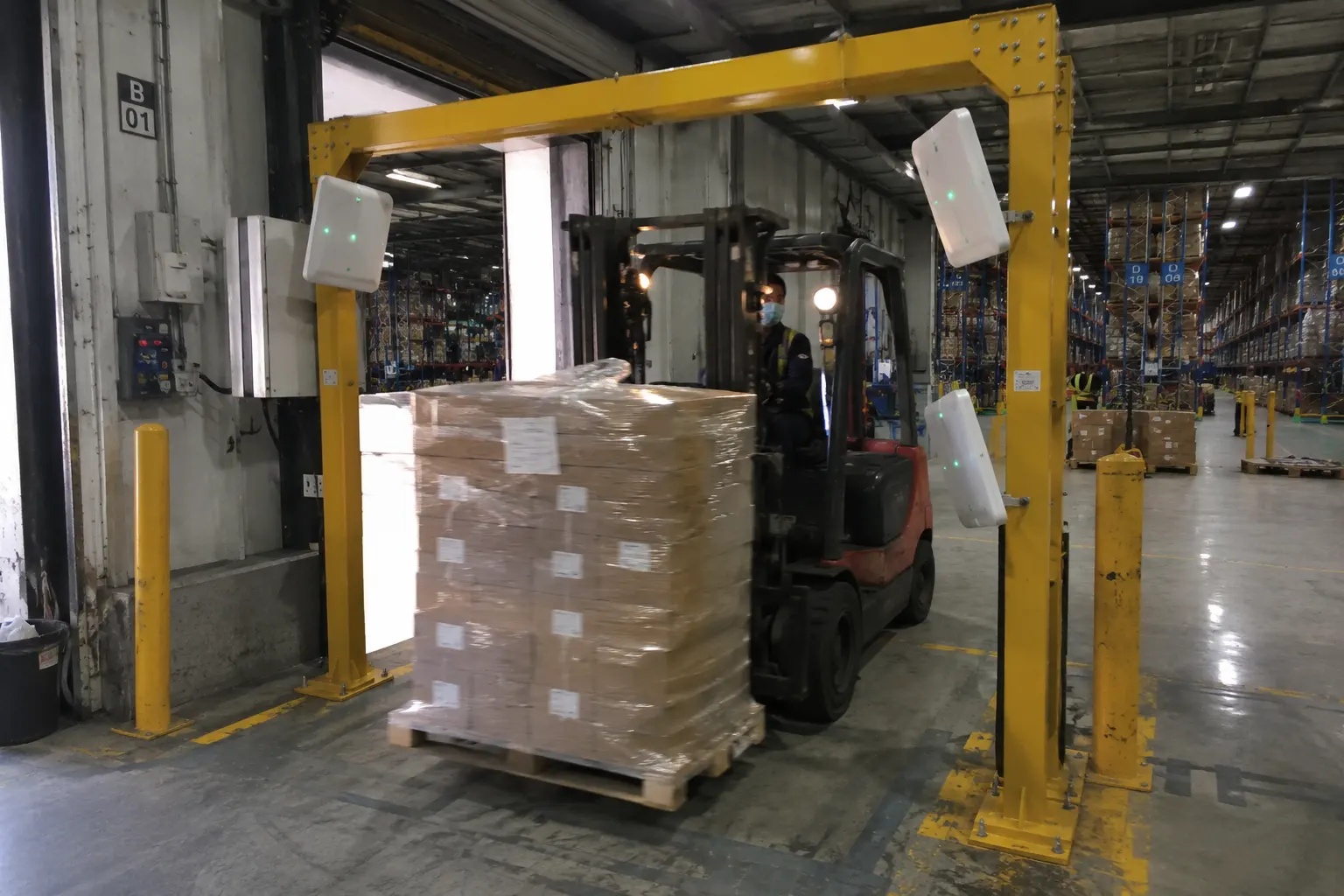
In distribution, the one-at-a-time scan bottleneck goes away. Goods arrive on a pallet, roll past a fixed reader at the dock door, and the system confirms what's inside without a box being opened. how RFID is used in logistics covers receiving, cross-docking, and yard management as they actually run.
Retail runs the same idea down to the item. Stores read shelves and back rooms on a continuous loop instead of periodic manual counts, so shrinkage and stockouts surface while there's still time to fix them. On the line, manufacturing tags components and tools so each station can confirm the right parts are present. RFID application scenarios gathers use cases across industries if you want the wider view.
The constraint buyers actually plan around is the physical environment. Metal and liquid throw radio energy around — reflect it, absorb it — so reads won't behave the way they do in a clean open space. That's why tag choice, antenna placement, and read-point design get tuned per site instead of copied from a single default.
For the broader mechanics of how RFID technology works and what it can track in a B2B operation, our full explainer walks through the components, frequency bands, and field behavior in more depth.
Conclusion
RFID is a wireless identification method built on three parts — tag, reader, antenna — reading through radio waves without line of sight. LF, HF, and UHF are the frequency choices; passive UHF is the default once you're tracking at scale. Any operation where bulk, fast, accurate ID beats manual scanning is a fit.
If you're scoping a project, the next step is the read-cycle detail and the frequency rules for your target market. Those pages go deeper than this overview and help turn a definition into a rollout plan.
Frequently Asked Questions
Q: What is RFID technology in simple terms?
A: RFID is a way to identify objects using radio waves. A small tag on an item holds a unique ID, and a reader picks up that ID without touching or seeing the tag. It lets you count and track many items at once.
Q: How does RFID work without a battery?
A: Most RFID tags are passive. They have no battery and instead draw power from the radio signal sent by the reader. The reader's energy briefly powers the tag's chip, which then sends its stored ID back. Active tags do use a battery, but passive tags are the common, low-cost option.
Q: What is the difference between RFID and NFC?
A: NFC is a short-range form of HF RFID operating at 13.56 MHz, usually within a few centimetres. RFID is the broader family that includes LF, HF, and UHF and reaches from centimetres to several metres. NFC is built for tap interactions like payments; RFID covers tracking at distance.
Q: What can RFID track in a business?
A: RFID tracks physical items that carry a tag: cartons, pallets, returnable containers, retail products, work-in-process, tools, and access badges. Anything that needs to be counted, located, or authenticated without manual scanning is a candidate.
Q: Is RFID better than barcodes?
A: It depends on the job. RFID reads many tags at once without line of sight and works through packaging, which suits high-volume receiving and shipping. Barcodes are cheaper per label and sufficient for slower, item-by-item scanning. Many operations keep both.
Q: Which RFID frequency should I choose?
A: Use LF for short range near metal or liquid, HF for NFC and item-level apps around 13.56 MHz, and UHF for long-range, high-volume tracking such as logistics and retail. Local frequency rules also shape the choice, so confirm the allowed band for each market.
Q: What industries use RFID?
A: Common users include logistics and warehousing, retail, manufacturing, healthcare and pharma, agriculture and livestock, and access control. Any sector that moves or stores physical assets at scale can apply it.
Q: Does RFID require line of sight?
A: No. RFID reads through packaging, cardboard, and plastic because it uses radio waves rather than visible light. This is the main advantage over barcode scanning, which needs a clear view of each label.
Q: Are RFID tags reusable?
A: Some are. Durable active and rugged passive tags on returnable containers or assets are reused across cycles. Low-cost disposable labels are typically single-use and stay with the shipped item.
Q: How far can RFID read?
A: Range depends on frequency and tag type. LF is under 10 cm, HF reaches about 10 cm to 1 m, and UHF can reach several metres with the right antenna. Active tags extend further, sometimes tens of metres.
Q: How much does an RFID tag cost?
A: Passive UHF labels are the cheapest, often a few cents each at volume, which is why they dominate logistics and retail. HF and LF tags cost more per unit, and rugged or on-metal tags carry a premium for durability. The total cost of ownership also covers readers, antennas, and integration — budget for the system, not just the tag.
Q: Is RFID secure? Can tags be read or cloned by anyone?
A: A standard passive tag broadcasts its ID when queried, so it is not a secure credential by itself and can be read by any compatible reader in range. For access control or anti-counterfeit use, choose tags with built-in encryption or cryptographic features, and keep the reading zone controlled. Treat the tag ID as an identifier, not as a secret.
Q: What is the difference between passive and active RFID?
A: Passive tags have no battery; they draw power from the reader's signal and are cheap and maintenance-free, which suits high-volume tracking. Active tags carry their own battery, reaching longer ranges — often tens of metres — for large assets and vehicles, at a higher per-tag cost and a finite service life. Most supply-chain and retail use is passive.