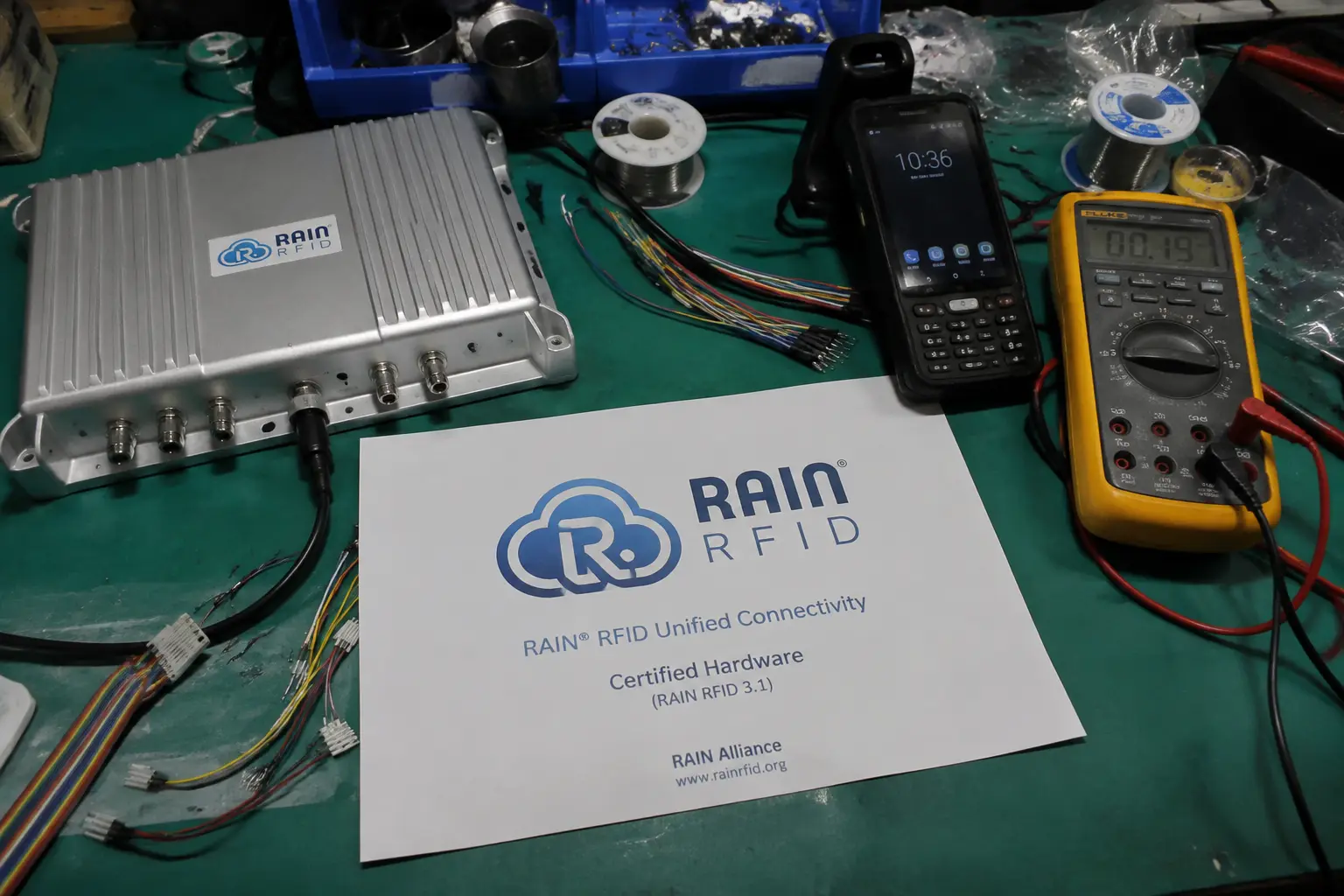
By the Fongwah Technical Team · Updated July 10, 2026 · 20 years designing and building RFID readers, modules, and tags.
Sarah runs omnichannel operations for a mid-size apparel retailer. Last quarter her boss asked her to "roll out RAIN RFID." Two weeks later her IT lead forwarded a quote for NFC stickers, assuming they were the same thing. Sarah had read "RAIN" in three vendor decks and still couldn't answer the simplest question: what is RAIN RFID? If that confusion sounds familiar, you're in good company. The name is new, the technology is not, and almost nobody explains the difference without a wall of RF jargon.
What is RAIN RFID in one line? It is the industry brand name for passive UHF RFID — the battery-free, long-range, bulk-reading flavor built on the GS1 EPC Gen2 / ISO 18000-63 standard. "RAIN" isn't a rival technology; it's the UHF passive branch of the RFID family, branded so buyers can find compatible, standardized hardware. In the next ten minutes you'll get a plain-English definition, the RAIN vs RFID and NFC relationship, the four-step physics of a battery-free tag, and a workflow-first buyer checklist.
Key takeaways
- No battery, meters of range, thousands of tags per second. That combination is why RAIN owns retail inventory and supply-chain tracking.
- It is not NFC. A standard phone reads NFC, not passive UHF, so don't spec RAIN expecting phone taps.
- Standards keep it open. EPC Gen2v2 / ISO 18000-63 means a tag from one vendor reads on a reader from another.
1. What Is RAIN RFID?
RAIN RFID is the marketing and standards umbrella for passive ultra-high-frequency (UHF) RFID. When you see the RAIN logo, it tells you the product follows the global UHF passive standard and interoperates with other RAIN-certified gear. Think of it like "Wi-Fi" for wireless networking: a brand name wrapped around a standardized technology.
The technology itself operates in the 860–960 MHz band, depending on region. Tags carry no battery. The reader supplies the energy, and the tag reflects (backscatters) a coded reply. That single design choice is what gives RAIN its signature strengths:
- Range in meters, not centimeters. Typical reads run 1–12 m, and farther with tuned antennas.
- Bulk reads at speed. A good portal reads hundreds to well over 1,000 tags per second.
- Tags that cost pennies at volume, because there's almost nothing inside them.
| RAIN RFID at a glance | |
|---|---|
| Frequency | 860–960 MHz (region-dependent) |
| Power | Passive (no battery; reader-powered) |
| Typical read range | 1–12 m (up to ~15–20 m tuned) |
| Read speed | Hundreds to 1,000+ tags/second |
| Tag cost at volume | Cents each |
| Core standard | GS1 EPC Gen2v2 / ISO 18000-63 |
That table is the whole pitch in five rows; the rest of this article explains why those numbers look the way they do.
Mapping this to a buying decision? The companion RFID reader buying guide expands each spec into a vendor-neutral selection framework.
2. Does "RAIN" Stand For Something?
Short answer: no, RAIN is not an acronym. This is the single most misunderstood point on the topic, and it's exactly why searches for "what does RAIN RFID stand for" are so common.
The RAIN Alliance — the group behind the brand — chose "RAIN" as a word, not letters. Just as rain connects sky to ground, RAIN RFID connects physical items to the cloud, where software can identify, locate, and track them. The name also nods to the underlying tech: RAdio frequency IdeNtification.
You'll see a "backronym" online claiming RAIN means "Radio-frequency Identification for Automatic Identification of Non-contacting Objects." Some early adopters floated it, but the RAIN Alliance does not use it. Treat it as a misconception.
When a client asks "what does RAIN RFID stand for," the accurate reply is simple: RAIN is a brand name for passive UHF RFID, inspired by the rain-to-cloud analogy. Getting that right signals you understand the ecosystem, not just the buzzword.
3. RAIN RFID vs RFID: What's the Relationship?
This is where most confusion lives, so let's draw the family tree cleanly.
RFID (radio-frequency identification) is the umbrella. It covers every system that uses radio waves to identify tagged objects. Under that umbrella sit several branches defined by frequency and power:
- LF (125–134 kHz): short range, reads through metal and liquid.
- HF / NFC (13.56 MHz): cards, access, phone taps.
- UHF passive (860–960 MHz): long range, bulk reads. This branch is RAIN.
- Active RFID: battery-powered tags for very long range (tens to hundreds of meters).
So the relationship is simple: RAIN is a subset of RFID, not a rival. Specifically, RAIN = passive UHF RFID compliant with EPC Gen2 / ISO 18000-63. A device can be RFID without being RAIN — it might be LF, HF, NFC, or active.
That distinction matters when buying: "RFID reader" and "RAIN reader" are not interchangeable. A 13.56 MHz HF reader can't see a RAIN UHF tag — they speak different radio languages.
One more branch to separate early: passive vs active. RAIN is always passive, which is why tag cost stays in cents and range stays in meters. If your project must see a container from across a yard, you've left RAIN and entered active RFID. Our deeper comparison of active vs passive RFID walks that boundary in detail.
4. How RAIN RFID Works
RAIN RFID how it works comes down to four steps. The magic trick is a tag with no battery that still transmits data. Here is the version we use when training integrators.
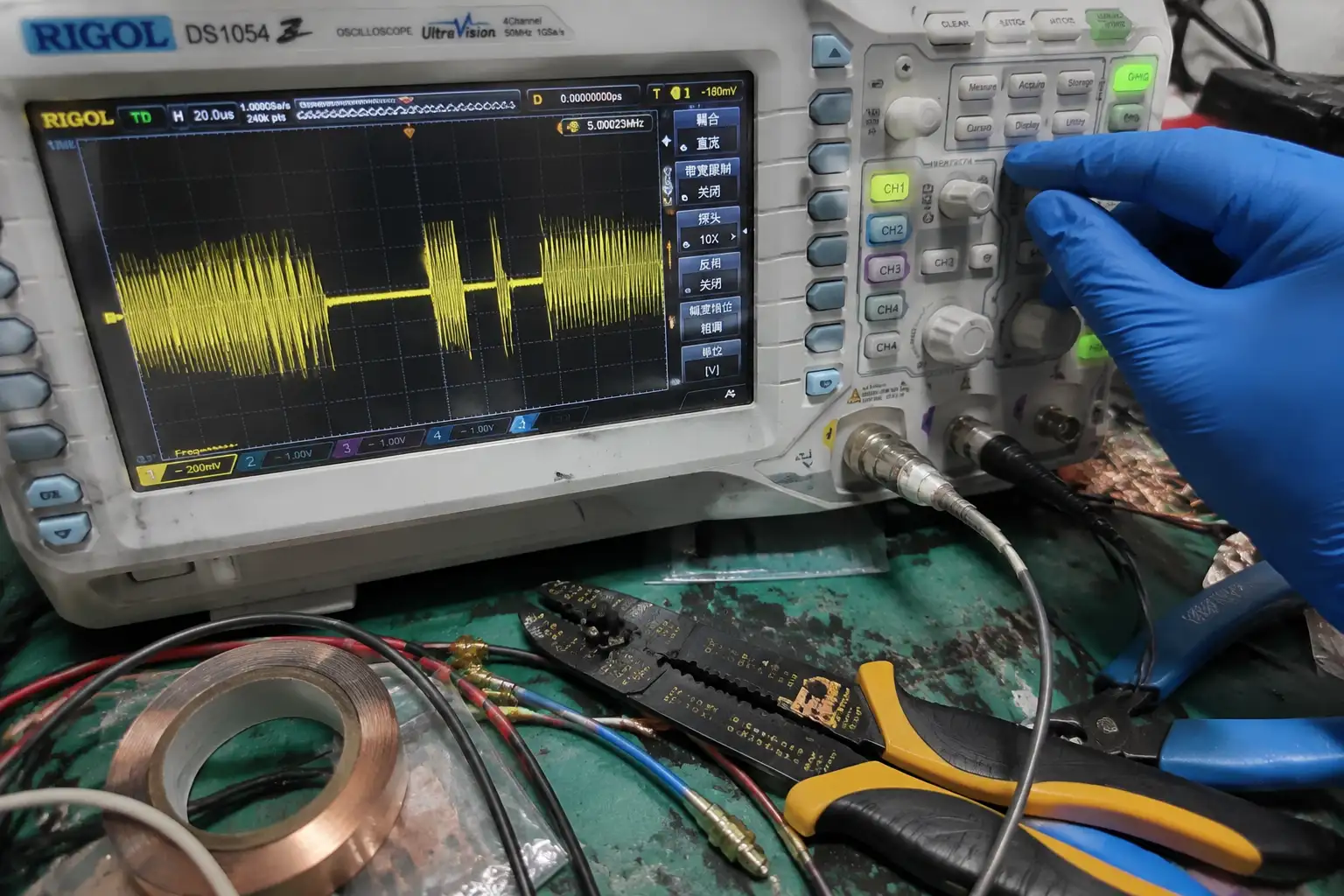
Step 1. The reader broadcasts energy. A RAIN reader (via its antenna) emits a continuous UHF radio wave. That wave does double duty: it carries the command and the power.
Step 2. The passive RFID tag harvests it. The tag's antenna captures enough energy from that field to wake its chip. No battery required — the reader is the power plant.
Step 3. The tag backscatters its reply. The chip can't push its own strong signal, so it does something clever: it switches its antenna load on and off. That tiny switching reflects the reader's wave back, modulated into a data pattern — "talking" by interrupting the reader's signal in a coded rhythm.
Step 4. The reader decodes and forwards. The reader detects those reflections, demodulates the tag's serial number (the EPC), filters duplicates, and passes clean data to your software: a WMS, POS, or cloud platform.
Passive, not powered
Because the reader powers the tag, range is bounded by harvestable energy — the trade-off behind "meters, not kilometers." It's also why RAIN tags are cheap and last essentially forever: no battery to fail.
Backscatter and anti-collision in plain words
Imagine a teacher walking into a silent room of a thousand students, each holding a number. The teacher can't hear them all shout at once. So the system uses an anti-collision algorithm (the Q algorithm in EPC Gen2) that calls on small random groups until every student has answered exactly once. That's how one reader counts 1,000 tags in a second instead of hearing one garbled roar.
The standards behind RAIN: EPC Gen2 and ISO 18000-63
Interoperability is why RAIN succeeded where proprietary UHF stalled. The air-interface protocol is GS1 EPC Gen2, and its lineage trips people up:
| Spec | What it is | Relationship |
|---|---|---|
| EPC Gen2 v1 | Original GS1 UHF standard | Adopted as ISO 18000-6C |
| EPC Gen2 v2 | Current GS1 UHF standard | Published as ISO/IEC 18000-63 |
| RAIN | Brand covering both | "RAIN" = EPC Gen2-compliant UHF passive |
In practice, EPC Gen2 and ISO 18000-6C / 18000-63 describe the same UHF air interface; the ISO number is just the international standardization of the GS1 spec. When a vendor says "ISO 18000-6C," they usually mean the earlier Gen2v1 behavior; "ISO 18000-63" maps to the newer Gen2v2. Both are RAIN.
The GS1 EPC data layer
A RAIN tag's memory is organized into four banks:
- Reserved holds the kill and access passwords (security).
- EPC is the electronic product code (typically 96 or 128 bits), your unique item ID.
- TID is the tag ID, set by the chip maker to identify the model.
- User is optional writable space for extra data.
That structure is why a RAIN tag can carry a true item-level serial, not just a repeated SKU — the foundation of real inventory visibility.
For the official specification, see the GS1 EPC Gen2 UHF air interface and the international standard ISO/IEC 18000-63 that underpins RAIN's interoperability.
5. RAIN RFID vs NFC (and HF)
Buyers mix these up constantly (our RFID vs NFC decision guide breaks it down point by point); here's the head-to-head. Both are RFID, but different worlds.
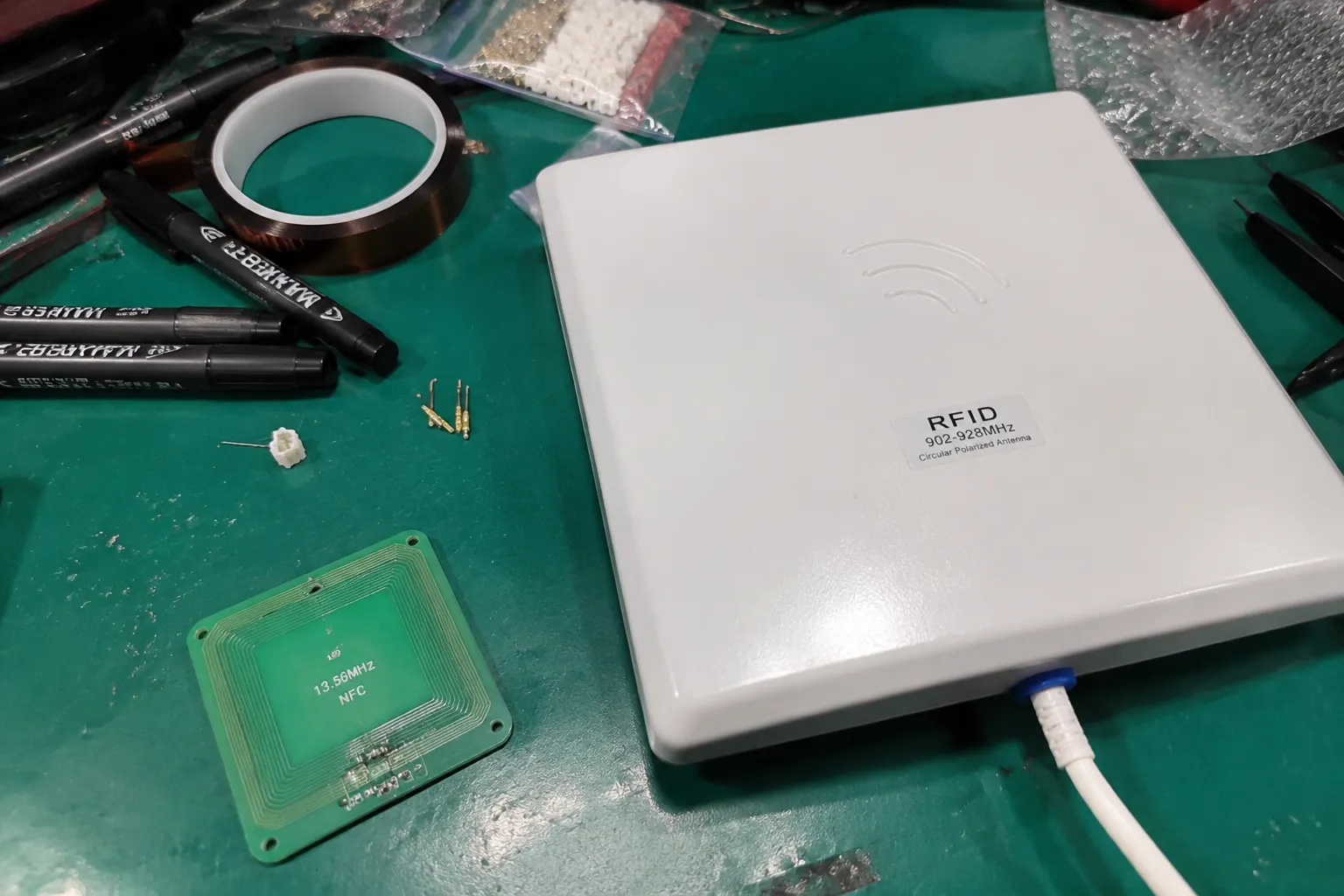
RAIN RFID (UHF) reads meters away in bulk without a phone; NFC (HF, 13.56 MHz, ISO/IEC 14443) only works within about 10 cm and is readable by any smartphone.
| RAIN RFID (UHF) | NFC (HF, 13.56 MHz) | |
|---|---|---|
| Frequency | 860–960 MHz | 13.56 MHz |
| Typical range | 1–12 m | <10 cm (tap) |
| Phone-readable? | No (needs a UHF reader) | Yes (any smartphone) |
| Power on tag | Passive | Passive |
| Read style | Bulk, no line of sight | One at a time, tap |
| Best for | Inventory, logistics, pallets | Access, payment, engagement |
| Tag cost | Cents at volume | Cents to low dollars |
The deciding question is almost always: does a phone need to read it? If yes, you want NFC or HF. If you need to count a whole rack of garments from a few meters away, you want RAIN. They're complementary, not competitors — many retailers run RAIN in the back room for inventory and NFC at the front for customer interaction. That's the exact setup Sarah's team landed on after the opening confusion: RAIN handhelds for stock counts, NFC stickers for the loyalty app.
NFC is itself a subset of HF RFID. If phone reads matter, browse our NFC tags (NTAG213/215/216) . Just remember a phone cannot read a passive UHF UHF RAIN RFID tag .
6. Key Benefits of RAIN RFID
Why has RAIN eaten the retail and supply-chain market? Five reasons:
- No line of sight. Unlike barcodes, a RAIN tag can be inside a box, behind a label, or facing any direction and still read.
- Bulk and fast. A pallet of 200 garments counts in about a second. Barcode scanning does that one label at a time.
- Cheap tags. At volume, passive UHF tags cost only cents, making item-level tagging affordable.
- Meters of range. Fixed portals and handhelds read across a room, not just at contact.
- Mature, open ecosystem. Because of EPC Gen2 standardization, you're not locked to one vendor.
A distribution center we supported switched from handheld barcode guns to a RAIN portal. Clerks used to scan cartons one by one; after the portal, a forklift rolling through the door logged the whole pallet automatically. Receiving time on that lane dropped by roughly two-thirds, and mis-ships fell because nothing slipped past unread.
7. Typical Applications: Retail & Supply Chain
RAIN earns its keep wherever you must count many items fast and at range — the same use cases our explained guide to RFID in business covers in depth:
- Retail item-level inventory. Hang-tags and price labels carry RAIN, so a handheld sweep reconciles shelf vs system in minutes.
- Supply-chain and DC portals. Dock-door readers log every carton and pallet hands-free.
- Logistics and parcel sorting. Conveyor readers sort tagged shipments without manual scans.
- Asset and RTI tracking. Reusable totes, roll cages, and pallets get tracked across the loop.
- Manufacturing WIP. Work-in-process becomes visible at each station.
Beyond the core four, RAIN also serves healthcare, aviation, and laundry/rental (encapsulated tags). For apparel, see our RFID cards and tags tuned for UHF.
For apparel retailers, the layer after inventory visibility is stopping shrinkage at the exit. Our guide to standardized RAIN RFID retail loss-prevention deployments breaks down the antenna specs, store zoning, and GS1 TIPP logic that turn RAIN into a working theft-prevention system.
8. How to Choose a RAIN RFID System
You don't need an RF degree to spec RAIN; you need a workflow. Walk this in order:
1. Define the scenario. Who reads, where, how often, attended or not? A shelf audit and a dock portal are different builds.
2. Confirm the band is RAIN/UHF. If you need meters of range and bulk speed, UHF passive is the answer. (Need phone taps? Use NFC.)
3. Pick the reader form factor. Continuous infrastructure → fixed reader. Mobile audits → handheld. An encoding desk → desktop/USB writer. Your own product → an embedded RFID reader module . Browse our full UHF RFID reader line to compare fixed, handheld, and embedded options.
4. Choose the tag form factor. Soft labels for apparel, hard tags for reuse, on-metal tags near steel, on-liquid tags near water. A UHF RAIN RFID tag that matches the surface is half the battle.
5. Respect the environment. UHF is sensitive to metal and liquid. Walk the site; spec IP-rated enclosures and special tags where needed.
6. Check regional frequency compliance. The same RAIN reader must be configured per market: FCC 902–928 MHz in the US, ETSI 865–868 MHz in Europe, and 920–925 MHz in China. For the full country-by-country map, see our guide to RFID frequency regulations by country.
7. Pilot before you scale. A two-week pilot in a real slice of your environment surfaces the metal, liquid, and orientation problems that spec sheets hide.
RAIN choice is workflow-first. That is the one thing to nail. Match band to physics, reader to scenario, and tag to surface — then pilot. The longest spec sheet rarely wins; the best fit does.
This is exactly the decision path the RFID reader buying guide builds out with tables and a 7-step checklist. Use this Spoke to understand RAIN, then use the Pillar to buy it with confidence.
Frequently Asked Questions
Q: Is RAIN RFID the same as UHF RFID?
A: Almost. RAIN specifically means passive UHF RFID that complies with the EPC Gen2 / ISO 18000-63 standard. "UHF RFID" can technically include non-standard or active UHF systems, while "RAIN" guarantees the standardized, interoperable passive kind.
Q: Can a smartphone read RAIN RFID tags?
A: No, not directly. Standard phones have an NFC (HF, 13.56 MHz) chip, not a UHF transceiver. To let phones read tags, use NFC. Specialized UHF reader sleds exist, but the phone alone cannot read passive RAIN tags.
Q: What is the read range of RAIN RFID?
A: Typically 1 to 12 meters with commodity gear, and up to roughly 15 to 20 meters with tuned antennas and a favorable environment. Range depends on reader power, antenna gain, tag type, and surroundings, with metal and liquid shortening it.
Q: Is RAIN RFID secure?
A: The air interface is not encrypted, but the tag has safeguards. A kill password can permanently disable it, and an access password can lock memory banks. Treat tag security as part of your design.
Q: RAIN RFID vs barcode, which should I use?
A: Use barcodes where you scan one item at a time, at contact, and cost must be near zero. Use RAIN where you must count many items fast, without line of sight, at a distance. Many operations keep both, with barcodes for printed proof and RAIN for automated counts.
Conclusion
RAIN RFID isn't a mystery once the pieces click into place. You now know what it is, how a battery-free tag talks back, and where it beats both barcodes and NFC. The only question left is which reader actually fits your workflow, and the buying guide below answers exactly that.
Ready to turn understanding into a spec? Open the RFID reader buying guide for the full selection framework, then browse our UHF RFID readers and RAIN-ready tags. Building RAIN into your own product? Our embedded reader modules and OEM/ODM team can tailor the form factor and firmware to your enclosure. Talk to our team to request spec sheets and start a pilot today.