
ourcing high-performance RFID readers direct from an OEM manufacturer is the most reliable way to maximize ROI on an access-control or asset-tracking deployment. You capture factory-grade specifications and in-house quality control at a fraction of branded-distributor pricing — without giving up the read reliability your clients expect.
Budgets are tight, and end clients still demand enterprise-level security for less money. Buy cheap, low-quality hardware and you inherit failure rates that quietly destroy your margin. The strategy that works is balancing cost against verified performance, and knowing which technical metrics separate a "cost-effective" reader from a "cheap" one.
Sourcing directly from a specialized RFID Reader Manufacturer lets you lower the overall RFID Access Control System price while accessing enterprise-level specs. The metrics that matter — anti-collision algorithms, standard wiring protocols, and verified read speed — are what let affordable units perform like expensive Western brands and lift your Return on Investment (ROI).
Here is the failure mode Fongwah's engineering team sees constantly. At 8:00 AM, ten employees walk up to a factory gate and badge in at once. If the reader freezes, you get a line out the door and a client on the phone within the hour. That single scenario is why "cheap" and "cost-effective" are not the same thing.
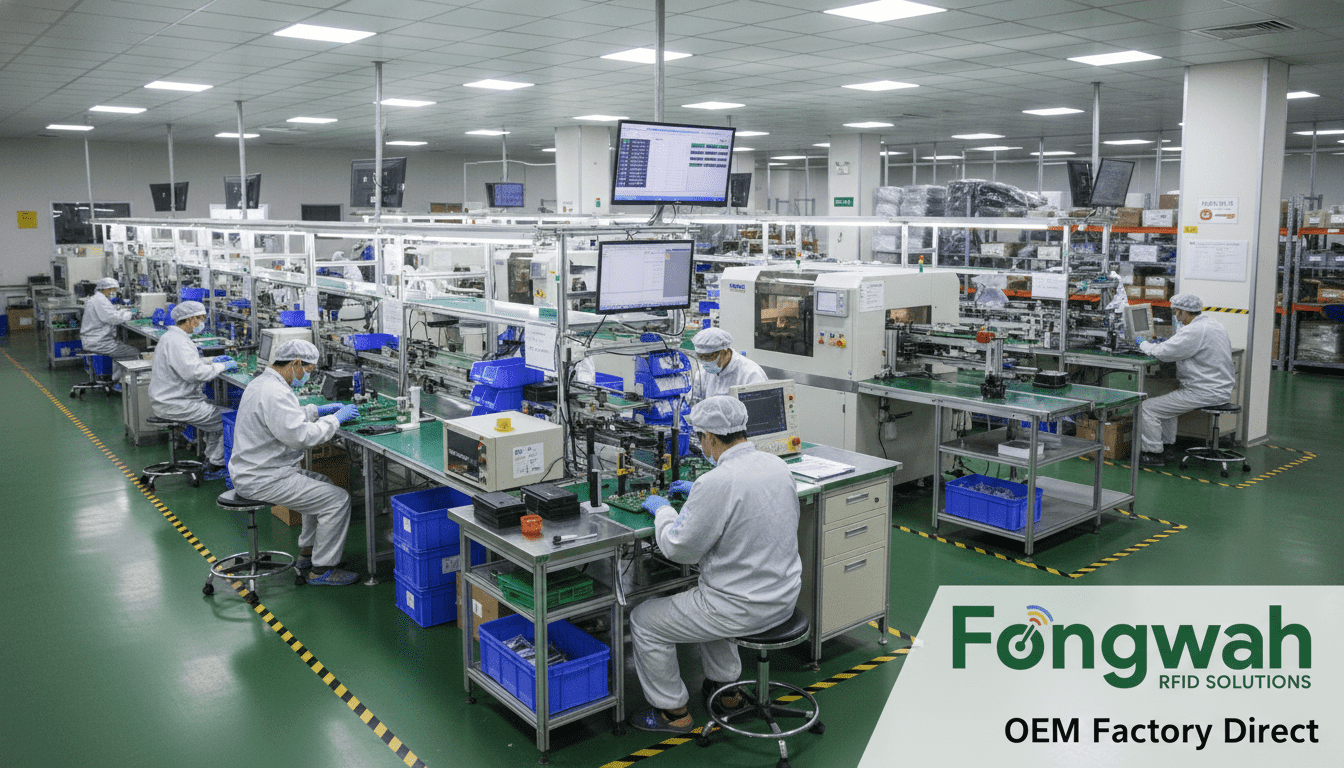
Fongwah's production and QA teams have spent years on the manufacturing floor. The gap between a cheap unit and a cost-effective one is not theoretical: cheap readers typically fail within three months, while cost-effective readers built under in-house manufacturing control run for years at a lower landed cost. Controlling the factory is what lets a specialized OEM deliver reliability without the enterprise price tag.
This guide shows you how to define true reader performance, decode what actually drives the RFID access control system price, and simplify installation with standard wiring. By the end, you will know how to mix technology tiers across access zones to maximize ROI while keeping your installers productive.
Key Takeaways
- Sourcing direct from an OEM like Fongwah removes 2–3 distribution tiers (each adding ~30%), collapsing the supply chain to factory-to-buyer.
- True performance is defined by read speed and anti-collision, not just read distance — UHF Gen2 readers inventory up to 700+ tags/sec.
- Match the band to the zone: HF/NFC (13.56 MHz) for office doors, UHF (860–960 MHz) for parking and warehouses.
- Standard interfaces (Wiegand 26/34, RS232/485, TCP/IP, USB) and a clear wiring diagram cut installation labor — often the biggest hidden cost.
- Verify a China OEM's QC with bench-tested samples, full datasheets, and a documented factory test process before volume ordering.
How Do You Define High Performance in a Commercial RFID Door Lock Environment?
Speed is the first thing a user notices. If an employee has to wave a credential three times to open a door, they complain — and your client blames the integrator. But responsiveness is only the visible layer of performance.
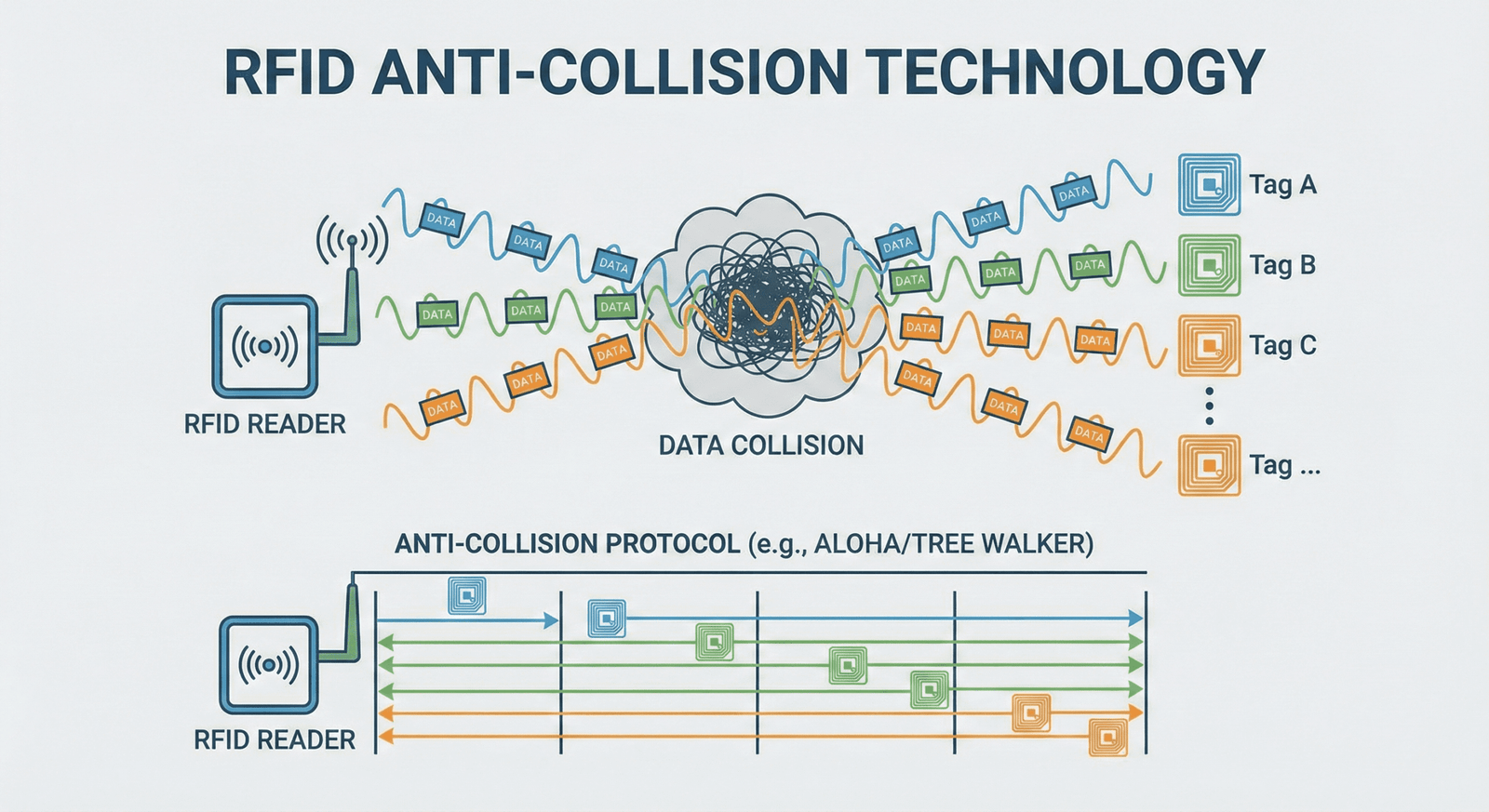
True performance is defined by read rate and the anti-collision algorithm. A RFID door lock commercial system must process multiple tags simultaneously without signal interference, keeping traffic flowing during shift changes and peak entry windows.
Fongwah's QA team validates every reader with a stress test the team calls the "Shift Change Simulation." Engineers present a bundle of 20 credential cards to the reader at once. Many generic readers fail this test — they beep once, then stall, unable to separate one signal from another. That stall is a tag collision. In a real deployment it is a disaster: at an 8:00 AM factory gate, ten employees badge in together, and a reader that freezes creates a line out the door.
High-performance readers use deterministic anti-collision routines to poll tags one by one, very quickly. For HF systems, look for ISO 14443A compliance (or ISO 15693 for longer item-level reads) that supports fast data transfer. For UHF, look for the Q-algorithm in the EPC Gen2 standard — optimized implementations inventory up to 700+ tags/sec. Fongwah designs its readers around high-sensitivity antenna modules so they push through noise even when a tag sits in a wallet or near keys, where metal causes attenuation.
Frequency Bands, Read Ranges, and What the Spec Sheet Should Show
When you review a spec sheet from any factory, do not fixate on "Read Distance" alone. A reader that reads at 10 meters but takes 2 seconds to process is useless; a reader that reads at 5 meters but processes in 50 milliseconds is the winner. Prioritize read speed and anti-collision capability.
Understand the three bands and their real-world numbers:
- LF (125 kHz) — EM4100, ISO 11784/11785. cm-scale range. Used for basic access and harsh-metal environments.
- HF / NFC (13.56 MHz) — ISO 14443A and ISO 15693. Read range 5–30 cm depending on antenna. The standard for smart cards and commercial door locks.
- UHF (860–960 MHz) — EPC Gen2 (ISO 18000-6C). Read range 1–12 m on a fixed reader with a high-gain antenna, 0.5–5 m handheld. The backbone of logistics and parking.
UHF regional bands are regulated, so confirm the band before you deploy: FCC 902–928 MHz in North America, ETSI 865–868 MHz in Europe (EN 302 208), and China 920–925 MHz. A reader tuned to the wrong regional band will underperform or fail compliance.
Antenna gain matters too. Typical UHF patch antennas run 6–9 dBi; circular-polarized panels sit around 6–8 dBi. Higher gain means longer range but a narrower beam — tune the antenna to the lane, not just the label.
Want to see these metrics on a real spec sheet? Explore Fongwah's RFID reader modules → to compare anti-collision rates and interface options side by side.
What Factors Truly Drive the RFID Access Control System Price?
You might assume the price gap between brands is pure marketing. Often it is — but the real cost driver is the supply chain and the technology inside the box.
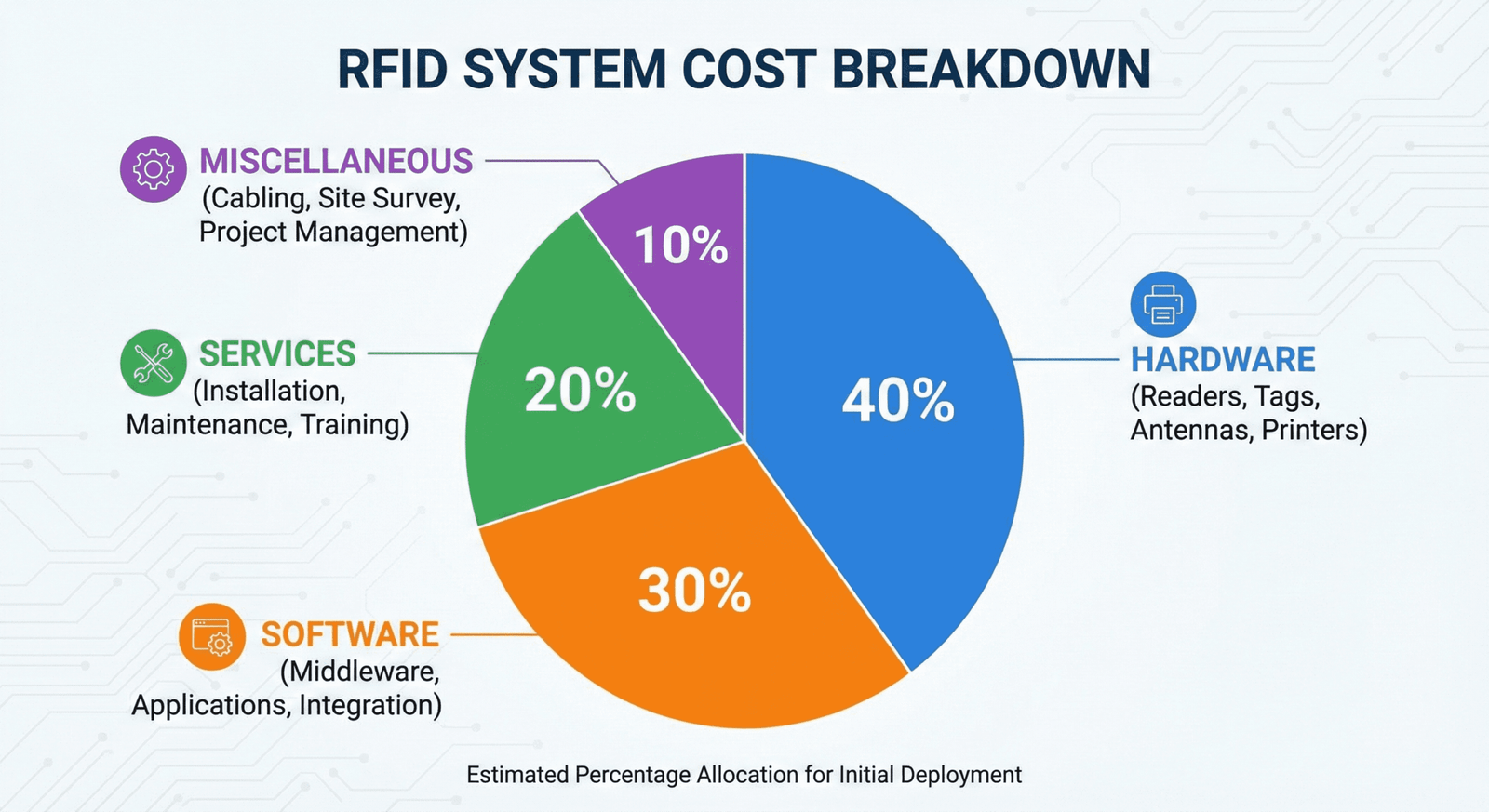
The RFID Access Control System price drops sharply when you cut out the middlemen. By partnering directly with an OEM factory, you pay for the hardware — chipsets, antennas, and casing — rather than a distributor's brand premium.
Procurement managers who compare Fongwah's factory-direct quotes against major European brands are often surprised. The question is usually, "Is something missing?" Nothing is missing. The traditional RFID supply chain runs Factory → Trading Company → Global Distributor → Regional Reseller → Buyer, with each tier adding roughly 30%. As the OEM, Fongwah collapses that chain: the buyer talks to the factory, and the factory talks directly to the production line.
The technology itself also sets cost. Different tiers suit different scenarios:
- Office Buildings (HF / NFC, 13.56 MHz) — Proximity cards or key tags. Readers are smaller, cheaper, and the technology is mature. The most cost-effective solution for standard doors.
- Logistics and Gates (UHF, 860–960 MHz) — Larger, more expensive readers needing powerful antennas and careful tuning for long-range, high-throughput reads.
Use the comparison below to budget by zone:
| Attribute | LF Proximity (125 kHz) | HF / NFC (13.56 MHz) | UHF (860–960 MHz) |
|---|---|---|---|
| Protocol | EM4100, ISO 11784/85 | ISO 14443A, ISO 15693 | EPC Gen2 (ISO 18000-6C) |
| Typical Read Range | cm-scale | 5–30 cm | 1–12 m (fixed) / 0.5–5 m (handheld) |
| Reader Cost | Lowest | Medium | High |
| Tag Cost (bulk) | Low | Medium | Lowest |
| Security | Poor (easily cloned) | High (encrypted) | Moderate |
| Best Application | Basic entry | RFID door lock commercial | Parking / Warehouse |
By partnering directly with a specialized RFID Reader Manufacturer, B2B clients access factory-grade pricing while keeping enterprise-level performance. Choose the right tech for the right zone: cheaper HF readers for internal office doors, and budget the powerful UHF readers for the parking garage. This mix-and-match strategy is what maximizes ROI.
Ready to price a mixed-zone deployment? Request a factory-direct quote → and see how much the distribution markup was costing you.
Is the RFID Access Control Wiring Diagram Too Complicated for Your Installers?
Labor is the most expensive part of any installation. If technicians spend hours figuring out which wire goes where, every dollar saved on hardware vanishes on the ladder.
A clear, standard RFID Access Control Wiring Diagram is the mark of a professional product. Readers that use standard interfaces — Wiegand 26/34, RS232, RS485, TCP/IP (Ethernet), USB, and GPIO — let your team connect to virtually any controller in minutes, not hours.
Fongwah field engineers have stood on the ladder at 6 p.m. with a reader in one hand and a screwdriver in the other, squinting at a bundle of identical black wires or a label in an unfamiliar language. Every minute lost to guesswork is billable labor walking out the door. Clear, standardized wiring documentation is what separates a clean deployment from a support call.
Wiring & Integration — Simplified for Installers
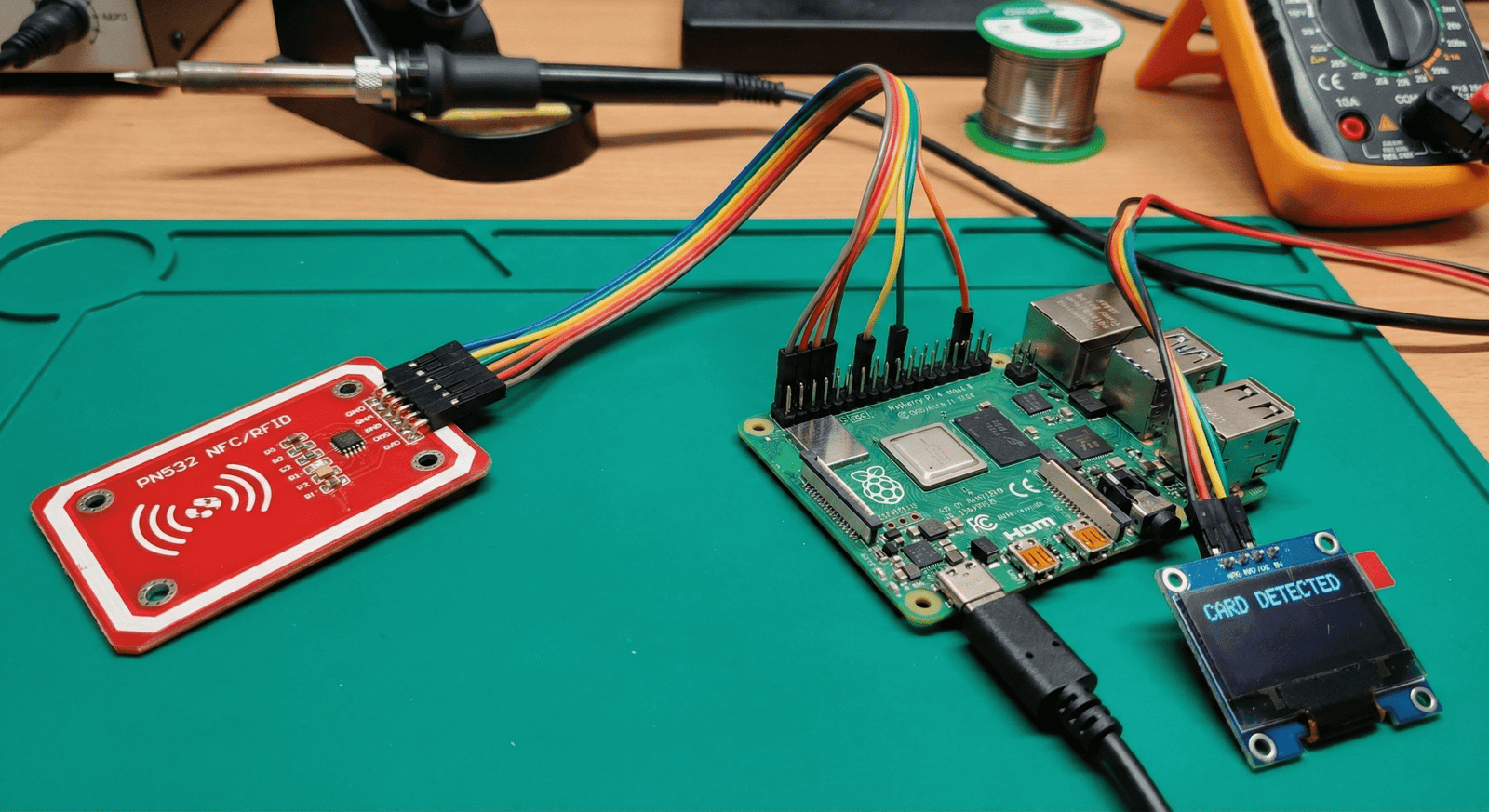
One of the biggest headaches for onsite engineers is unclear wiring documentation. Fongwah distinguishes clearly between its Installation Readers (for doors) and Desktop Readers (for card issuance and enrollment) to prevent installation errors.
Every Fongwah product ships with a detailed datasheet and a color-coded wiring diagram for rapid deployment.
Standardization vs. Plug-and-Play
It is crucial to note the pinout differences based on your application. For Fongwah Desktop Enrollment Readers (USB Interface), the front-desk provisioning units use a standardized 5V USB interface for direct PC connection:
- Red: +5V DC (USB Power)
- Black: GND (Ground)
- Green: USB Data + (Communication)
- White: USB Data − (Communication)
Integrator Note: All Fongwah desktop units are tested for signal integrity on the Data+ and Data− lines, ensuring stable transmission during batch card programming.
When you source from a China OEM, ask for the datasheet and the wiring diagram before you buy. Send it to your lead engineer and ask, "Can we install this easily?" A clear diagram usually signals clean firmware inside; a messy one often means the internals are a mess too. Fongwah publishes these diagrams on its site and in every box. The goal is "Plug and Play," not "Plug and Pray" — and that installation efficiency is a massive, often-overlooked part of your ROI.
Technical FAQ for System Integrators
Q1: Why is the price difference so significant between major US brands and Chinese RFID readers?
The gap in RFID access control system price usually comes from brand premiums and multi-layer distribution markups, not component quality. As an OEM manufacturer, Fongwah eliminates the middlemen. Its readers use the same high-grade silicon chips and undergo rigorous in-house QC, so you access enterprise-level performance at a factory-direct cost.
Q2: What is the difference between "Commercial" and "Industrial" RFID door locks?
Commercial RFID door-lock systems (typical offices) prioritize aesthetics and a compact design, usually built on NFC/HF (13.56 MHz). Industrial readers (warehouses, gates) prioritize IP65/IP67 ruggedness, long-range UHF detection (up to 12 m), and high read rates. Fongwah provides specialized hardware for both scenarios so you do not overpay for features a given site does not need.
Q3: How do I ensure the readers won't interfere with each other in a high-density installation?
Check the "Anti-collision" specification when sourcing. Fongwah readers feature advanced anti-collision algorithms that prevent frequency interference when multiple readers sit close together — critical for busy logistics centers or multi-lane parking lots. Combined with proper UHF regional-band tuning (FCC 902–928 / ETSI 865–868 / China 920–925), this keeps dense deployments stable.
Q4: How do you verify a China OEM's quality control before volume ordering?
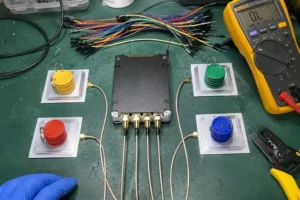
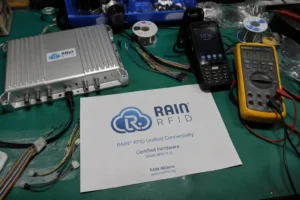
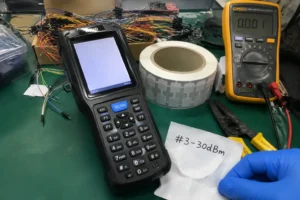
Request three things before committing to volume: (1) bench-tested engineering samples you can validate on your own workbench, (2) full datasheets with measured performance (read range, anti-collision rate, interface list), and (3) a documented factory QC process. Fongwah supports this with a free sample evaluation program and factory-direct electrical testing — including S-parameter / VNA verification and per-shipment consistency checks — so integrators can validate quality before they buy.
Q5: Which host interfaces should I require for easy integration?
Require the interfaces your controller actually supports. The standard set for B2B RFID integration is Wiegand 26/34, RS232, RS485, TCP/IP (Ethernet), USB, UART, and GPIO. Wiegand and RS485 remain the default for legacy access controllers; TCP/IP and USB dominate modern, networked, or PC-driven enrollment systems. Fongwah's SDK support (C++, C#, Java, Python, and Android demo code) lets your team integrate the reader into existing host software without rewriting from scratch.
Q6: How should I budget HF vs UHF across access zones?
Spend where the performance is needed. Use HF/NFC (13.56 MHz) readers for internal office doors — mature, encrypted, and the most cost-effective for standard entries. Reserve UHF (860–960 MHz) readers for parking garages and warehouses, where long range and high throughput justify the higher hardware cost. Mixing tiers by zone — rather than over-specifying every door — is the simplest way to maximize ROI across the whole site.
Maximize ROI by Sourcing Smart
Optimizing ROI is not about buying the cheapest hardware you can find. It is about sourcing smart: a manufacturer that offers transparent specs, direct pricing, and standard wiring gives you high security and healthy margins.
Fongwah is an OEM/ODM manufacturer that builds readers under in-house manufacturing control, with customization of module form factor, interface, firmware, and enclosure to fit your deployment. The SDK library (C++ / C# / Java / Python / Android) and free sample evaluation program are built for engineers integrating at scale.
Ready to validate before you volume-order? Request free samples and an RFQ from Fongwah → and get factory-grade specs, a full datasheet, and a wiring diagram your installers can actually read.