Most asset tracking failures trace back to a decision made too early: picking the tag before the job. Passive and active RFID tags are not upgraded and downgraded versions of the same thing. They are built around opposite assumptions about power, range, and cost, and the wrong assumption drains a budget or leaves blind spots in the data.
This guide looks at one lens only, the tag's power source. Frequency selection is a separate decision, covered in the comparison of UHF and HF tags for retail inventory and in the broader piece on which RFID technology fits a given project; mounting is covered in how to choose the right RFID tag. Keep the three questions separate and the buying decision gets much simpler.

Before comparing price sheets, it helps to understand why the two tag families behave so differently on site.
The dividing line is the power source. A passive tag carries no battery and draws the energy it needs from the reader's radio field, while an active tag holds its own battery and transmits a signal on its own schedule, and that one difference separates a read range of a few centimetres from one of tens of metres.
A passive tag is essentially a microchip and an antenna. When a reader powers up nearby, the tag wakes, reflects back its data, and goes dark again. That simplicity is why passive tags cost pennies. The trade is reach, since the tag answers only when a reader is close enough to energize it.
Between them sits a third design. A semi-passive tag, also called battery-assisted passive (BAP), carries a battery that powers the chip only and never a transmission: the tag still waits for the reader's field to wake it and carry its reply. Its service life falls between the other two, shorter than a tag with no battery, far longer than one that broadcasts under its own power. Cold chain temperature logging is the typical use.
Active tags then divide by behaviour, not hardware. A transponder-type tag stays silent until a reader interrogates it, then answers once. A beacon-type tag broadcasts on a fixed interval with no reader present, second by second or minute by minute. That interval is the setting that decides battery life: shorter intervals buy more continuous location and spend more of the cell.
Naming matters when specifications are compared. Passive UHF is formally known as RAIN RFID, and the air interface behind it is EPC Gen2, maintained by GS1 as the GS1 UHF Air Interface Protocol and published internationally as ISO/IEC 18000-63. Frequency follows the tag family: passive tags run at LF 125–134 kHz, HF 13.56 MHz and UHF 860–960 MHz; active tags typically use 433 MHz or 2.4 GHz. Active air interfaces have their own standards, ISO/IEC 18000-7 (433 MHz) and ISO/IEC 18000-4 (2.45 GHz, which also defines active operating modes).
An active tag flips the power relationship: it does not depend on the reader's RF field to power its transmitter. Depending on the system design, it may broadcast periodically as a beacon or transmit in response to an interrogation. That self-powered signal travels far and cuts through noise that would swallow a passive reply. The cost is bulk, price, and a battery that must eventually be serviced.
Passive vs. semi-passive vs. active RFID at a glance
| Passive | Semi-passive (BAP) | Active | |
|---|---|---|---|
| Power source | The reader's radio field only | A battery runs the chip; the reader's field powers the reply | A battery runs the chip and the transmitter |
| Typical read range | A few centimetres to roughly 10 metres | Longer than passive, shorter than active | Tens of metres |
| Operating frequency | LF 125–134 kHz, HF 13.56 MHz, UHF 860–960 MHz | UHF 860–960 MHz | 433 MHz or 2.4 GHz |
| Tag unit cost | Cents | Between passive and active | Tens of US dollars |
| Battery and service life | No battery; service life set by encapsulation and environment | Battery runs the chip only, so it outlasts an active tag | Finite, then replace or service |
| How it is read | At a chokepoint, when a reader energises it | At a chokepoint, with better reliability | Continuously, on a set broadcast interval |
| Best-fit application | High-volume, low-value inventory | Cold chain and temperature logging | RTLS on high-value mobile assets |
How do battery life and replacement cycles affect the long-term cost?
A tag's sticker price is the smallest part of what a deployment costs over its lifetime.
Active tags cost more up front, cents versus tens of dollars per unit, and need battery service on a cycle set by their broadcast interval, whereas passive tags carry no battery and their readable life is set by the encapsulation and the environment rather than by a cell, which keeps the total cost math in their favor for large volumes.
The per-tag number hides the infrastructure side. A passive system needs readers placed close together, because each tag only responds when energized. An active system covers the same area with fewer, more widely spaced readers, and those cabling savings pull the two totals closer than the tag prices suggest.
The recurring cost is where active systems diverge. Batteries fade on a clock, so a fleet of active tags means a refresh cycle, while passive tags simply sit there. Total cost of ownership across an RFID rollout shows how these curves cross by volume and lifespan. For single-trip assets, the disposable versus reusable tag trade-off matters more, since an unrecovered battery is pure waste.
The service visit turns that cycle into a line item. Because the broadcast interval is settable, from seconds to minutes, it is the cause and battery life is the effect: tighter intervals buy more continuous location and spend more of the cell. Replacement cost is not the price of a battery either, but a visit per tag, labour, downtime, and tracking which units are due, all multiplied across the fleet.

When does read range and the surrounding environment settle the choice?
Two facilities with the same budget can still land on opposite answers once the physical site enters the discussion.
Active tags win when assets span long distances, move fast, or sit near metal and liquid, because they broadcast at tens of metres while passive UHF tops out near ten metres; passive tags stay competitive in close-range, controlled, low-interference spaces.
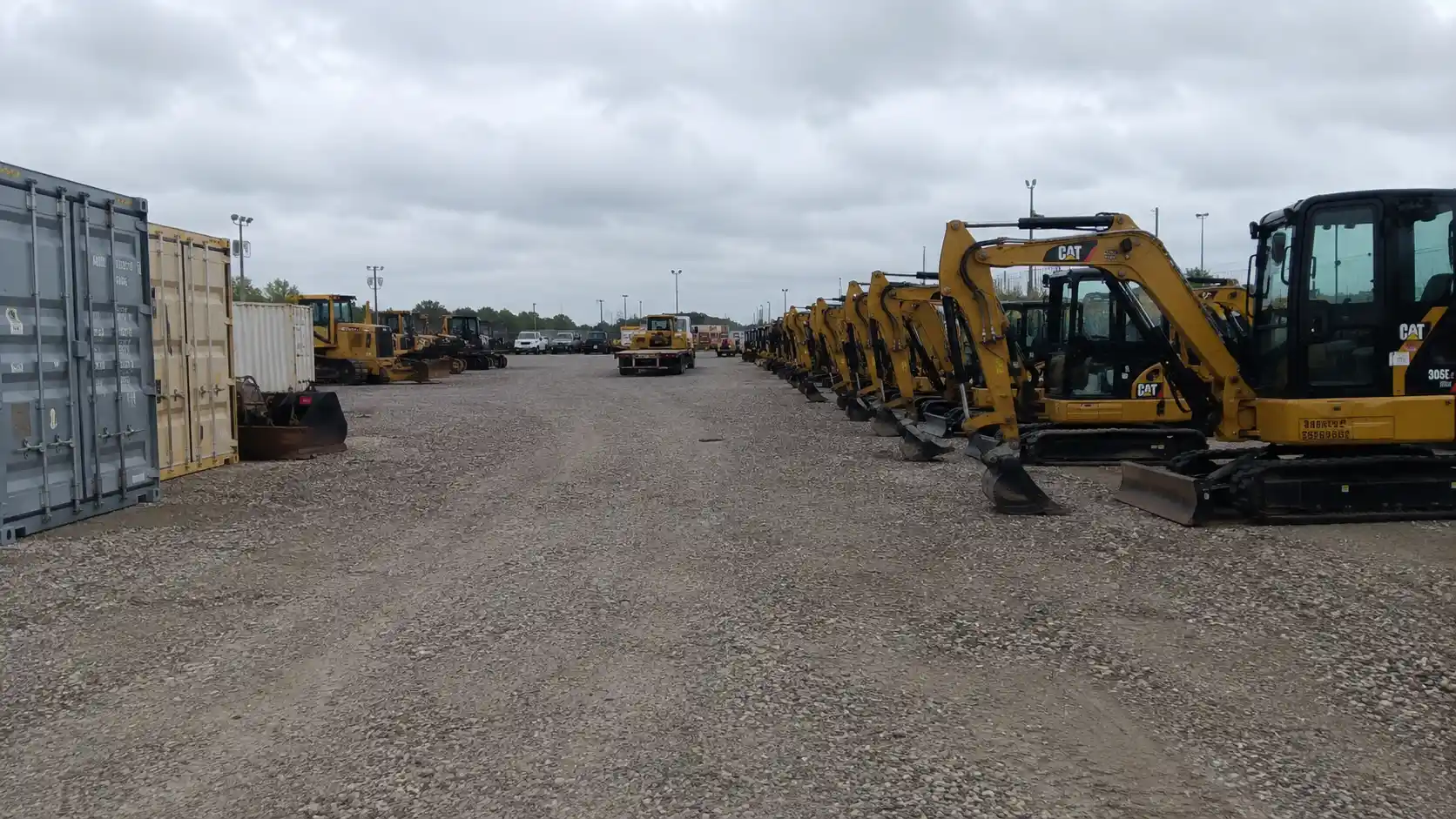
Read range is the gap buyers notice first. For a yard of heavy equipment or an aisle of fast-moving carts, the difference between a tag that waits to be energized and one that broadcasts is decisive.
The environment adds a second filter. Radio waves reflect off metal and get absorbed by water, and a passive tag's weak reply is the first thing those effects erase, so mounting on steel or a liquid tote demands an engineered on-metal build and careful reader placement, examined in the environmental interference troubleshooting checklist and in choosing the right RFID tag for the surface. An active tag is generally less constrained by the weak backscatter link that limits passive RFID, although metal, liquid, multipath and RF interference can still affect an active system, which is why it is common in shipyards, refineries, and cold storage. In the United States, active transmitters fall under FCC rules for unlicensed devices, set out in 47 CFR Part 15.
Metal deserves its own note, the most common reason a passive design underperforms after sign-off. A steel surface reflects radio energy and detunes a standard inlay, so a general-purpose UHF tag on steel can fall to a fraction of its free-air read range. On-metal tags fix this mechanically, using a foam or air gap to stand the antenna off the metal and restore the field. Frequency mismatch works from the other direction: a tag tuned for one regional UHF band may show reduced read performance when used outside its intended frequency range, particularly when antenna tuning is narrow. A 2026 metal surface test of 10 RFID tags walks through the mechanism.
Fongwah Engineering Note: reader and antenna choice sets passive UHF range
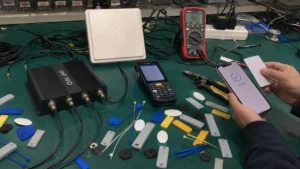
The range figures above are not abstract. The UHF reader line profiled here shows the spread a buyer can specify within passive RFID, all on the same EPC Gen2 / ISO 18000-6C air interface at 860–960 MHz:
| Product | Form | Published read range | Main driver |
|---|---|---|---|
| U1-CT-01 module | Embedded UHF | ~50 cm | Module-class, low gain |
| U1-CU-71 desktop | Desktop UHF | 0–50 cm | 1 dBi, 0–20 dBm |
| U6-CU-91 desktop | Desktop UHF | 0–100 cm | 3 dBi, 0–26 dBm |
| U6-IE-01 fixed | Fixed UHF | up to 4 m | 4 dBi circular |
| U6-IE-02 fixed | Fixed UHF | up to 8 m | 8 dBi circular |
| U8 fixed | Fixed UHF, 4 SMA | up to 10 m | 4 dBi, 6–32 dBm |
Two points fall straight out of the spec sheet. First, passive range is set by the reader and its antenna gain, not the tag alone: the same UHF tag reads at 50 cm on a desktop unit and at 8–10 m on a high-gain fixed reader. Second, the HF and dual-frequency readers in the same catalogue (13.56 MHz, 125 kHz) sit under 5 cm by design — a different job (cards, access, apparel), not a weaker UHF. Fongwah's UHF products carry CE (Red), FCC, TELEC and RoHS certifications, which is the practical side of the compliance question in the FAQ.
This note reflects Fongwah's passive RFID portfolio; active 433 MHz / 2.4 GHz sourcing is handled separately.
Where do UWB and BLE fit when accuracy, not range, is the requirement?
Read distance answers whether a tag can be heard at all. Accuracy is a different requirement.
When the requirement is accuracy rather than distance, the choice shifts from traditional active RFID to ultra-wideband for sub-metre precision, or to Bluetooth Low Energy for basic zone-level positioning at the lowest cost and the lowest power draw — with BLE Direction Finding able to reach much higher accuracy when the infrastructure supports it.
The umbrella term is RTLS, short for real-time location system: tags, fixed anchors or readers, and a positioning engine, giving a location at any moment rather than a record of where an asset was last seen. Traditional active RFID, UWB and BLE all sit under it.
Ultra-wideband takes its name from how it uses spectrum: instead of modulating a narrow carrier, it sends very short pulses across a very wide band and derives distance from signal timing. Under the FCC's rules, a UWB transmitter is one with a fractional bandwidth of at least 0.20 or a UWB bandwidth of at least 500 MHz (47 CFR Part 15, Subpart F). That supports sub-metre accuracy, at the highest cost of the three: the densest anchor layout, time synchronisation between anchors, and the shortest battery life.
Bluetooth Low Energy sits at the opposite end. BLE is a 2.4 GHz protocol built for small payloads and coin-cell broadcasting, making it the cheapest per tag, the least power-hungry and the longest-lived of the three. In its basic form it gives up precision: standard BLE beacons using received-signal-strength (RSSI) resolve position to a zone or a room rather than a point, which suits indoor wayfinding, room occupancy, and healthcare equipment. With Bluetooth Direction Finding (AoA/AoD) and locator infrastructure, BLE positioning can reach much higher accuracy, though at greater cost and complexity.
UWB vs. BLE vs. traditional active RFID
| Traditional active RFID (433 MHz / 2.4 GHz) | UWB | BLE | |
|---|---|---|---|
| Location accuracy | Zone or room level | Sub-metre | Zone–room (RSSI); higher with Direction Finding |
| Range per infrastructure point | Tens of metres | Shorter than traditional active | Shorter than traditional active |
| Battery life | Set by the broadcast interval | Shortest; precision costs power | Longest of the three |
| Infrastructure density | Lowest, a few readers cover a large site | Highest, anchors need time synchronisation | Moderate |
| Best-fit use | Locating assets across yards and large sites | Precision RTLS, forklift tracking, collision avoidance | Zone-level indoor positioning, offices and healthcare |
How should the asset's value and function drive the final call?
The same building often needs both tag types, assigned by what each asset is worth and how it is used.
Match the tag to the asset: high-value, mobile, or safety-critical equipment justifies active tags, while high-volume, low-value inventory is best served by passive tags.
Consider a hospital. Infusion pumps and ventilators are expensive, move between floors, and must be found in seconds during an emergency, so real-time location justifies an active tag. Patient wristbands exist only to confirm identity at a bedside reader a few centimetres away, where a disposable passive band is cheaper and safer.
Construction and heavy industry follow the same logic at larger scale. Tools, generators, and vehicles dispersed across a site are the assets described in the guide on monitoring tools and equipment on job sites in real time; there, losing one machine for a day can cost more than the entire active tagging program. Retail apparel and palletized goods sit at the other end, where unit cost makes passive the only sensible answer.
Most of these decisions reduce to one distinction: chokepoint reads versus continuous location. A chokepoint read happens at a door or a gate and records that an asset passed, giving a last-known location; continuous location comes from tags broadcasting on a set interval, so the reported position is refreshed at each beacon rather than only when a reader happens to energise the tag. The rule follows from the verb: if the system must locate an asset automatically at any moment without a worker scanning for it, active RTLS is usually the stronger fit; if periodic inventory, handheld search, or portal-based movement events are enough, passive UHF may solve the problem at much lower tag cost. Getting it backwards costs money either way: passive tags used where the need is locating will count accurately and still leave a team searching, while active tags used where counting is enough spend battery and service visits to answer a question a cheaper tag handles.

Conclusion
Passive and active RFID tags are not better or worse in the abstract. They answer different questions about power, range, lifespan, and cost, and the right choice follows from the asset, the site, and the budget in front of you. Start from the tag's power source, then layer in frequency and mounting constraints, and the decision stops feeling like a gamble.
When you have mapped your assets and still need a hardware partner to build the tags and readers around them, contact Fongwah.
FAQ
Q: What is the difference between active and passive RFID?
A: An active tag carries its own battery and transmits on its own schedule, reaching tens of metres; a passive tag has no battery and draws energy from the reader's field, which caps it near ten metres. Everything else follows: active tags cost tens of US dollars and need battery service, while passive tags cost cents and run maintenance-free.
Q: Can one RFID system use both passive and active tags at the same time?
A: Yes. Many sites run both, assigning active tags to high-value mobile assets and passive tags to high-volume inventory. The two types usually connect to separate readers and software layers, but one asset management platform can present both feeds together.
Q: How far can a passive asset tag be read outdoors?
A: In open air with a strong reader and a well-tuned antenna, passive UHF tags reach roughly ten metres, though real sites rarely hit the lab maximum. Tag orientation, nearby metal, liquid, antenna choice and reader power pull the practical range lower. Beyond that, active tags are the safer design.
Q: Do active RFID tags need special frequency approvals?
A: Active RFID tags are intentional transmitters, so the applicable radio rules depend on the frequency, protocol, transmit power and the country where the device is used. A 433 MHz active RFID tag, a 2.4 GHz BLE tag and a passive 902–928 MHz RAIN RFID system do not fall under exactly the same operating requirements. In the United States, short-range transmitters are generally covered by FCC rules (47 CFR Part 15); in Europe, ETSI short-range device standards apply, with 2.4 GHz devices governed by their own band rules. Because active tags operate at 433 MHz or 2.4 GHz rather than the passive UHF bands, the certification basis differs by hardware — the tag maker should supply compliance statements for every region you ship to. Passive UHF band specifics by country are summarised in RFID frequency regulations by country.
Q: Are active tags worth it for a small workshop?
A: Usually not, if the assets sit within a few metres of a reader and the counts are modest. Passive tags cover close-range tracking at a fraction of the cost. Active tags earn their price when assets leave the building, spread across a yard, or must be located rather than merely inventoried.
Q: Do passive RFID tags work on metal surfaces?
A: Not with a standard inlay. Metal reflects radio energy and detunes the antenna, so a general-purpose UHF tag mounted directly on steel can fall to a fraction of its free-air read range. On-metal tags are built for this, using a foam or air gap to separate the antenna from the metal and restore the field. Frequency mismatch causes a similar loss, covered in a 2026 metal surface test of 10 RFID tags.