

You invest heavily in RFID, but the system fails to deliver results. Returns drop, and frustration rises fast. You must identify hidden pitfalls before they drain your budget.
Avoiding costly RFID mistakes requires a comprehensive site survey to identify interference, selecting application-specific tags for distinct surfaces, and ensuring your middleware filters redundant data effectively. This proactive approach prevents read errors and system bottlenecks in complex warehouse environments.

I remember my early days as a production line operator. We installed a system without testing the environment first. It failed miserably. I do not want you to make that same mistake. Let us look deeper into the specific traps you must avoid.
Is Your Warehouse Environment Sabotaging Your Signal?
Metal racks and liquid containers kill RF signals instantly. Your readers blink, but no data comes through. You need to map your facility's electromagnetic footprint right now.
Warehouse environments sabotage signals through multipath effects and absorption. Metal reflects waves, causing null spots, while liquids absorb UHF energy. You must perform a spectrum analysis and adjust antenna angles to overcome these physical barriers.

The Hidden Dangers of Reflection and Absorption
My experience as an engineer taught me that invisible enemies are the worst. In a warehouse, your enemy is physics. When I worked on a project involving beverage storage, we failed to account for water absorption. The UHF waves simply vanished into the liquid. This happens because water absorbs radio frequency energy at 860-960 MHz.
You must look at your facility critically. Metal shelves act like mirrors for RF waves. This creates "multipath" interference. The waves bounce around and cancel each other out. We call these "null spots." If a tag passes through a null spot, the reader will not see it. It is not a hardware failure; it is a physics problem.
Below is a breakdown of how common materials affect your system:
| Material Type | Effect on RF Signal | Suggested Solution |
|---|---|---|
| Metal (Steel racks) | Reflects signals | Use directional antennas and angle them down. |
| Liquid (Water bottles) | Absorbs signals | Place tags away from the liquid content. |
| Cardboard (Dry) | Transparent (Good) | Standard setup works well. |
| Concrete Walls | Attenuates/Dampens | Increase reader power or add repeaters. |
I always tell my customers at Fongwah: do not guess. You need to run a site survey. You should use a handheld reader to map the signal strength in every aisle. This critical step saves you money on hardware replacement later.
Are You Using the Wrong Tags for Your Assets?
One tag does not fit all applications. Stick a standard label on a steel drum, and it goes silent. You risk losing inventory visibility completely.
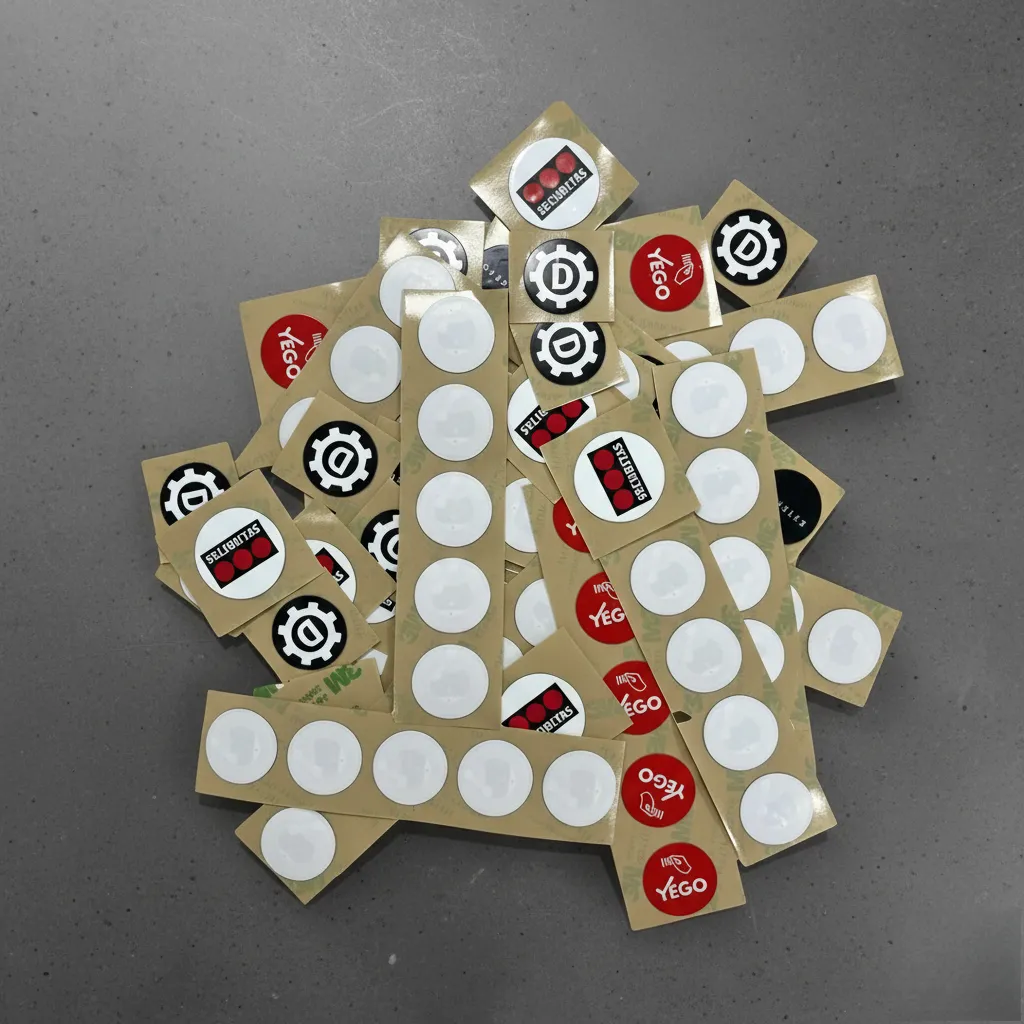
Using the wrong tags causes read failures. Standard dipoles fail on conductive surfaces due to detuning. You must use mount-on-metal tags with spacers or flag tags to maintain the impedance match required for reliable activation and energy backscatter.
Understanding Tag Detuning and Material Science
I often see clients buy the cheapest inlay they can find. This is a fatal error. During my time as a team supervisor, I saw a client stick a paper label directly onto a car engine part. The metal detuned the antenna immediately. The tag did not work.
You must understand that an RFID tag is a tuned circuit. It needs a specific frequency to wake up. When you place a standard tag on metal, the metal changes the electrical properties of the tag's antenna. The frequency shifts, and the reader can no longer "hear" the tag. This is why we develop specific anti-metal tags at Fongwah. These tags have a special layer that separates the antenna from the metal surface.
Here is how you should categorize your asset tagging strategy:
| Asset Surface | Problem | Recommended Tag Type |
|---|---|---|
| Plastic Pallets | Low interference | Standard Wet Inlay (Paper/PET) |
| Metal Containers | Detuning/Shorting | PCB Anti-Metal Tag or Foam-backed Label |
| Computers/IT | High Density/Metal | Small form-factor Ceramic Tag |
| Clothing | Crumpling/Washing | Laundry Tag (pps material) |
Do not trust the maximum read range on the datasheet. That range is measured in a perfect lab. In your warehouse, that range will drop. You must deliver energy to the chip efficiently. If you choose the wrong tag, even the most expensive reader cannot help you.
Is Your Data Integration Creating a Bottleneck?
Your readers work, but your server crashes. Too much raw data floods your ERP. You choke your network with redundant information.
Data integration bottlenecks occur when middleware fails to filter cross-reads and duplicate scans. You need edge processing to filter raw tag reads at the device level, sending only actionable, business-logic events to your central management system.

The Trap of Raw Data Overload
Hardware is only half the battle. The other half is software. A high-performance reader can read a tag 500 times per second. If you have 100 tags passing a gate, that is 50,000 reads in a moment. If you send all that data to your database, your system will freeze.
I learned this the hard way when I moved into management. We had a client whose server crashed every Monday morning. Why? Because every pallet movement generated millions of data points. They were not filtering anything. You simply do not need to know that Tag A is present 500 times. You only need to know when it arrived and when it left.
You need "Middleware" logic. This software sits between the reader and your database. It filters the noise. We must also talk about "Cross-reads." This happens when Dock Door A reads a pallet sitting at Dock Door B. This creates false data. Your inventory report will be wrong.
Use this logic table to plan your data flow:
| Data Event | Raw Action | Middleware Action | Final Output |
|---|---|---|---|
| Tag enters field | Reads 100 times/sec | Filter duplicates | "Tag Detected" (Time X) |
| Tag sits in field | Constant reading | Ignore/Filter | No Output |
| Tag leaves field | Signal stops | Detect absence | "Tag Departed" (Time Y) |
| Stray Tag next door | Weak/Intermittent read | RSSI Threshold Filter | Ignored (False Positive) |
You must treat data like a resource. Refine it before you store it. At Fongwah, we advise testing your software logic with small batches first. If you solve the logic problem, your scalability problems disappear.
Conclusion
Success in RFID relies on rigorous environmental tests, proper tagging for specific surfaces, and smart data filtering. Avoid these mistakes to ensure a high return on investment.Struggling with a specific warehouse signal issue? Don't waste your budget on guessing. Chat with Jay on WhatsApp for a free technical consultation.
---