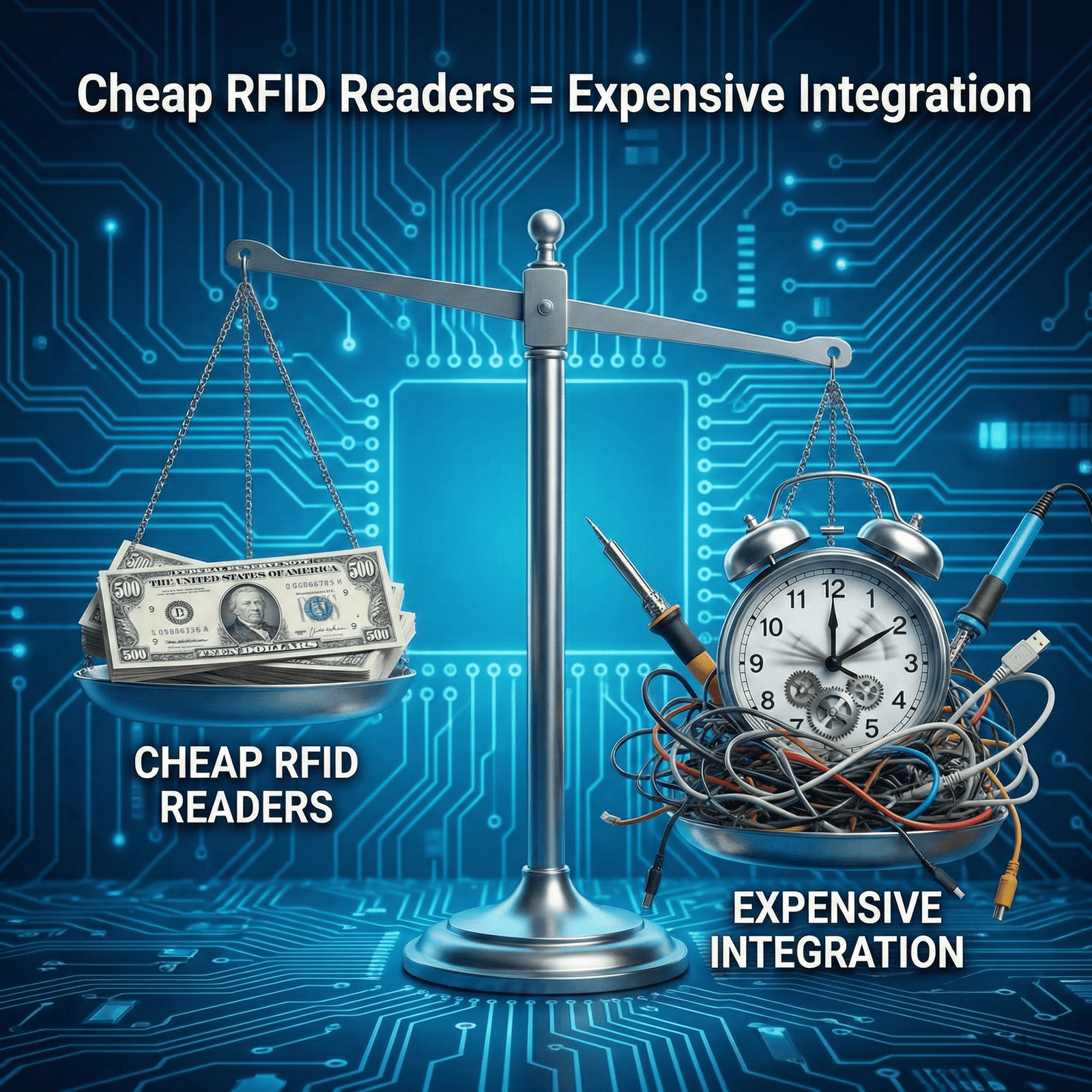
- A Manufacturer's Guide to Calculating TCO (Total Cost of Ownership) for System Integrators
- Why Free SDKs From Generic Suppliers Are the Most Expensive Software You Will Ever Buy
- Bridging the Gap: How Fongwah Delivers Industrial Stability Without the Big Brand Markup
Many project managers search for "lowest price RFID reader" and celebrate saving fifty dollars on hardware. But when the integration phase begins, that celebration turns into panic as the project deadline slips by weeks.
The "RFID cost of implementation" is never just the price on the invoice. It includes the developer hours required to make the device talk to your software, the cost of field failures, and the ongoing support needed to keep the system running. A cheap reader with a bad SDK is a liability, not an asset.
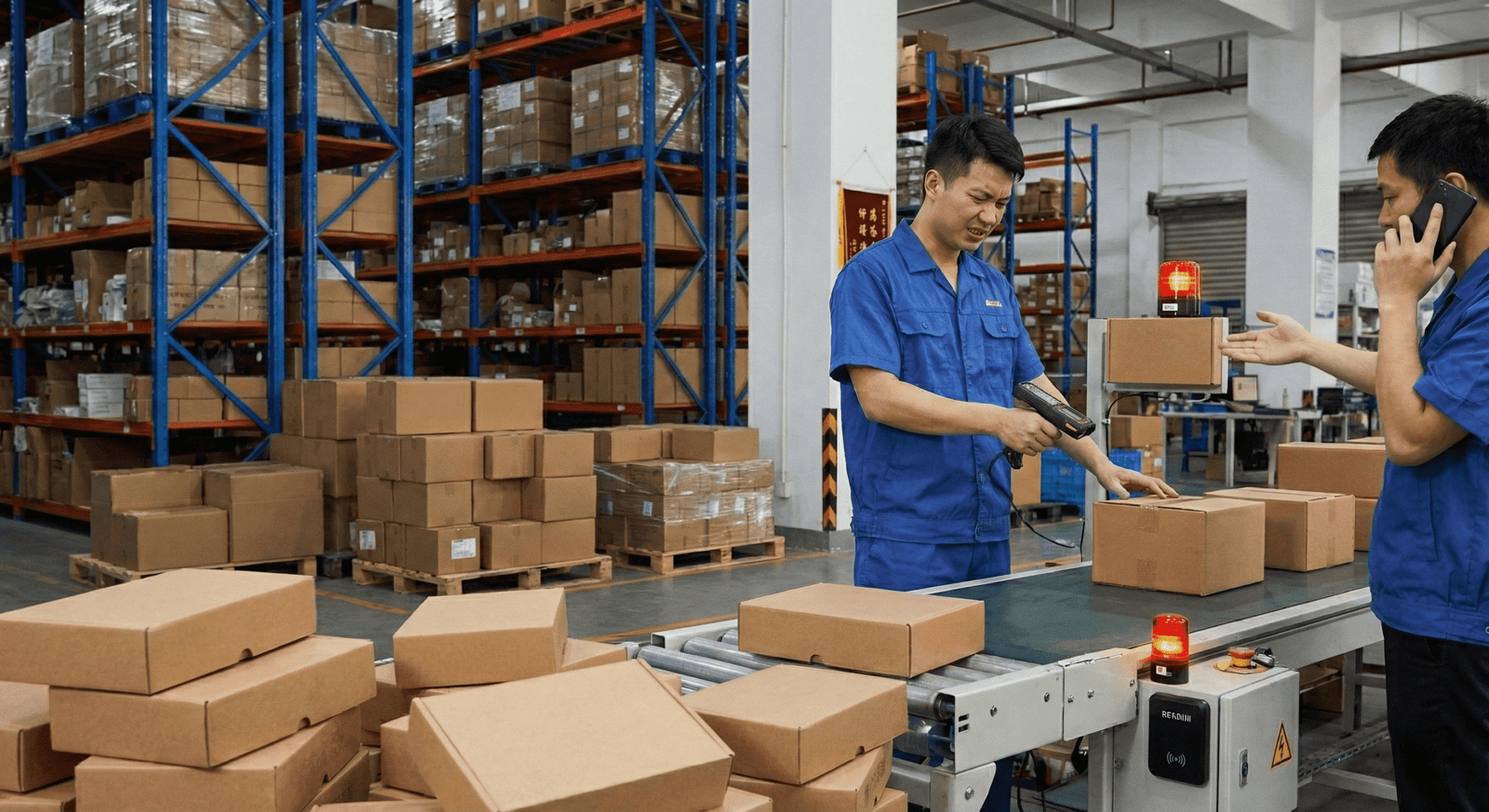
I have been in the RFID industry for five years now. I started on the factory floor, and now I talk to global partners on a daily basis.. I remember a specific client from Texas. He was building a parking control system. He bought 200 unbranded UHF readers because they were $40 cheaper than ours. Three months later, he called me. "Jay," he said, "My developers have spent 100 hours trying to fix a memory leak in their driver. The supplier won't email me back. Can you help?" He saved $8,000 on hardware but spent $15,000 on wasted engineering time. This is the trap of the "Unit Price." To understand the real value, you have to look at the Total Cost of Ownership (TCO).
Is your "cheap" RFID reader actually costing you $100 per hour in developer time?
Your software team is your most expensive resource. If they are reading poorly translated manuals instead of writing code, you are burning cash at an alarming rate.
A robust SDK (Software Development Kit) is the difference between a 2-day integration and a 2-month nightmare. Fongwah provides native support for C#, Java, and Python with clear examples, ensuring your "RFID cost of implementation" stays low by minimizing the hours your engineers spend debugging basic connectivity.
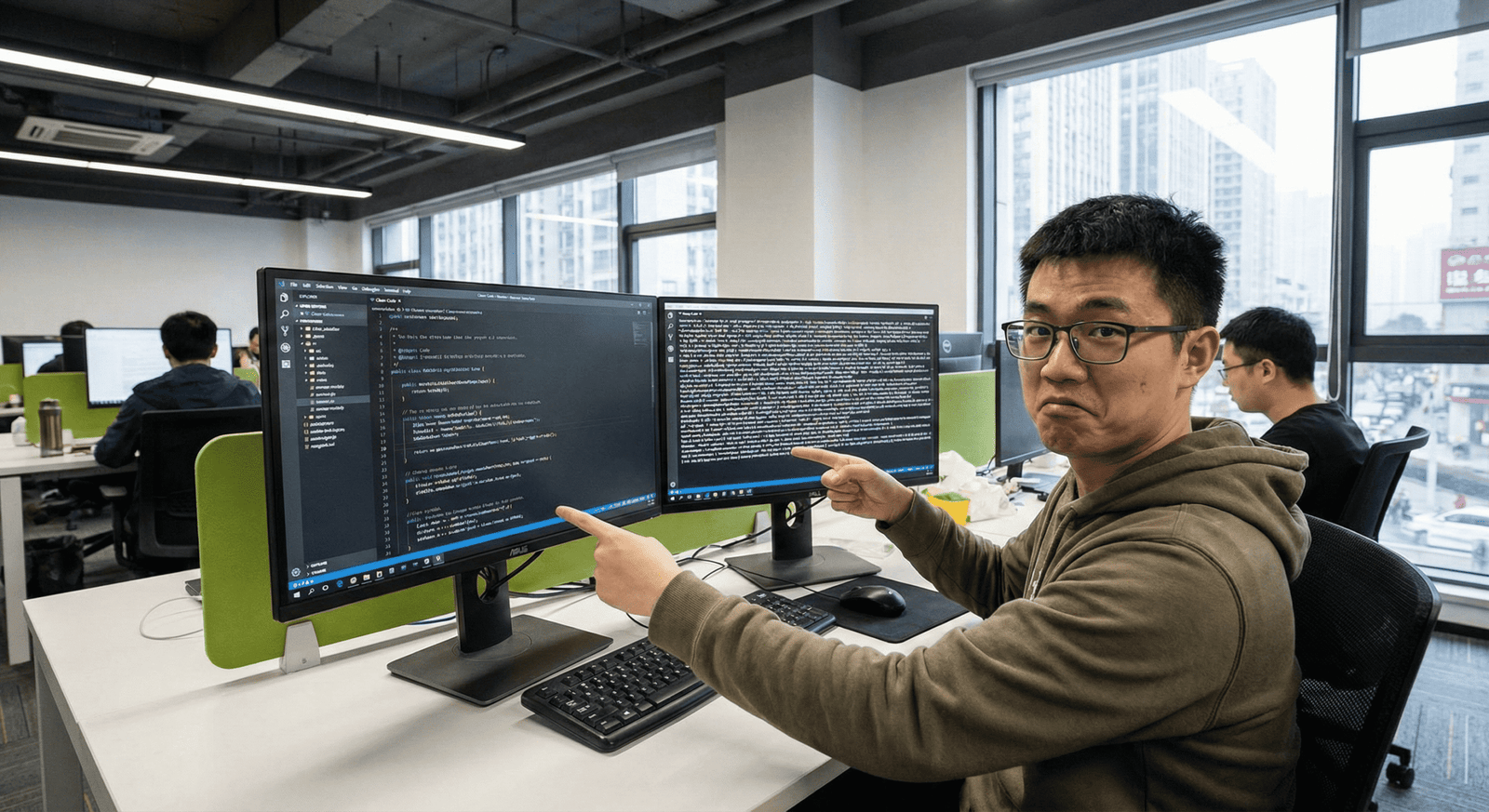
I work closely with William, our technical expert. He always tells me, "Hardware is just a rock without software." When you buy a generic reader from a trading company, you often get a CD-ROM with a folder called "SDK." Inside, you find a PDF in Chinese and a DLL file from 2018. There are no examples. There is no source code. If you are a System Integrator (SI) in the US, your engineer likely charges $100 to $150 per hour. Let’s do the math. If your engineer spends two weeks (80 hours) figuring out how to make the reader filter duplicate tags because the SDK doesn't have a built-in function, that is $8,000 to $12,000 gone. That destroys your profit margin on the installation. At Fongwah, we build our SDKs for speed. We provide a "Hello World" example. You plug in our reader, run the script, and it reads a tag in 30 seconds. We expose all the necessary parameters: Read Power, Frequency Hopping, and Session Settings. We support modern languages. If you are building a web app, we have a WebSocket solution. If you are building a desktop app, we have C# and Java libraries. We recently helped a library automation company switch to our HF readers. Their CTO told me, "Your documentation saved us three weeks of development time." That is the hidden value. You pay a little more for the box, but you save thousands on the labor.
What is the price of silence when your asset tracking system goes offline?
Reliability is boring until things break. A reader that overheats and stops scanning pallets effectively shuts down your entire warehouse operation.
In critical asset tracking environments, hardware stability is non-negotiable. Cheap readers often lack proper heat sinks and thermal management, leading to data gaps and operational downtime that cost businesses far more in lost productivity than the price of a premium industrial reader.
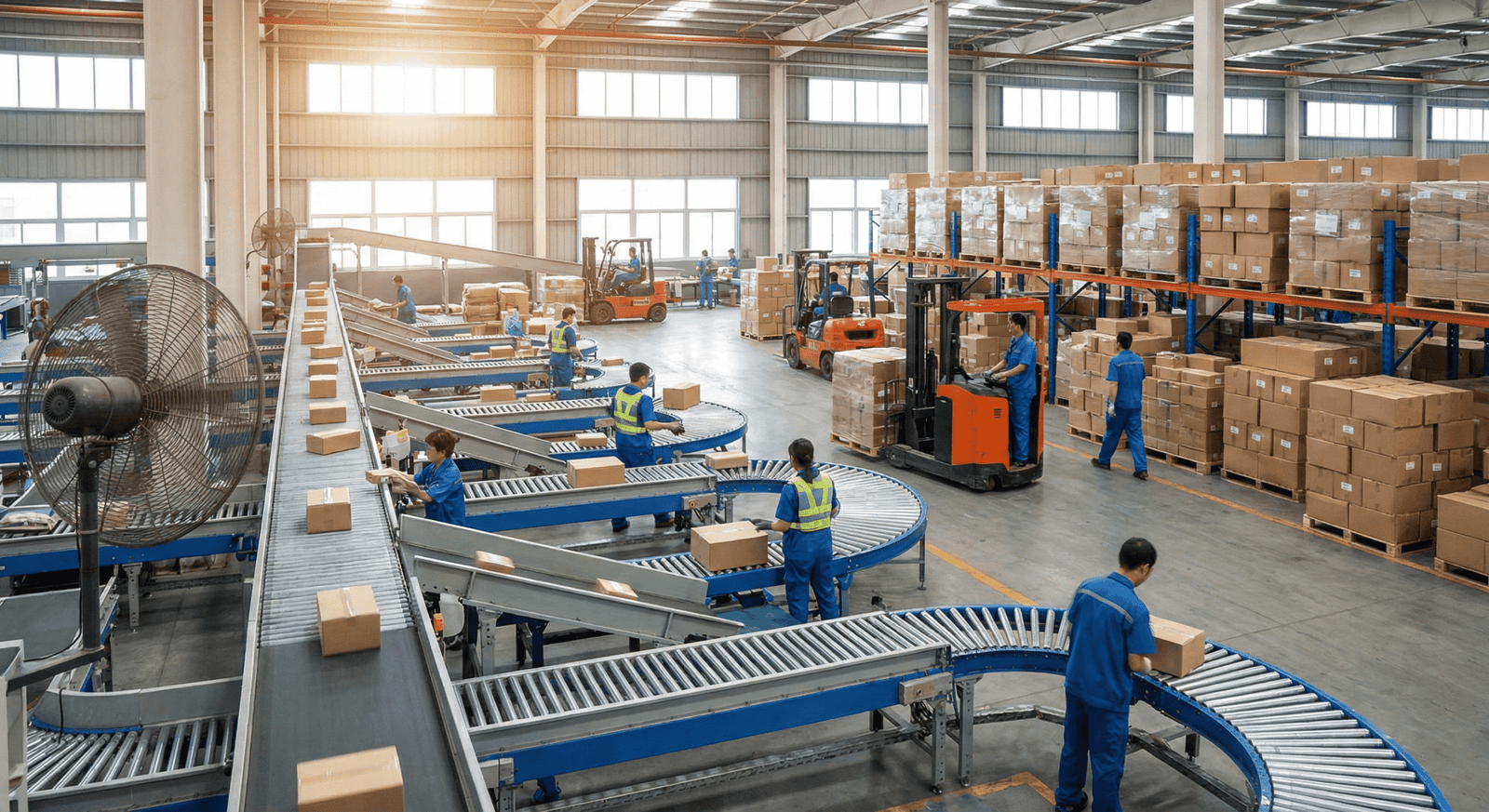
I want you to imagine a logistics center in July. It is hot. The conveyor belt is moving fast. A cheap UHF reader is mounted in a plastic box. It has been scanning for 6 hours straight. Suddenly, it stops. The internal chip reached 85°C and triggered a thermal shutdown. The conveyor keeps moving. Pallets go onto the truck without being scanned. Now your inventory system is wrong. You ship the wrong goods. The customer complains. You have to pay for return shipping. This is a "Field Failure." When we design a reader at Fongwah, William makes us torture it. We put it in a heat chamber. We run it at full power (30dBm) for 24 hours. We look at the "Read Rate Stability." Does it read 100 tags per second at Hour 1? Yes. Does it read 100 tags per second at Hour 24? If the answer is "No," we redesign the heat sink. We use aluminum alloy casings for our industrial fixed readers, not just for looks, but for heat dissipation. We use high-quality power amplifiers that are efficient and generate less waste heat. A generic reader might save you money on day one. But if it fails on day 100, you have to send a technician to the site to replace it. A "Truck Roll" (sending a technician) costs at least $200. If you have to replace 10% of your readers every year, your TCO explodes. We aim for "Install and Forget." That is how you build a reputation as a reliable integrator.
Can you get enterprise performance without paying the "Big Brand" tax?
You feel stuck between two bad options: risky, unsupported cheap hardware or overpriced equipment from the famous giants like Zebra or Impinj.
Fongwah occupies the "Sweet Spot" in the market, offering 95% of the performance of top-tier brands at 40% of the cost. By cutting out massive marketing budgets and focusing on engineering, we provide a high-ROI alternative for integrators who need professional specs without the brand premium.
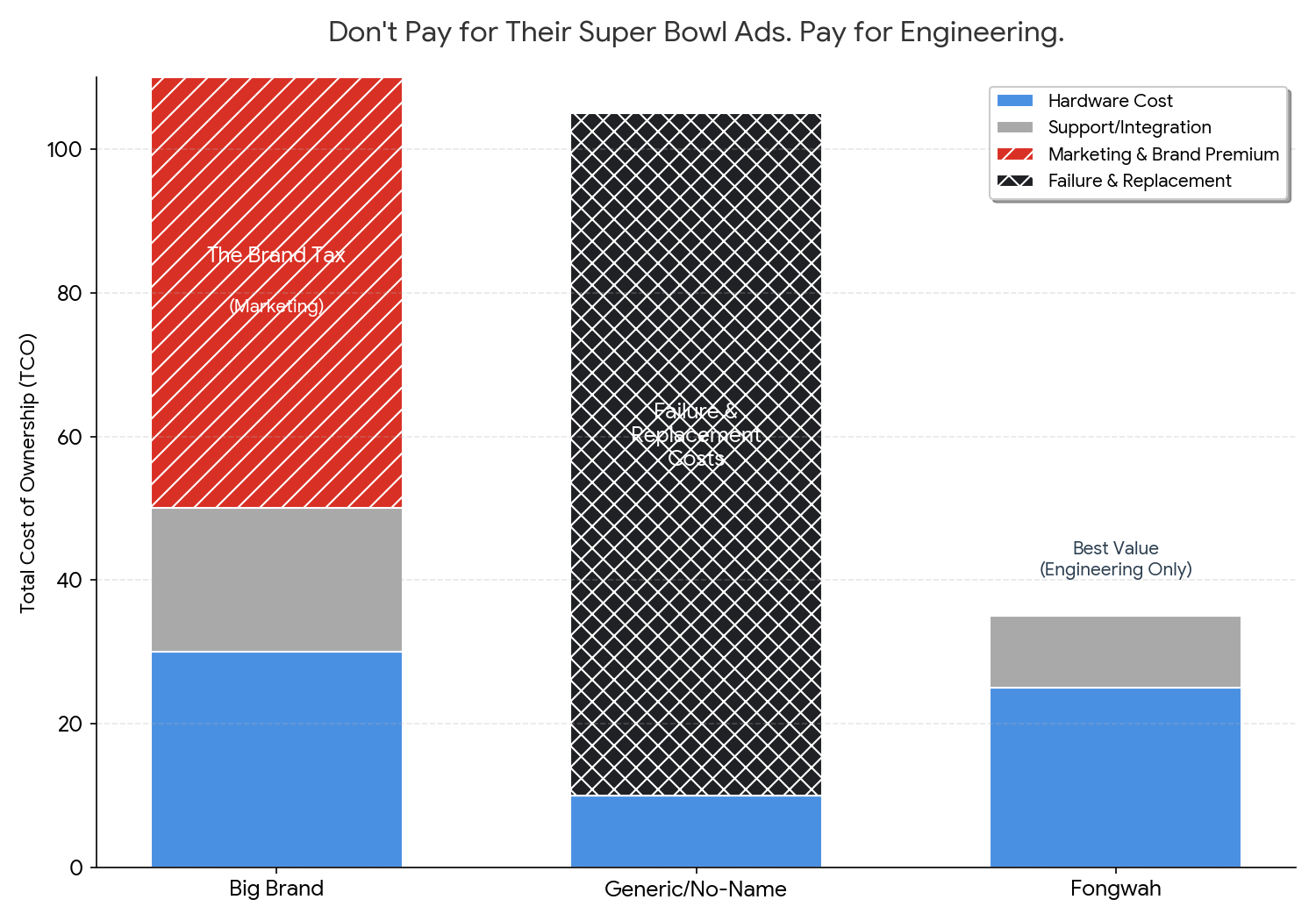
This is the conversation I have most often with Procurement Managers. They know the big names. They trust the big names. But the big names come with a big price tag. If you are deploying 5,000 reading points for a retail chain, a $200 difference per unit is $1 million. That is a budget breaker. On the other hand, they are terrified of the "No-Name" stuff from Alibaba. This is where Fongwah fits in. We are an OEM manufacturer. We actually make the hardware. We have been doing it for 20 years. We use the same high-end chips (like Impinj E710 or R2000) inside our readers. We just don't spend millions on Super Bowl ads or massive sales teams in every state. Here is a breakdown of what the 3-Year Total Cost looks like for a typical project (100 Units):
| Cost Category | Generic "No-Name" | Big Brand Name | Fongwah Standard |
|---|---|---|---|
| Hardware Cost | $5,000 ($50/unit) | $50,000 ($500/unit) | $15,000 ($150/unit) |
| Integration Labor | $10,000 (High friction) | $2,000 (Easy) | $2,000 (Easy) |
| Maintenance (3 Yrs) | $5,000 (High failure) | $500 (Low failure) | $500 (Low failure) |
| Total 3-Year Cost | $20,000 | $52,500 | $17,500 |
Look at the numbers.
The "Cheap" Trap: The generic option ends up costing you $2,500 more in the long run due to hidden labor and maintenance costs.
The "Big Brand" Tax: The big brand is safe, but you are paying a $35,000 premium just for the logo, eating all your profit.
The Fongwah Solution: We give you the industrial stability you need to sleep at night, at a price that helps you win the contract.
Frequently Asked Questions about RFID Implementation Costs
Q1: What is the real cost of RFID implementation for a warehouse?
Answer: The hardware (readers and tags) typically only accounts for 30% of the total budget. The real RFID cost of implementation lies in software integration and middleware. Choosing a reader with a mature SDK (like Fongwah's) can reduce developer hours by up to 40%, significantly lowering the overall project cost.
Q2: Why are some RFID readers $200 and others $2,000?
Answer: The difference often lies in the "Hidden BOM" (Bill of Materials). While the cost of RFID readers from generic sources looks low, they often lack thermal management and stable drivers. Industrial brands charge for reliability. Fongwah bridges this gap by offering industrial-grade stability at OEM prices, avoiding the "brand tax."
Answer: In RFID asset tracking, reliability is money. If a cheap reader overheats and misses scans, you lose inventory visibility. This "downtime cost" can exceed the hardware price in just one week. Our analysis shows that spending 15% more on quality hardware upfront can prevent 300% in maintenance costs later.
Conclusion
When calculating the RFID cost of implementation, look beyond the sticker price. By choosing Fongwah, you minimize expensive developer time and field failures, ensuring your project is profitable from installation through to long-term maintenance.
---