Choosing between a handheld and a fixed RFID reader is not really a question of which device is better.
The right choice depends on how inventory moves, where RFID events need to be captured, how often counting happens, and whether the process can rely on an operator being present.
A handheld reader brings the read point to the asset. A fixed reader waits at a defined location for the asset to pass through its RF field.
That difference explains most of the purchasing decision.
If your main task is periodic shelf counting, asset search, or exception handling, start with handheld RFID. If tagged goods repeatedly pass through predictable points such as dock doors, conveyors, or production stations and you need automatic event capture, fixed RFID is usually the stronger fit.
Many mature sites eventually use both.
For a deeper comparison of labor and operating cost, see the fixed versus handheld RFID labor analysis.
Quick Decision Tree: Handheld or Fixed RFID Reader?
Before comparing specifications, walk through the workflow.
Do tagged items repeatedly pass through one predictable physical point?
If yes, a fixed reader is a strong candidate.
If no, and the reader needs to move between shelves, rooms, racks, assets, or exception locations, handheld RFID is usually more practical.
Do you need the RFID event to happen automatically without an operator initiating every read?
If yes, move toward fixed RFID.
If an employee is already performing a periodic count, inspection, search, or audit, handheld RFID may be enough.
Is the main task inventory auditing or real-time movement tracking?
Shelf audits and search-and-find usually favor handhelds.
Dock-door, conveyor, gate, and production-line events usually favor fixed readers.
Will the installation remain in the same location long enough to justify antennas, cabling, mounting, tuning, and integration?
If yes, fixed infrastructure becomes easier to justify.
If the site is temporary, frequently rearranged, or still being tested, handheld equipment offers more flexibility.
This decision tree should narrow the choice before price and reader specifications enter the discussion.
Is Your RFID Counting Continuous or Periodic?
Counting cadence is one of the clearest differences between handheld and fixed RFID.
Periodic inventory work normally has a defined start and finish.
An operator takes the handheld reader into the warehouse, walks the required locations, completes the count or search task, and returns the device when the job is finished.
Continuous tracking works differently.
The system needs to detect tagged items every time they move through a defined point, regardless of whether somebody is standing there.
That is where fixed readers become valuable.
When Handheld RFID Fits Better
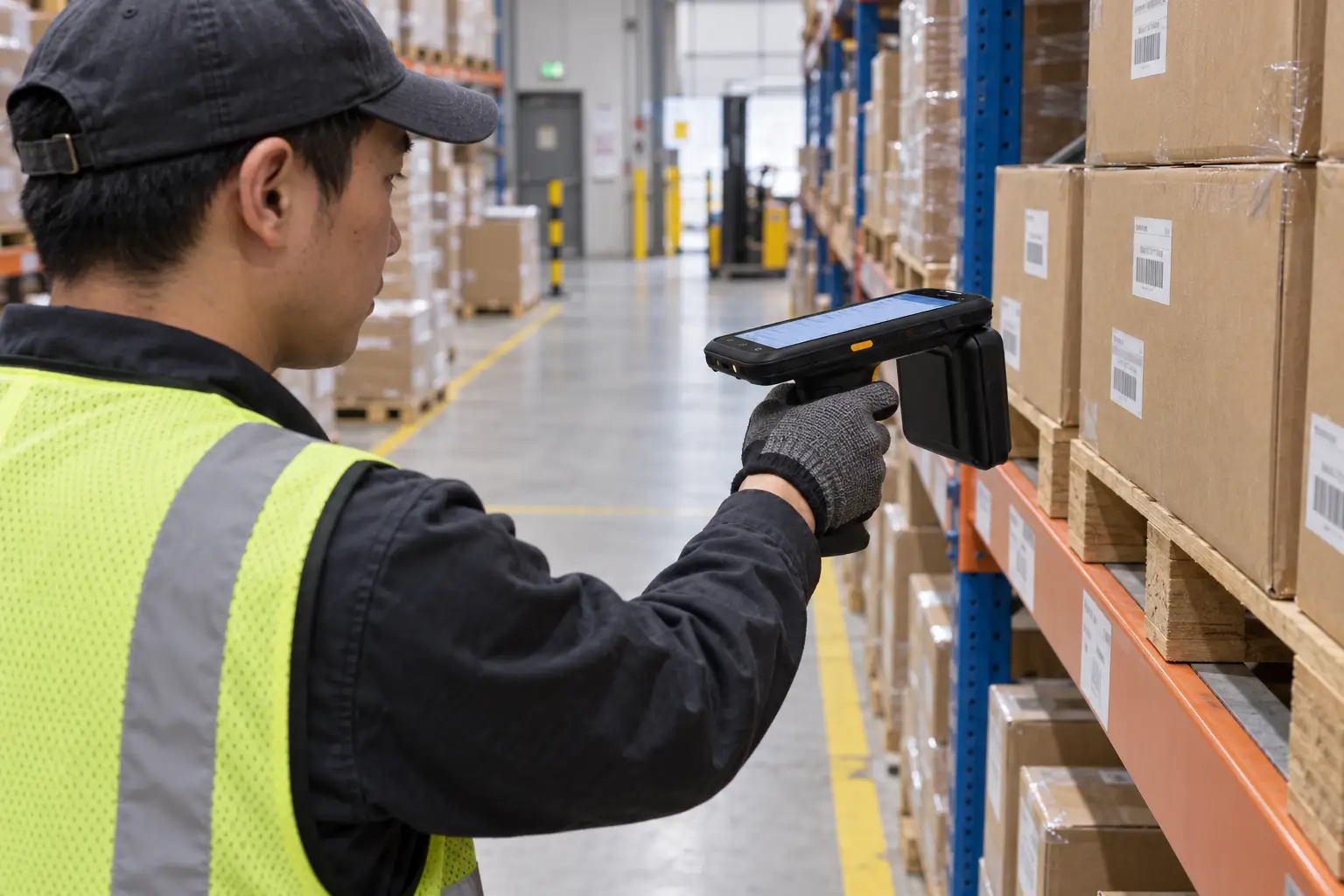
A handheld reader is particularly useful when the read location changes.
Typical examples include:
- weekly or monthly inventory counts
- shelf audits
- locating misplaced stock
- tool or asset searches
- exception handling
- checking items across several rooms or aisles
- temporary or changing warehouse layouts
The operator brings the reader close enough to the target area and moves through the inventory until the required tags have been collected.
Actual read distance depends on the handheld reader, tag type, antenna design, orientation, surrounding materials, and RF environment, so the workflow should be tested with the real tagged assets rather than designed around a single advertised range figure.
One advantage is that there is little permanent RF infrastructure to install.
That makes handhelds attractive when the main requirement is flexible inspection rather than automatic event capture.
If the two reader types are new to you, what RFID readers do explains the basic role of the reader in the system.
When Does a Fixed RFID Reader Make More Sense?
Fixed readers become attractive when the movement path is predictable.
Instead of sending the reader to the asset, the operation sends the asset through the reader's field.
Common fixed RFID locations include:
- receiving doors
- shipping doors
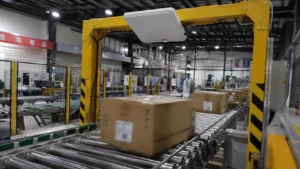
- conveyor stations
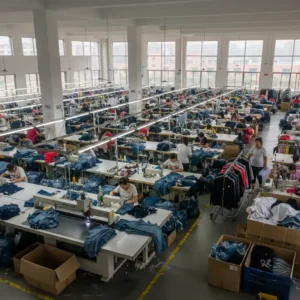
- manufacturing checkpoints
- access gates
- smart cabinets
- automated packing or sorting stations
At these points, the RFID event can happen automatically as tagged goods move through the process.
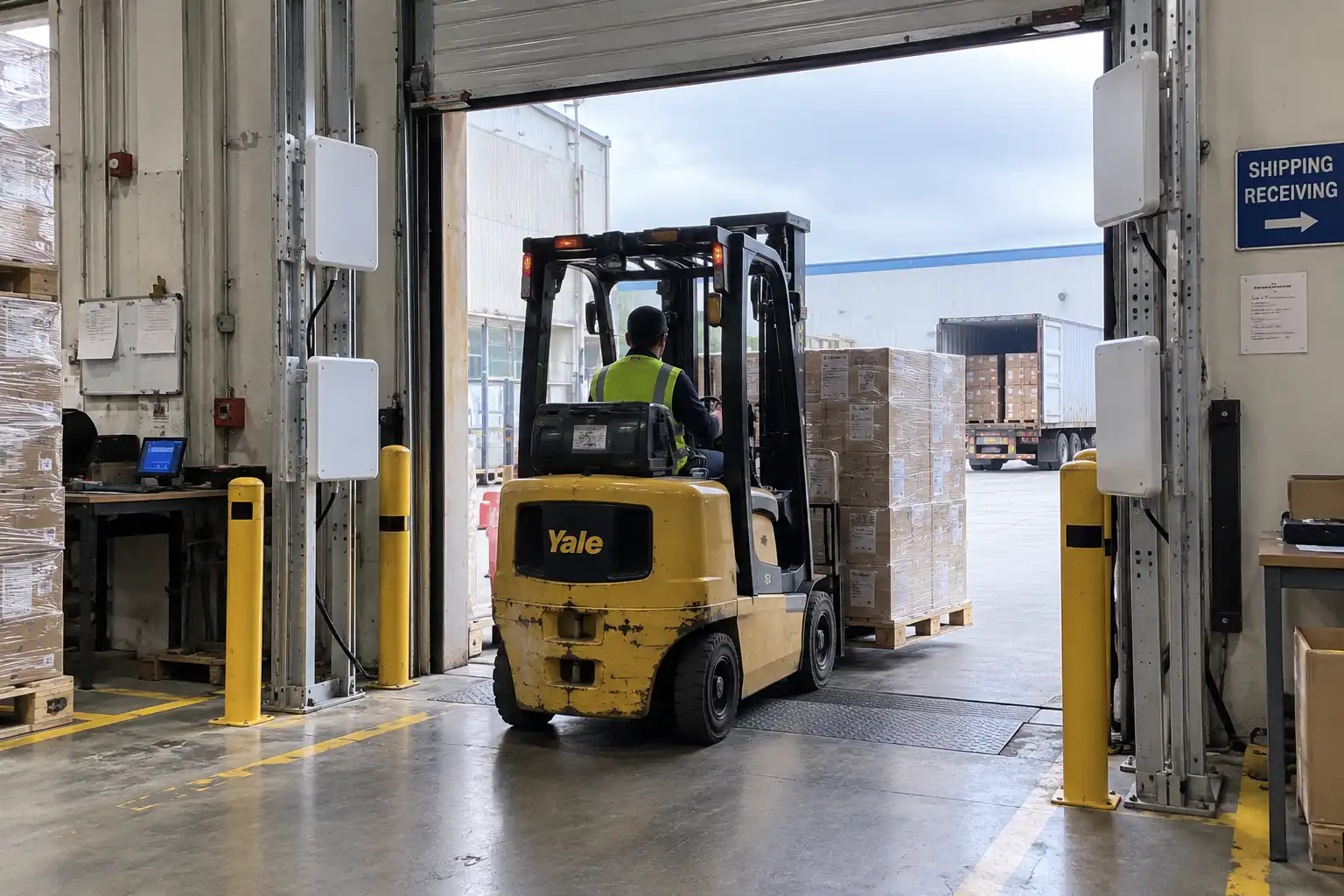
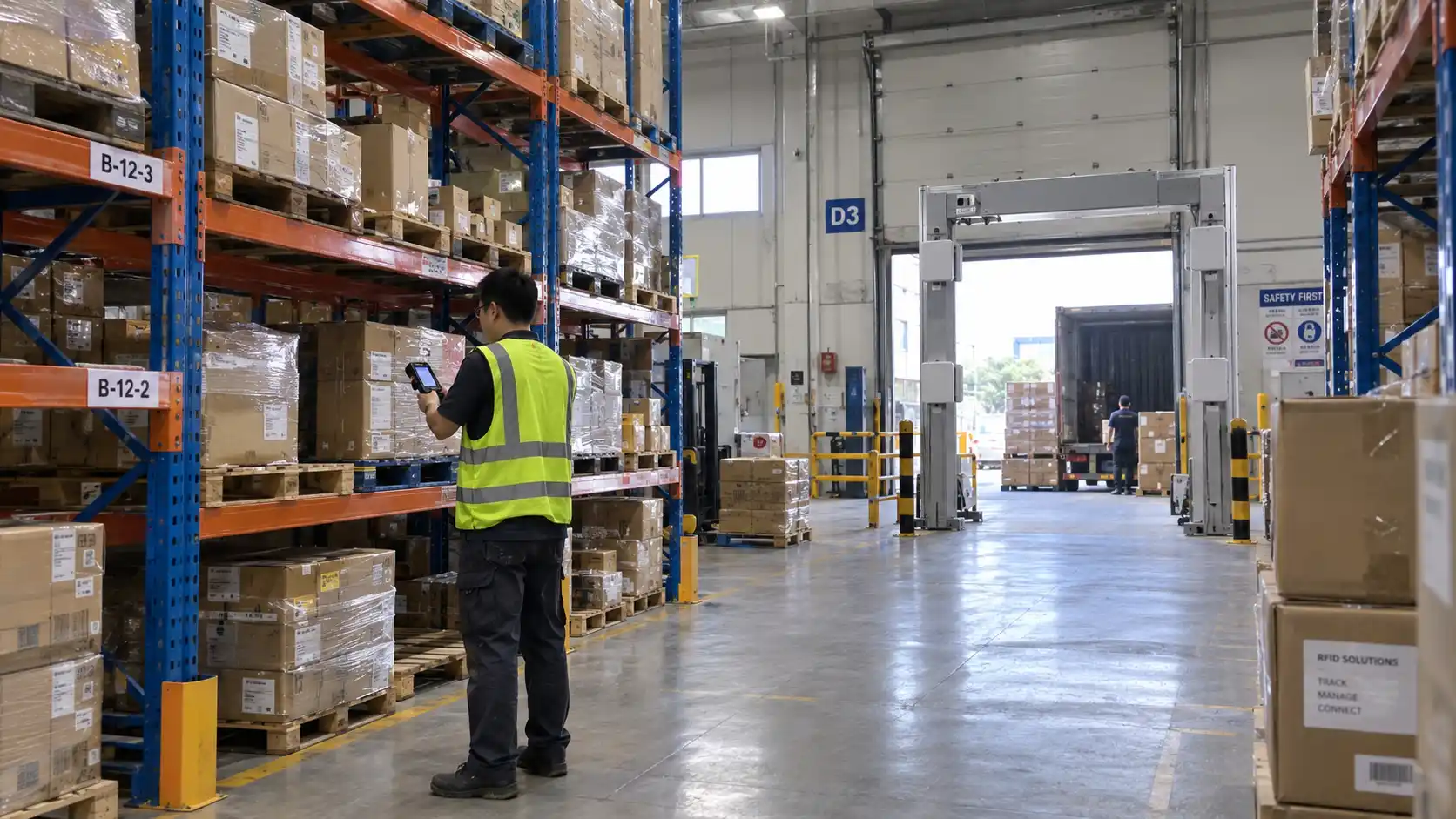
A dock-door installation, for example, may use several antennas positioned around the opening and connected to a fixed reader.
When a tagged pallet or group of cartons moves through the controlled zone, the reader collects the tag observations and passes the resulting event to the WMS, ERP, or middleware layer.
The forklift driver does not need to stop and manually trigger every individual item.
That is the real advantage of fixed RFID: the read becomes part of the movement itself.
Throughput Matters, but There Is No Universal SKU Threshold
It is tempting to say that a warehouse should switch to fixed RFID after a particular number of SKUs per day.
In practice, throughput alone is not enough.
Consider two sites that both process 300 tagged items per day.
One receives those items gradually over an eight-hour shift.
The other receives most of them through one dock door during a short morning peak.
Their RFID requirements can be completely different.
The more useful questions are:
- How concentrated are the movements?
- Does each movement require a manual scan today?
- Would missed scans create inventory errors?
- Does stopping to scan slow the process?
- Does every item pass through a repeatable location?
- How many labor hours could automatic capture remove?
Use the busiest realistic operating period rather than only the daily average.
If the same high-volume movement repeatedly passes through a controlled point, fixed RFID becomes easier to justify even before the total annual volume becomes very large.
The guide to using an RFID reader effectively covers how a fixed read zone should be tuned after installation.
Do You Audit Shelves or Track Movement?
Another simple distinction is whether the reader moves to the tags or the tags move to the reader.
Shelf inventory is usually irregular.
Products may sit at different heights, depths, orientations, and rack locations. A worker has to move through the space anyway.
That naturally favors handheld RFID.
Flow tracking is more structured.
A carton travels down the same conveyor. A pallet crosses the same receiving door. A tote enters the same production station.
Those repeatable paths allow a fixed antenna system to monitor the process continuously.
Handheld Example: Shelf Audit
An operator may begin at one end of a warehouse aisle and move systematically through the racks.
The handheld collects the EPCs it sees, the application compares them with the expected inventory, and exceptions can be reviewed before the worker moves to the next area.
The strength of the handheld is mobility.
The same device can be used on another aisle, in another room, or to locate a single missing asset.
Fixed Example: Flow Tracking
A carton moving through a conveyor read point does not need an employee to stop and scan it manually.
The reader is already installed at the location where the event matters.
The read can then be linked to a business event such as:
Received
Moved to production
Packed
Shipped
The limitation is equally important.
A fixed reader only sees the zones designed around it.
A tagged item sitting outside those zones may still require a handheld reader or another fixed read point.
Handheld vs Fixed RFID Reader Comparison
Instead of treating one daily-volume number as the deciding threshold, compare the operating pattern.
| Operating condition | Handheld RFID usually fits better | Fixed RFID usually fits better |
|---|---|---|
| Counting frequency | Periodic audits | Continuous or event-based tracking |
| Asset movement | Assets remain in many locations | Assets pass through predictable points |
| Operator involvement | Operator already performs the task | Read should happen without manual scanning |
| Primary application | Shelf count, search, inspection, exception | Dock, conveyor, gate, production checkpoint |
| Site layout | Frequently changing | Stable and repeatable |
| Installation | Minimal permanent infrastructure | Antennas, mounting, cabling, network and tuning acceptable |
| Coverage | Flexible and mobile | Continuous coverage of defined zones |
| Expansion | Add more handheld users/devices | Add additional fixed read points |
| Best role | Audit and exception tool | Automatic event-capture infrastructure |
This table is a starting point rather than a formula.
Labor cost, read accuracy requirements, integration cost, site layout, tag performance, and how long the installation will remain in service still need to be considered.
For the cost side of the decision, use the fixed versus handheld RFID reader comparison.
Does a Permanent Site Favor Fixed RFID?
Fixed RFID requires more infrastructure than a handheld deployment.
Depending on the application, that may include:
- antenna brackets
- RF coaxial cables
- Ethernet
- PoE or DC power
- conduit
- network drops
- protective enclosures
- sensors or GPIO wiring
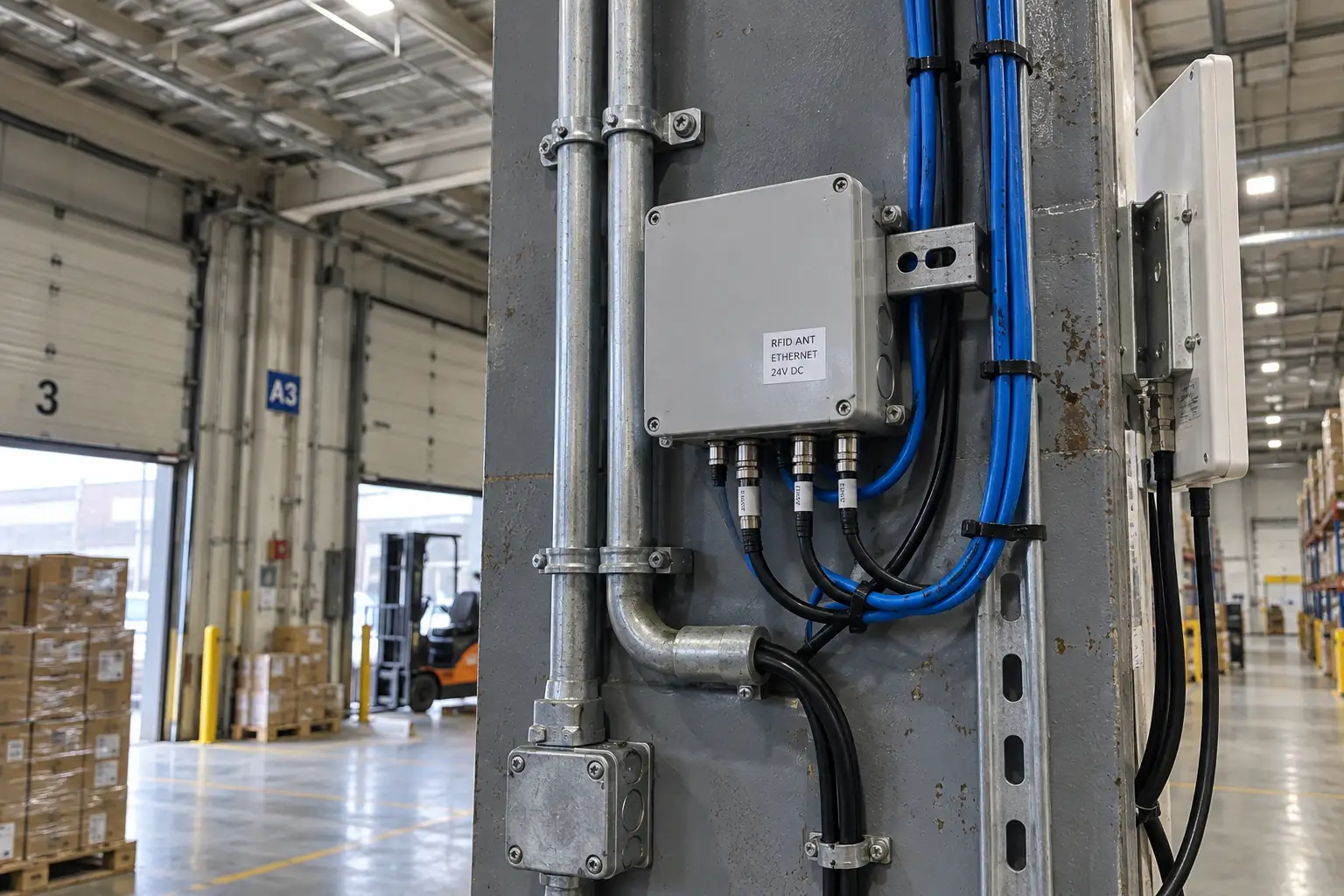
That investment makes more sense when the workflow and physical location are reasonably stable.
A permanent warehouse dock, conveyor, or production line is a good candidate because the same read point may operate for years.
A temporary facility, frequently rearranged warehouse, pilot project, or short-term inventory program may not justify the same installation effort.
That does not mean a rented site can never use fixed RFID.
It simply means installation cost, permission to modify the building, expected site lifetime, and the ability to reuse the equipment should be part of the decision.
Can You Use Handheld and Fixed RFID Together?
Yes, and many practical RFID systems eventually do.
The two form factors solve different problems.
Fixed readers are strong at automatic event capture.
Handheld readers are strong at mobility and exceptions.
A warehouse can therefore use fixed readers at receiving and shipping doors while keeping handheld readers for:
- cycle counts
- shelf audits
- locating missing items
- investigating inventory discrepancies
- reading areas outside the fixed infrastructure
The two systems can feed the same inventory platform.
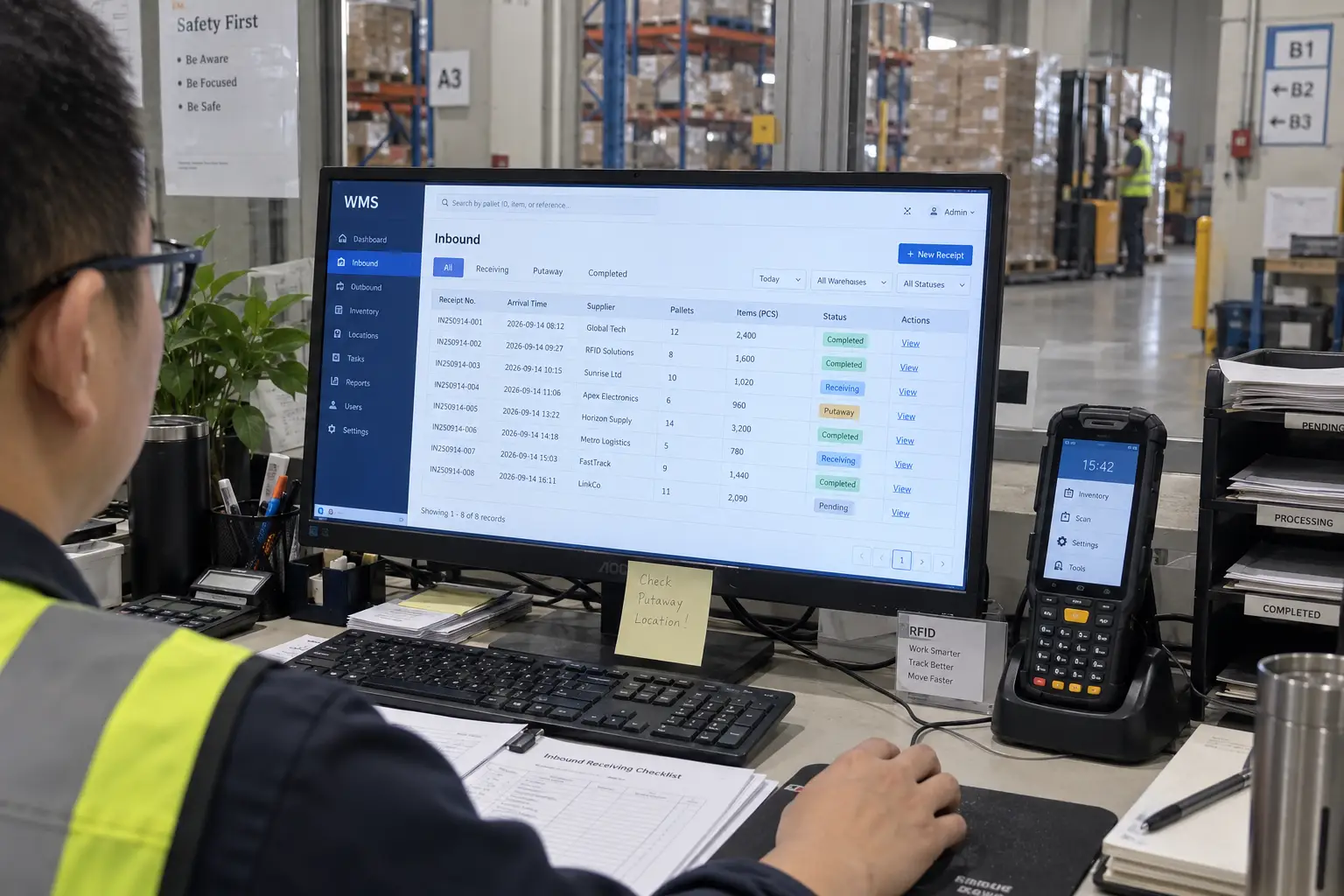
For example, a fixed portal may record that a pallet entered the warehouse.
Later, a handheld audit can confirm whether the tagged cartons are still in the expected storage area.
The fixed layer records movement events.
The handheld layer helps validate inventory between those events.
That makes hybrid RFID less a compromise and more a division of labor.
What If Your RFID Volume Changes Seasonally?
Seasonality matters, but it should not automatically force a fixed-reader purchase.
The important question is whether the peak period changes the workflow, not simply whether the monthly volume increases.
A handheld process may remain practical if a seasonal increase still allows operators to complete counts without delaying receiving, picking, or shipping.
But if peak season turns a previously manageable manual scan process into a bottleneck, automatic capture at a fixed read point may become attractive.
When evaluating the peak period, look at:
- maximum movement rate through the read point
- how long the peak lasts
- overtime or extra labor required
- delays caused by manual scanning
- frequency of missed movements
- value of real-time inventory visibility
A site can also grow into a hybrid approach.
It may begin with handhelds while workflows are still developing and later add fixed readers at the locations where movement volume becomes stable enough to automate.
The reverse is also common: a site with fixed portal coverage still keeps handheld readers for tasks that cannot be reduced to a permanent read zone.
FAQ
Which RFID Tasks Are Best Suited to Handheld Readers?
Handheld RFID readers are well suited to periodic inventory counts, shelf audits, asset search, exception handling, inspections, and environments where the read location changes.
They are particularly useful when an operator already needs to move through the area and permanent antenna infrastructure would add little benefit.
Which RFID Tasks Are Best Suited to Fixed Readers?
Fixed RFID readers are best suited to repeatable movement through controlled locations such as dock doors, conveyors, gates, cabinets, and production checkpoints.
They are valuable when the RFID event should happen automatically without requiring somebody to initiate every read manually.
Is There a Specific Daily SKU Volume Where I Should Switch to Fixed RFID?
There is no universal SKU-per-day threshold.
The decision depends on how concentrated the movements are, whether they pass through a predictable read point, how much manual scanning is required, the labor cost of that process, and the operational impact of missed reads.
Peak flow through the actual read point is usually more useful than an average daily number.
Can Handheld and Fixed RFID Readers Use the Same Tags?
Often they can when the readers and tags operate under compatible RFID standards and frequency requirements.
However, tag performance still depends on antenna design, mounting surface, orientation, environment, and the way each read zone is configured.
Test the actual tag in both workflows before standardizing the deployment.
Can a Warehouse Use Both Handheld and Fixed RFID Readers?
Yes.
A common architecture uses fixed readers for automatic movement capture at dock doors or production points and handheld readers for inventory audits, exceptions, and search-and-find tasks.
Both can ultimately feed the same inventory or warehouse-management system.
Should a Temporary or Rented Site Avoid Fixed RFID?
Not necessarily.
But the installation effort becomes more important.
Consider how long the site will remain in use, whether cabling and antenna mounting are permitted, whether the infrastructure can be moved later, and whether handheld readers could achieve the same operational result with less installation work.
Conclusion
The choice between handheld and fixed RFID starts with the workflow, not the reader specification sheet.
If the reader needs to move to the assets, handheld RFID is usually the natural starting point.
If the assets repeatedly move through a defined location and the read should happen automatically, fixed RFID becomes a stronger candidate.
Many operations eventually need both: fixed readers for continuous event capture and handheld readers for audits, search, and exceptions.
Rather than choosing from an arbitrary daily SKU threshold, map where inventory moves, identify which RFID events need to happen automatically, calculate the manual work those events currently require, and then choose the form factor that fits that process.
For a broader hardware-selection checklist, see the RFID reader buying guide.
If you want help matching handheld, fixed, or hybrid RFID to your warehouse or production workflow, contact Fongwah to review the read points, inventory movement, and deployment requirements.