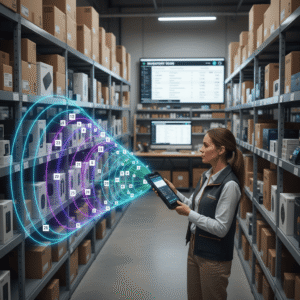

Choosing the wrong RFID technology can drain your budget and fail operational goals. Are you struggling to decide between the low cost of passive tags and the high performance of active systems?
Active RFID uses battery-powered tags to broadcast signals over long distances for real-time tracking (RTLS), ideal for high-value assets. Passive RFID relies on reader energy to reflect signals, offering a cost-effective solution for high-volume inventory management within short ranges.

Many project managers rush into purchasing hardware without fully understanding the infrastructure requirements. This often leads to systems that are either too expensive to maintain or too weak to perform. In this guide, I will break down the differences based on my years of experience at Fongwah.
What Are the Fundamental Differences in Range, Cost, and Data Rate?
Confusion about technical specifications often leads to costly project failures. You need to look past the jargon and understand how these differences impact your Total Cost of Ownership (TCO).
Passive RFID tags are cheaper and battery-free but have a shorter read range and lower data rate. Active RFID tags have a longer range and higher data rates but come with a higher unit cost and battery maintenance.

Breaking Down the Physics and Financials
When I started as a production line operator, I quickly learned that "cheap" tags aren't always the cheapest solution if you need hundreds of readers. To make the right choice, you must understand the trade-offs.
1. The Power Source Difference Passive tags have no internal power. They wait for a reader to send a signal, which wakes them up to reflect data back. This is why their range is limited. Active tags are different. They utilize an internal battery to "shout" their signal constantly.
2. Range Capabilities
- Passive: usually 1 to 10 meters (UHF). Great for chokepoints.
- Active: Up to 100 meters or more. Great for large yards.
3. Total Cost of Ownership (TCO) This is where many clients get it wrong. Passive tags cost cents, but the readers are expensive and you need many of them. Active tags cost $20 to $50+, but you need fewer readers to cover a large area.
Comparison of Fundamentals
| Feature | Passive RFID | Active RFID1 |
|---|---|---|
| Power Source | Reader Energy | Internal Battery |
| Max Range | Short (up to 15m) | Long (100m+) |
| Data Capacity | Low (ID number) | High (Sensor data) |
| Tag Cost | Low ($0.10 - $1.00) | High ($20.00+) |
Where Does Passive RFID Excel in Supply Chain and Inventory?
Losing track of thousands of small items creates massive inventory gaps and profit loss. Manual counting is too slow, error-prone, and outdated for modern manufacturing.
Passive RFID (UHF/HF) is the best choice for high-volume, low-cost assets like pallets and bins. It enables bulk scanning and supply chain visibility without the burden of battery maintenance.

High Volume and Low Maintenance
During my time as a team supervisor, handling thousands of components daily was a challenge. Passive RFID solves this by allowing "bulk reading." You can drive a forklift full of tagged pallets through a dock door, and the reader captures hundreds of tags in seconds.
Why Passive Wins for Inventory:
- Cost Efficiency: You cannot put a $30 active tag on a $5 cardboard box. A 15-cent passive tag makes financial sense.
- Longevity: Since there is no battery, the tag lasts virtually forever. You install it and forget it.
- Standardization: Technologies like UHF Gen2 are global standards. This helps with Supply Chain Visibility because a tag applied in China can be read in Canada.
However, remember the limitation. You must bring the reader to the tag, or the tag to the reader. It is not "real-time" unless the item is moving past a reader.
Passive RFID Ideal Scenarios
| Application | Benefit |
|---|---|
| Retail Apparel | Fast inventory counts. |
| Library Books | Automated check-in/out. |
| Manufacturing Parts | Tracking bins through assembly. |
When Is Active RFID Critical for Long-Range, Real-Time Tracking?
High-value assets often disappear in large industrial yards, causing operational paralysis. You cannot afford to lose expensive equipment or waste hours searching for vehicles.
Active RFID is essential for Real-Time Location Systems (RTLS) in large environments. It tracks assets like vehicles and personnel over long distances, providing constant visibility even in harsh conditions.

The Power of "Always-On" Tracking
Passive RFID waits to be asked; Active RFID speaks up on its own. If you manage a laydown yard for oil and gas pipes, or a holding lot for finished automobiles, you cannot scan every item with a handheld wand.
Real-Time Location Systems (RTLS) Active tags, often operating on 433 MHz or 2.4 GHz, send out a "beacon" signal every few seconds. Readers placed high up on light poles pick up these signals. This allows software to triangulate the exact position of an item.
Security and Safety In my experience working with heavier industries, safety is priority number one. Active RFID is used for personnel tracking. If a worker enters a dangerous zone, the system detects their active badge immediately and can shut down machinery.
Active RFID Ideal Scenarios
| Application | Benefit |
|---|---|
| Vehicle Yards | Locate specific cars instantly. |
| Oil & Gas | Track pipe and drill equipment in mud/snow. |
| Construction | Prevent theft of generators and large tools. |
How Do Battery Life and Sensor Integration Impact Your Hardware Decision?
Replacing dead batteries in thousands of deployed tags is a logistical nightmare. Ignoring environmental factors can destroy standard tags and ruin your data integrity.
Active tags require battery management but allow for temperature and humidity sensor integration. Passive tags are durable and simple, making them better for harsh environments where maintenance is impossible.

Durability and Intelligence
This section reflects a crucial decision point I often discuss with clients at Fongwah. We need to look at what's inside the plastic shell.
The Battery Trade-off Active tags have a lifespan. It might be 3 to 5 years, but eventually, they die. If you have 10,000 active tags, you are essentially replacing 10 batteries every day on average after a few years. Passive tags do not have this problem.
Sensor Integration However, active tags are smart. They can include sensors to monitor the condition of an asset.
- Cold Chain: Is the food frozen?
- Sensitive Electronics: Was the crate dropped? Active tags record this data and broadcast it. Passive tags with sensors exist, but they only tell you the status when you scan them, which might be too late.
Hardware Decision Matrix
| Feature | Passive Tag | Active Tag |
|---|---|---|
| Lifespan | 20+ Years (Indefinite) | 3-5 Years (Battery dependent) |
| Maintenance | None | Battery replacement required |
| Ruggedness | Very High (Simple circuit) | High (But battery is sensitive to heat) |
| Sensors | Limited availability | Excellent (Temp, Shock, Humidity) |
What Are the Integration and Scalability Requirements for Fixed Infrastructure?
A system that does not communicate with your ERP creates data silos and useless numbers. Scaling up should not require tearing down your entire software architecture.
Passive systems require more physical infrastructure and middleware to process data. Active systems require fewer readers but demand robust software to handle real-time data streams.

Connecting the Dots
From my perspective as a manager, the hardware is only 50% of the solution. The other 50% is how it talks to your system.
Middleware Functionality Passive readers generate a lot of "noise." If a pallet sits near a dock door, the reader might read it 100 times a second. Good middleware is needed to filter this so your ERP doesn't crash. Active systems send data less frequently (e.g., once every 5 seconds), but the data packets are more complex (location, battery level, temperature).
- Scaling Passive: Easy to add more tags (they are cheap). Hard to add more coverage (readers are expensive and need wiring).
- Scaling Active: Easy to add more coverage (readers read far). Expensive to add more items (tags are pricey).
A 5-Point Checklist for Project Managers
Before you sign a purchase order, go through this checklist to ensure Project ROI:
- Budget: Can you afford $30 per asset (Active) or only $0.20 (Passive)?
- Accuracy: Do you need to know exactly where it is now (Active), or just the last place it was seen (Passive)?
- Environment: is there metal or water? (Active usually handles interference better).
- Volume: Are you tracking 100 items or 100,000?
- Integration: Is your IT team ready to handle the data stream?
Conclusion
Select Passive RFID for cost-effective, high-volume inventory control. Choose Active RFID for real-time tracking of high-value assets where visibility and sensor data are critical for operations.
---Explore the advantages of Active RFID for real-time tracking and asset management. ↩