You spec a brilliant access system, but European customs seizes your hardware for ETSI violations, or metal interference destroys your Gen2 read rates. Ignoring global compliance doesn’t just cause data loss—it completely halts your multi-million-dollar international deployments.
When asking what information is stored on an RFID credit card, architects must prioritize underlying compliance. Deploying an ISO 14443 RFID reader for secure access or EPC Gen2 hardware for logistics demands strict adherence to global RFID standards and frequency regulations to guarantee secure encryption and cross-border operational legality.

Let's break down the actual regulatory physics separating your secure transit ticketing from your global warehouse logistics.
What Information is Actually Stored on an ISO 14443 Smart Card?
Integrators assume an RFID card just holds a serial number. Relying on public UIDs for corporate security leaves your entire physical infrastructure exposed to $10 cloning tools.
Compliant ISO 14443 RFID reader hardware interacts with partitioned memory sectors on the card. Rather than reading plaintext, these readers execute cryptographic handshakes to access encrypted applets, ensuring proprietary employee credentials or payment data remain completely isolated from unauthorized network interception.
Technical Performance Comparison
| Feature/Metric | Generic USB UID Reader | Fongwah S9-CU-00-00 Desktop Reader |
|---|---|---|
| ISO Compliance | Basic 14443A (UID only) | Full ISO 14443A/B & ISO 15693 |
| Data Access | Public Serial Number (Plaintext) | Secure Sector Read/Write |
| Software Authority | Keyboard Emulation (OS bound) | Native C#/Java SDK API Control= |

We need to talk about data architecture. When clients ask, "What information is stored on an RFID credit card?", they are fundamentally misunderstanding the technology. A compliant corporate smart card doesn't just store a flat text file with a name and ID number.
It utilizes partitioned memory blocks protected by SAM (Secure Access Module) keys. If you use a generic keyboard wedge reader, you are just grabbing the unencrypted public UID. It’s like using a public IP address as your server password.
Secure Sector Initialization
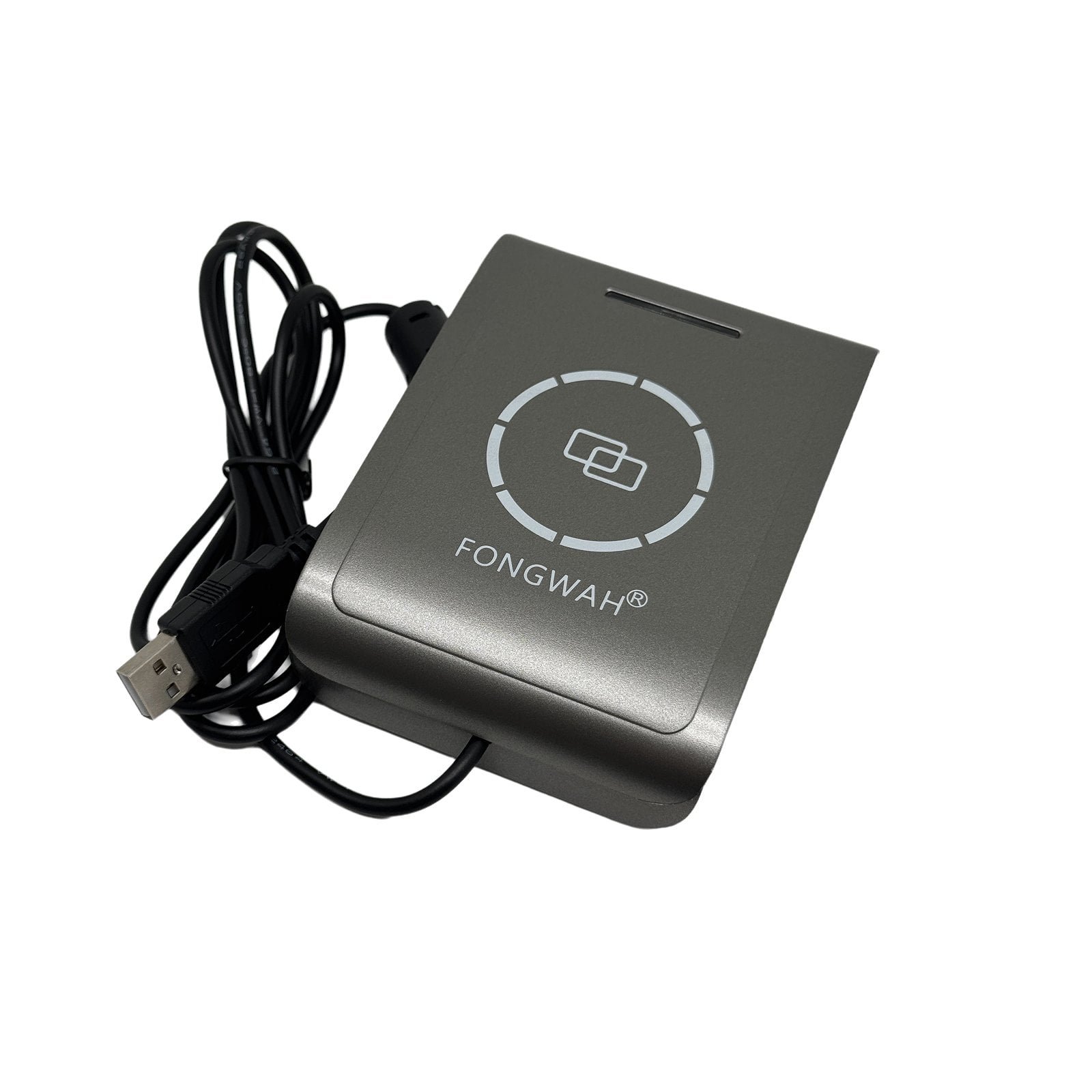
To actually build a compliant, secure identity issuance station, you need the Fongwah S9-CU-00-00. This isn’t a toy. It strictly handles 13.56MHz Contactless credentials, fully covering ISO 14443A/B and ISO 15693 protocols.
Because we provide the native Read/Write SDK via USB, your application can execute a secure cryptographic handshake. Your C# code authenticates the key, unlocks the specific sector, and writes your proprietary hashed payload directly into the silicon. You stop relying on vulnerable OS text fields and start engineering real, compliant data security for your corporate clients.
How Do Global RFID Frequency Regulations Impact EPC Gen2 Hardware?
You build a perfect UHF portal in the US, but when deployed in Germany, the readers fail completely. Ignorance of regional frequency hopping laws creates instant hardware dead zones.
Global RFID standards strictly partition the UHF spectrum. An EPC Gen2 compliance1 strategy must utilize hardware that accurately navigates FCC (902-928MHz) or ETSI (865-868MHz) channels. Deploying regionally certified, compliant RFID hardware ensures your backscatter signals don't violate local telecom laws or face severe network throttling.
Technical Performance Comparison
| Feature/Metric | Generic Gray-Market UHF Reader | Fongwah U6-NE-01 Embedded Module |
|---|---|---|
| Global Compliance | Uncertified (Risk of customs seizure) | CE, FCC, Red, TELEC Certified |
| LBT (Listen Before Talk) | Non-existent (Causes telecom interference) | Strict LBT Compliance |
| Sensitivity Threshold | -60dBm (Weak penetration) | -76dBm High Sensitivity |
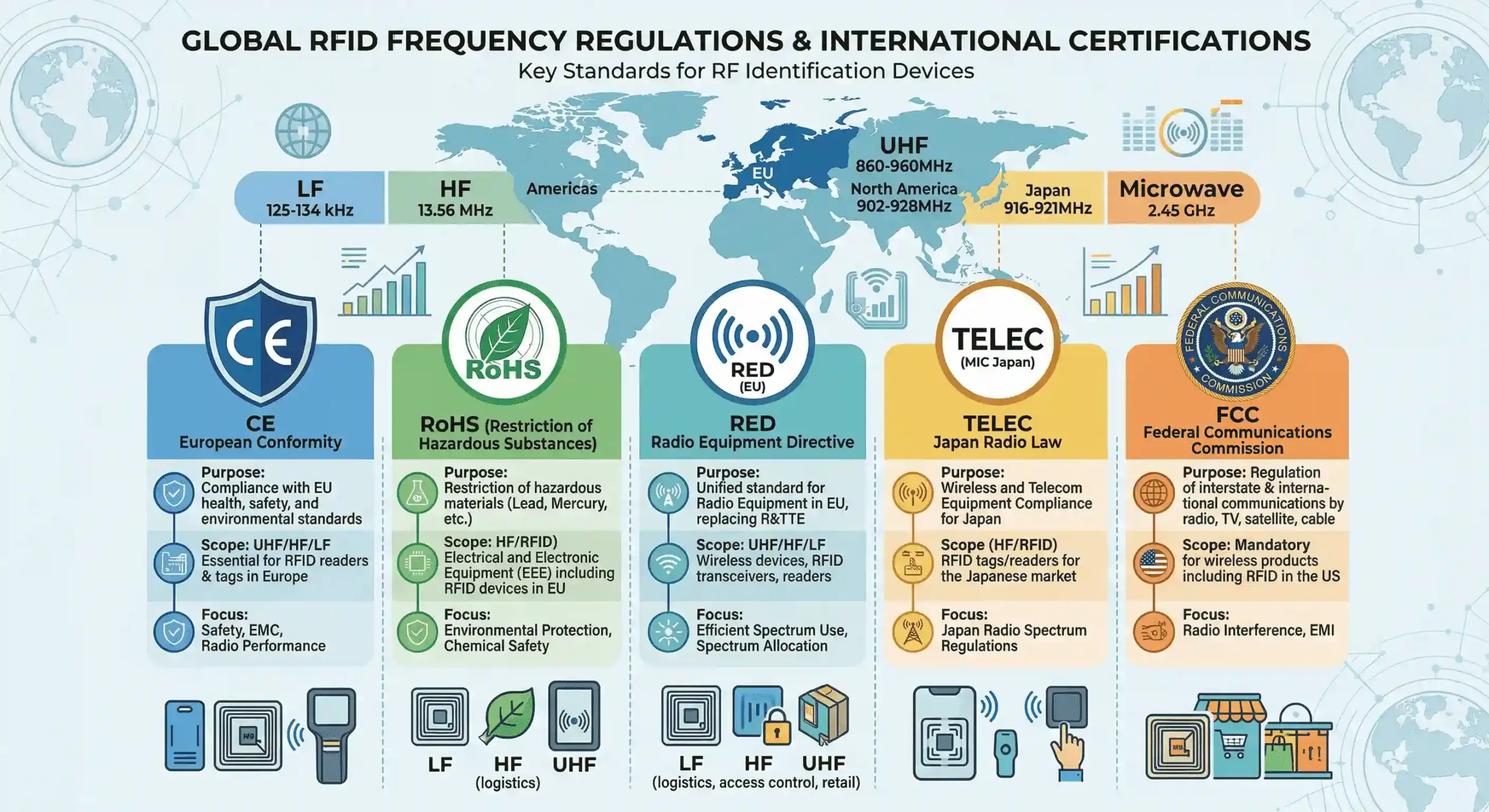
RF physics doesn't change, but the law does. If you are building a global supply chain solution, you can't just buy a bulk order of UHF readers and ship them to your European logistics hubs. The US FCC allows broader frequency hopping and higher power outputs compared to Europe's strict ETSI regulations.
If your reader blasts 915MHz in a European warehouse, it’s illegal, and the local telecom authority will shut your operation down. This is why EPC Gen2 compliance is a hardware-level issue, not just a software tag format.
Absolute LBT Compliance
You need a core engine that respects international boundaries. When you integrate the Fongwah U6-NE-01 Module, you are utilizing a system from a manufacturer that holds international compliance certificates including CE, RoHS, Red, TELEC, and FCC. It strictly adheres to LBT (Listen Before Talk) protocols required in dense regulatory environments.
With a highly sensitive -76dBm floor and native USB/Serial/RJ45 outputs , you capture an 8m read range reliably. Furthermore, our rich OEM and ODM customization experience ensures you get professional technical support for your specific regional deployment. You aren't just buying a module; you are buying a passport for your hardware deployment.
Can Your Hardware Actually Process 500 EPC Gen2 Tags Without Dropping Data?
Engineers assume any UHF reader can track a forklift pallet. But when 200 tagged items cross an industrial portal simultaneously, generic hardware crashes under the anti-collision load.
Meeting global RFID standards is useless if your hardware lacks processing throughput. True EPC Gen2 compliance in heavy industrial settings requires multi-port readers capable of advanced anti-collision algorithms, executing rapid Session and Q-value adjustments to parse hundreds of backscatter signals without dropping a single packet.
Technical Performance Comparison
| Feature/Metric | Standard Single-Port Reader | Fongwah U8 Fixed Reader |
|---|---|---|
| Read Throughput | ~50-100 reads/sec (High drop rate) | 500 reads/sec (Zero bottleneck) |
| Antenna Configuration | Single built-in patch | 4 SMA Ports (Multi-angle coverage) |
| Industrial Sensitivity | Average (-65dBm) | Extreme (-80dBm) |
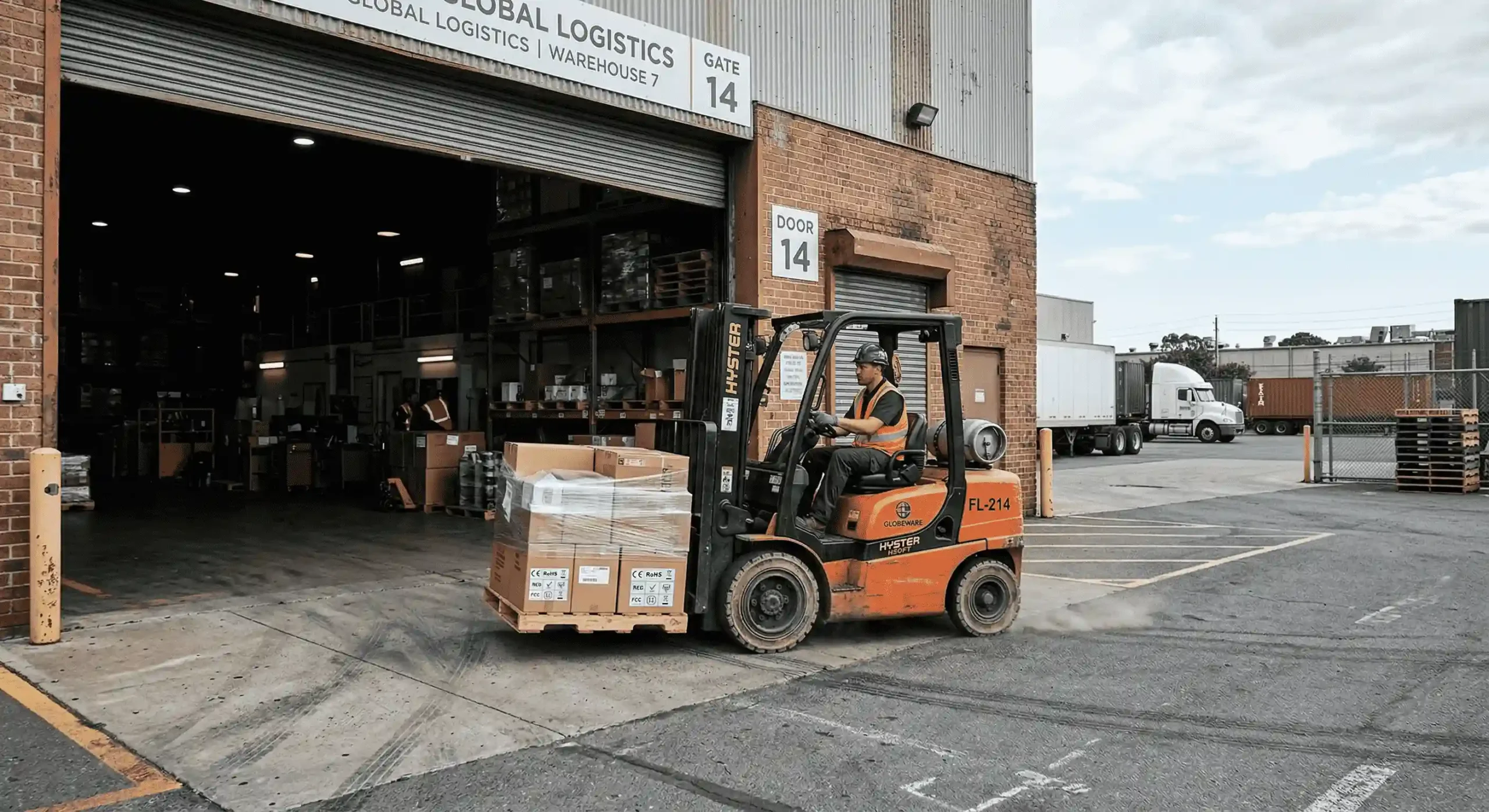
Compliance gets you in the door, but throughput keeps you from getting fired. When your client is moving liquid chemicals or dense metal parts through a dock door, the environment is brutal. The tags are detuned, the signals are reflecting off the forklift, and you have exactly 3 seconds to capture 500 EPC Gen2 data streams.
Generic hardware chokes here. It cannot switch antennas fast enough or process the Q-algorithm to isolate the tags.
Heavy Duty Multi-Port Processing
To solve high-density portal issues, you strip out the cheap gear and install the Fongwah U8 Fixed Reader. This unit handles a massive 500 reads/sec. It features 4 SMA ports and an extreme -80dBm sensitivity. It captures the weakest backscatter signals at up to 10m away with a 4dBi circular antenna.
Connected via RS232 or TCP/IP, it gives you the absolute data throughput required for global supply chains. Because you have our raw SDK, you can command the exact session flags required by EPC Gen2 standards to ensure every single pallet is verified. No missed reads, no phantom data.
Frequently Asked Questions
What is the difference between reading a public UID and secure sector data?
A public UID is an unencrypted serial number easily cloned by $10 devices. Secure sector data utilizes partitioned memory blocks protected by cryptographic keys. Compliant desktop readers, like the Fongwah S9-CU-00-00 , support ISO 14443A/B and ISO 15693 protocols and provide the necessary SDKs to read and write directly to these encrypted sectors, ensuring true corporate security.
Why do standard UHF RFID readers face customs seizure in Europe?
Global RFID standards dictate specific frequency bands and power outputs. Europe requires adherence to strict ETSI standards and LBT (Listen Before Talk) protocols. If your hardware blasts US FCC frequencies (902-928MHz) in Europe, it causes telecom interference. You must use globally certified hardware like the Fongwah U6-NE-01 module , which holds CE, FCC, Red, and TELEC certifications.
How can we reduce cabling costs when installing fixed RFID readers at warehouse dock doors?
Industrial deployments should minimize electrical runs. By utilizing fixed readers like the Fongwah U8 that support TCP/IP communication, integrators can leverage PoE (Power over Ethernet) architecture. This allows a single network cable to deliver both the data stream and power to the reader, significantly reducing installation time and costs.
Can generic RFID hardware handle high-speed forklift traffic?
No. Generic readers drop data when faced with high-density anti-collision scenarios. Industrial environments require heavy-duty processing. The Fongwah U8 fixed reader achieves a read speed of 500 times per second with an extreme receiving sensitivity of -80dBm, ensuring zero dropped packets even when 200 tagged items cross a portal simultaneously.
Conclusion & CTA (Call to Action): Stop bleeding engineering hours on cheap hardware. The true cost of an RFID reader is integration time. Prioritize robust SDKs and industrial stability to protect your actual project margins. Stuck on integration or sick of buggy DLLs? Ping me on WhatsApp. I'll send you a working C# sample code snippet right now.
---
EPC Gen2 compliance is essential for legal and efficient RFID operations, especially in logistics and supply chain management. ↩