
Stop fixating on the hardware sticker price. Project managers routinely cheer when they land a $100 RFID reader — then watch their lead engineer burn 60 hours on broken DLLs and overheating chips. In industrial automation, the "cheapest" hardware tends to become the costliest decision the moment integration begins.
RFID reader cost is best understood through Total Cost of Ownership (TCO): hardware acquisition, integration labor (driven by SDK quality), and operational downtime. Generic readers cut upfront CAPEX but quietly inflate OPEX through poor thermal management and missing LBT compliance. A mid-tier industrial reader such as the Fongwah U8, with verified C# SDKs, gives system integrators the strongest ROI.
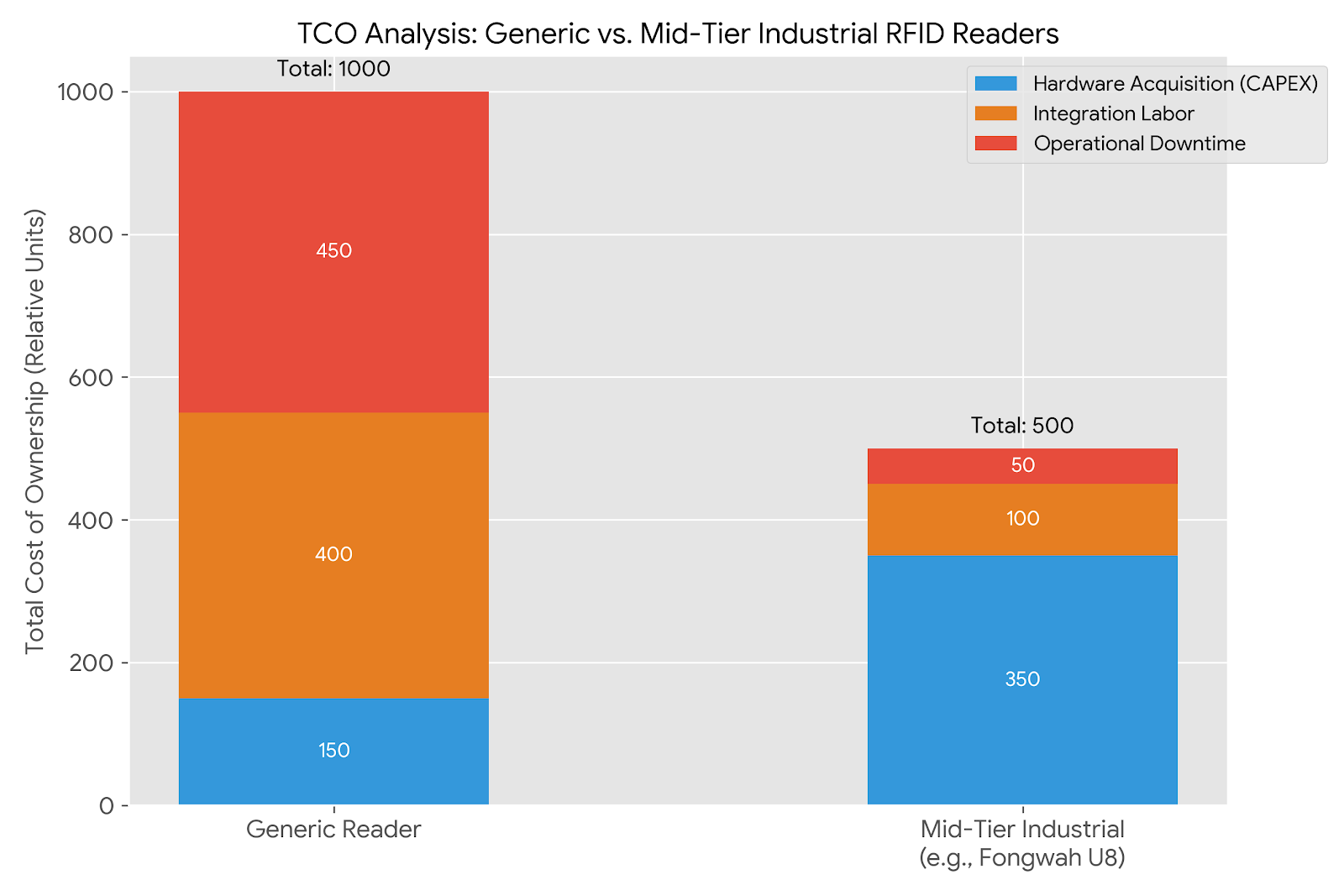
So let's set the marketing aside and look at the actual integration math — and why a short-sighted budget call quietly drains a project.
Does Your "Cheap" Reader Burn $150/Hour in Engineering Time?
Nothing derails a project timeline like an SDK that ships as a Google-translated PDF and a virus-flagged .exe. Your engineers are hired to build systems, not to reverse-engineer undocumented hardware protocols.
A robust SDK — native DLLs and copy-paste-ready C#/Java samples — is what actually compresses integration from weeks to days and protects your margin.
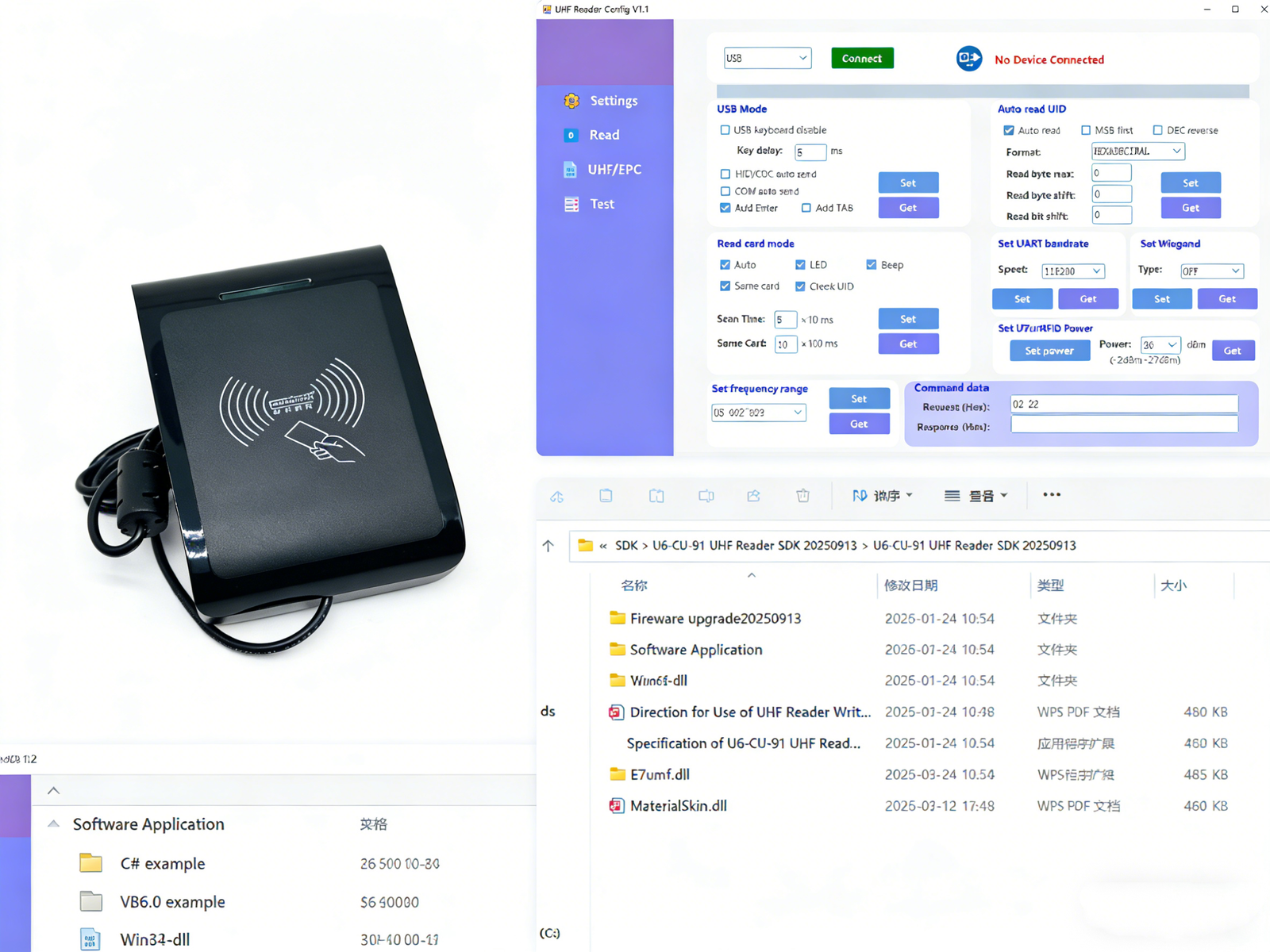
Most integrators hit the same wall. You unbox a generic reader, plug it in, and find it only does "Keyboard Emulation" — it dumps the EPC into Excel like a barcode scanner. Fine at a library front desk, useless for a manufacturing execution system (MES).
You need to write data, lock specific memory banks, and filter tags by mask.
At Fongwah, the handshake is the product. Ship a desktop issuer like the U6-CU-91 or the dual-frequency S9-BU-13-00, and you're not buying a plastic box. You're buying a Fongwah.dll that compiles and runs on the first try.
The "Hello World" Test
Fongwah's integration team uses a simple benchmark for hardware evaluation: how fast can a developer get a "beep" out of the reader in C#? If a senior engineer needs more than 20 minutes just to get the reader to acknowledge a command, the project is already in the red.
Run the "cheap vs. professional" numbers:
- The Scenario: You save $50 per unit on a generic reader with no proper SDK.
- The Reality: Your engineer (about $100/hr internal cost) spends three full days — 24 hours — sniffing COM-port traffic and debugging hex strings because the documentation is wrong.
- The Loss: Roughly $2,400 in labor to save $50 in hardware.
This isn't hypothetical. One Fongwah customer — a system integrator building a parking control system — bought 200 unbranded UHF readers, about $40 cheaper per unit than comparable Fongwah hardware. Three months later they were back, with their developers having sunk roughly 100 hours into a driver memory leak the original supplier wouldn't answer emails about. Hardware savings: about $8,000. Wasted engineering time: about $15,000. That's the trap of the unit price — a line item that looks green on the spreadsheet and red on the timesheet.
Fongwah's Approach: Fongwah provides the secondary development kit (SDK) for the entire U1, U6, and U8 series, supporting C++, C#, and Java. You don't just get a driver — you get the demo software's source code. Copy the initialization string, paste it into your Visual Studio project, and you're reading tags.
A recent library automation deployment switched to Fongwah HF readers; their CTO later noted the documentation "saved us three weeks of development time." That's the hidden value — a slightly higher box price, paid back many times over in saved labor.
| Integration Factor | Generic "Alibaba" Reader | Fongwah Technology | Big Brand (Impinj/Zebra) |
|---|---|---|---|
| Interface Mode | Keyboard Emulation (Mostly) | HID + TCP/IP + RS232 (SDK Included) | Cloud API + LLRP |
| Documentation | Poor / Missing | English Protocols + Code Samples | Extensive (Can be complex) |
| Setup Time | 2-3 Weeks (Debugging) | 2-3 Days | 1-2 Days |
| Integration Cost | High ($2,000+ Labor) | Low (Standard Dev Time) | Low (But High Unit Price) |
Will Thermal Throttling Kill Your Asset Tracking Reliability?
RFID readers run hot. Put a plastic-encased unit in an unconditioned warehouse and you'll eventually see "phantom data loss" as the RF module throttles output to avoid melting. For a closer look at field failure modes, see why readers and tags fail in harsh environments.
For the module-level design that prevents this, see our guide to RFID reader module thermal design.
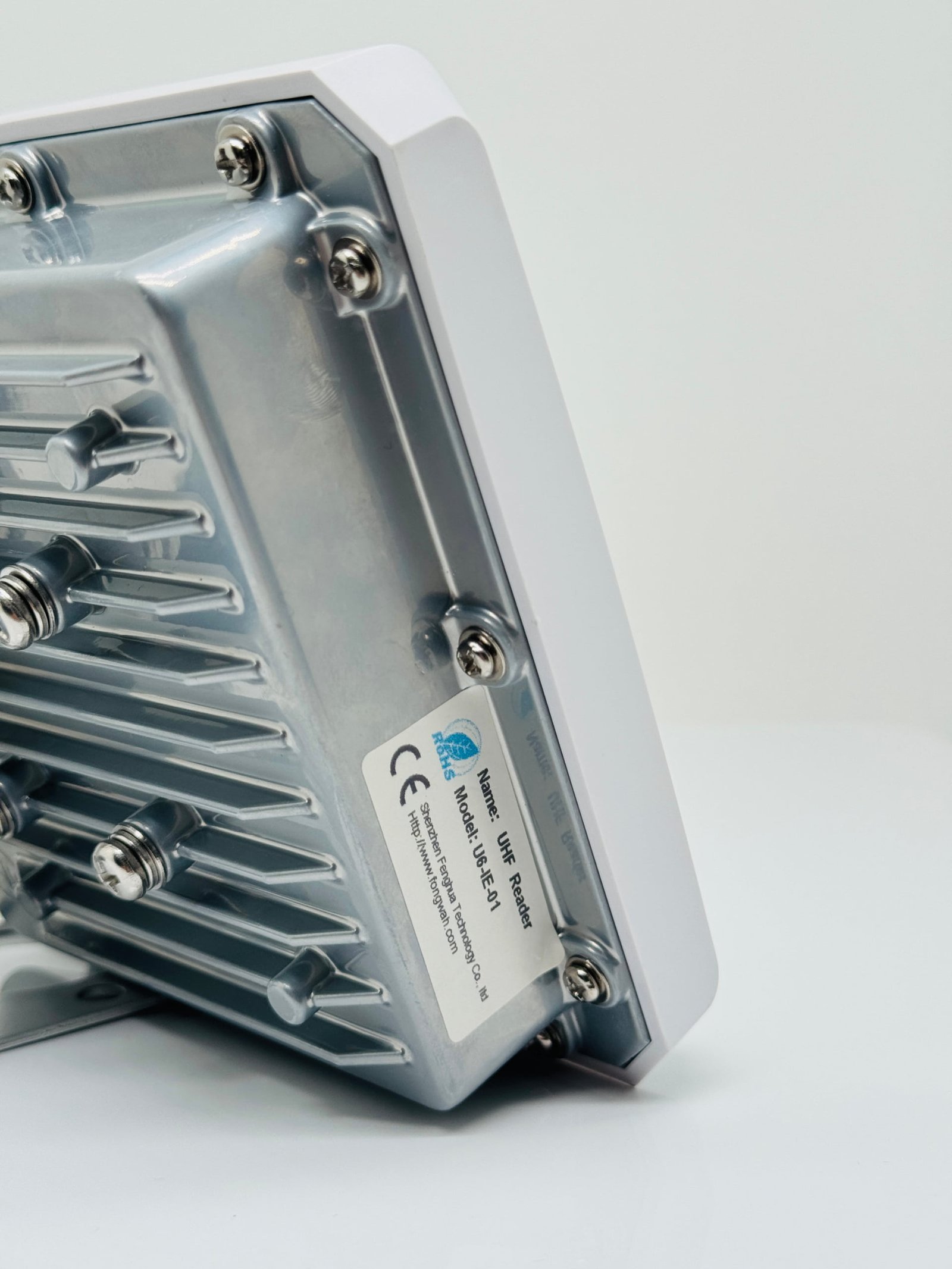
Industrial readers need aluminum alloy housings that double as heat sinks, holding MTBF steady. Proper thermal management keeps throughput high (around 500 reads/sec) without sensitivity drift.
Consider the physics most datasheets gloss over. A UHF reader driving an antenna at +30 dBm (1 W) generates real heat, and a plastic enclosure offers no path to shed it. As internal temperature climbs, the RF oscillator drifts.
- The Failure Mode: The reader rarely shuts down outright. Its sensitivity just drops — from a 10-meter read range down to about 3 meters.
- The Result: Suddenly your conveyor misses 15% of the tags. Operations blames the tags; IT blames the network. The real cause? A plastic case that can't dissipate heat.
The Hardware Reality: U8 Fixed Reader
The U8 Fixed Reader is built for heavy industrial and warehouse duty. For what actually drives UHF reader performance beyond the tag, see what actually drives UHF reader performance.
- Material: A finned aluminum casing — not cosmetic, it's the passive cooling system.
- Performance: Sustains 500 reads/second across 4 active SMA ports.
- Sensitivity: Holds −80 dBm even after 24 hours of continuous operation (Fongwah lab measurement).
On a logistics sorting line, a reader that needs a cool-down break is a liability. Ten minutes of line stoppage to reset a unit dwarfs the price of the reader itself.
Generic, Fongwah, or Impinj: Which Brand Maximizes Project Margins?
You don't buy a Ferrari to deliver pizza. Over-speccing with top-tier brands kills your bid; under-speccing with generics kills your reputation. For a full selection framework, see how to choose the right RFID reader.
The sensible TCO play is the "mid-tier industrial" zone. Devices like the Fongwah U6-IE-02 deliver roughly 90% of a premium brand's functionality at about 40% of the cost — protecting system integrator margins without sacrificing stability. The gap between consumer-grade and commercial-grade hardware is what widens integration and SDK cost far more than the sticker price ever will.
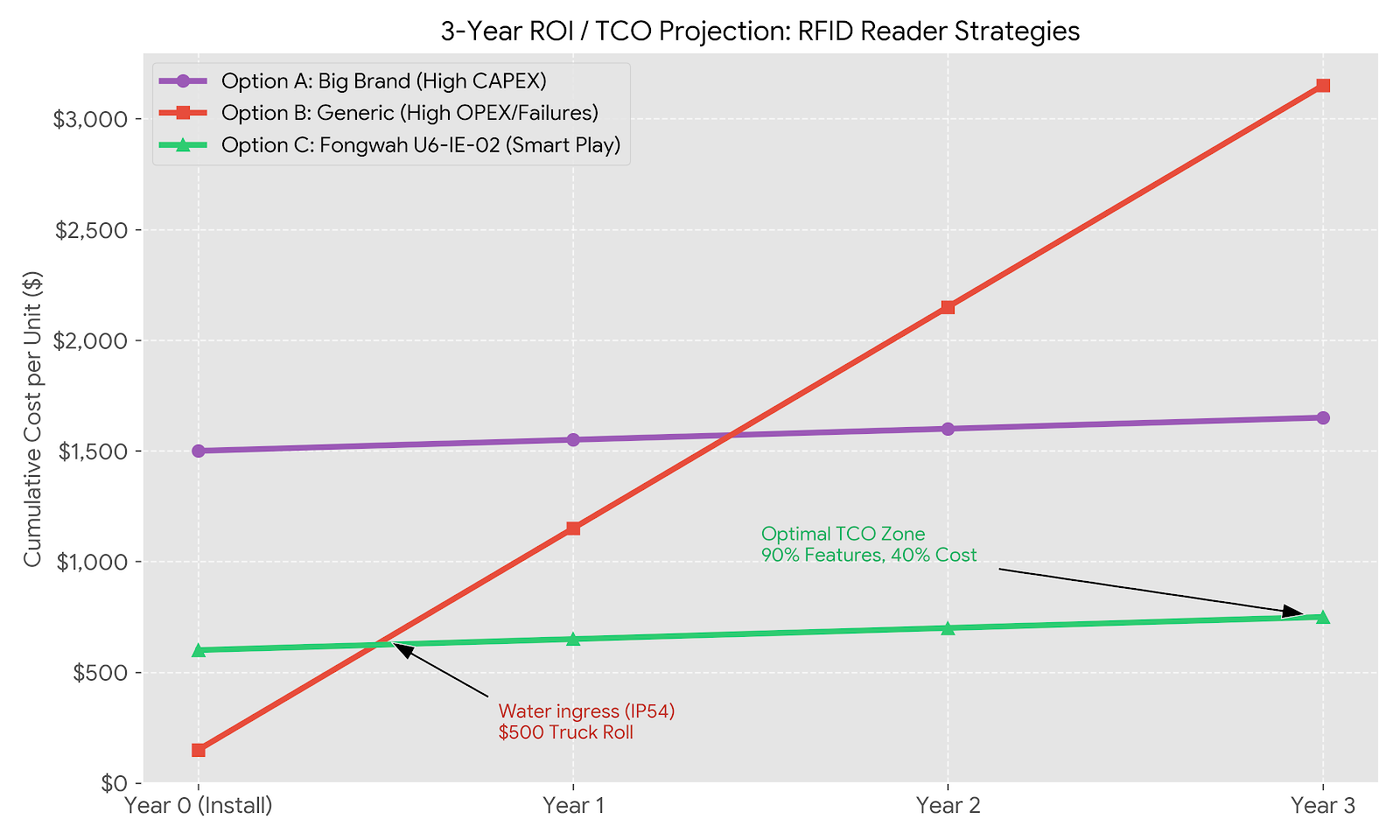
Take a parking management bid as a concrete example: 50 long-range readers to install.
Option A: The Big Brand (Zebra/Impinj) Spec a top-tier reader at $1,500/unit, with edge-computing features a simple gate opener will never use.
- Hardware Cost: $75,000.
- Outcome: You lose the bid — the quote is too high.
Option B: The Generic "No-Name" Buy a $150 reader that claims "10m range."
- Hardware Cost: $7,500.
- Outcome: Two months in, rain enters the poorly sealed case (IP54, not IP65) and the reader fails. You fly a technician out to replace it. One truck roll: $500. Margin gone.
Option C: The Fongwah Play Spec the U6-IE-02 Integrated Reader.
- Specs: 8 dBi circular-polarized antenna (8 m real-world range, typical).
- Protection: IP65 rated against dust and water.
- Compliance: CE/FCC certified with strict Listen Before Talk (LBT) compliance — critical, because cheap readers often skip LBT and interfere with other wireless systems. Fongwah units conform to regional frameworks including FCC Part 15.247 in the US and ETSI EN 302 208 in the EU. At the protocol layer, the U6-IE and U8 implement the ISO/IEC 18000-63 air-interface standard and GS1 EPC Gen2v2 specification.
- Cost: A fraction of the big brands, backed by 20 years of OEM manufacturing reliability.
The 3-Year TCO Calculation (Per Unit)
The table to show your CFO for a single reader:
| Cost Category | Generic Cheap Reader | Fongwah U6-IE-02 | Premium Brand |
|---|---|---|---|
| Unit Price | $150 | ~$150–$350 (typical project pricing) | $1,500 |
| Integration Labor | $1,000 (20+ Hours) | $200 (4 Hours) | $150 (3 Hours) |
| Compliance Risk | High (Seizure/Interference) | Zero (CE/FCC/TELEC) | Zero |
| Maintenance (3 Yrs) | $600 (Replacements) | $50 (Low Risk) | $50 |
| True Cost | $1,750 + Reputation Damage | $400–$600 (margin intact) | $1,700 |
The 3-Year TCO Calculation (100-Unit Project)
Same logic at a typical deployment — 100 units over three years:
| Cost Category | Generic "No-Name" | Big Brand Name | Fongwah U6-IE-02 |
|---|---|---|---|
| Hardware Cost | $5,000 ($50/unit) | $50,000 ($500/unit) | $15,000–$35,000 (~$150–$350/unit, typical project pricing) |
| Integration Labor | $10,000 (High friction) | $2,000 (Easy) | $2,000 (Easy) |
| Maintenance (3 Yrs) | $5,000 (High failure) | $500 (Low failure) | $500 (Low failure) |
| Total 3-Year Cost | $20,000 | $52,500 | $17,500–$37,500 |
Fongwah figures are illustrative typical project pricing, not firm quotes; the 100-unit row reflects volume deployment, the per-unit row reflects standalone integration.
At 100-unit scale, the generic option runs about $20,000 over three years versus roughly $17,500 for Fongwah at typical volume pricing — a $2,500 gap driven entirely by hidden labor and replacements. The big brand reaches $52,500, a ~$35,000 premium over Fongwah for a logo and features most gate projects never use. Fongwah sits in the middle on price and at the top on delivered stability: industrial-grade hardware without the brand tax. For deeper reading on RFID total cost breakdowns, see our companion piece on whether RFID's TCO is lower than you think.
Conclusion
The purchase order is the smallest line item in a reader's real cost. What actually drives total cost of ownership is paid later — engineering hours lost reverse-engineering a thin SDK, on-site read failures caused by thermal drift in a plastic enclosure, and the compliance exposure that surfaces only when a channel is jammed or a shipment is inspected. A $120 reader that burns $2,400 in integration labor and a week of field downtime is not cheaper than a mid-tier industrial unit that ships documented, CE/FCC/LBT-compliant, and reads reliably on day one.
For most UHF reader deployments, the trade is straightforward: a higher upfront price against far fewer unknowns in deployment and support. The Fongwah U8 and U6-IE series sit at the point where delivered cost is lowest — not because the box is the least expensive, but because the hidden costs are designed out: aluminum-finned heat dissipation, sustained −80 dBm sensitivity, 500 reads/s, and a verified C# SDK. The honest framing is that you are buying fewer surprises, not a discount.
Pair this cost view with our RFID reader buying guide for the spec side of the same decision.
If you are a qualified system integrator evaluating readers for a specific environment, we can supply up to 30 sample tags or one demo evaluation unit so you can verify read range, thermal behavior, and SDK fit on your own benches and sites. If you get stuck on integration or a DLL issue, we are glad to share a working C# example. No commitment required — the fastest way to confirm a reader's TCO is to measure it where it actually matters.
FAQ: Understanding the Cost of RFID Reader Implementation
Q1: What is the true cost of an RFID reader?
The true cost of an RFID reader is its Total Cost of Ownership (TCO) — hardware acquisition, the engineering labor required to integrate the SDK, and potential downtime from thermal failures. A "cheap" $150 reader can easily cost over $2,400 in hidden software debugging when the SDK is poorly documented.
Q2: Why do cheap UHF RFID readers fail in industrial settings?
Cheap readers typically use plastic housings that trap heat, leading to thermal throttling and reduced read range. Many also lack CE and FCC certifications and skip LBT (Listen Before Talk) protocols — defined in frameworks like ETSI EN 302 208 and FCC Part 15.247 — which causes interference with other wireless equipment and creates compliance risk.
Q3: How long should it take to integrate an RFID reader SDK?
With an industrial-grade reader like the Fongwah U8 or U6 series, a senior developer can reach basic read/write integration in 1–3 days using verified C# or Java sample code. Generic readers with poor documentation can trap engineers in weeks of protocol debugging.
Q4: What are the benefits of an IP65 rated integrated RFID reader?
An IP65 rating, as found in the Fongwah U6-IE-02, protects the reader fully against dust and low-pressure water jets. That matters for outdoor parking or warehouse environments, where it prevents hardware failure and keeps long-term maintenance costs down.