You struggle with data errors and slow inventory updates in your warehouse. Relying on simple scanners fails when you need to encode tags reliably in harsh, fast-paced environments.
You must select hardware based on function, not just price. Desktop units handle encoding, fixed readers manage automation, and handhelds handle audits. Choosing industrial-grade UHF RFID Reader Writers ensures data integrity and integration success.
Pro Tip: Connectivity Matters" "While desktop writers plug-and-play via USB like a keyboard, fixed readers are network devices. Our U6-IE-02 series supports TCP/IP and Power over Ethernet (PoE) , allowing your IT team to manage them remotely without running separate power lines to the ceiling.
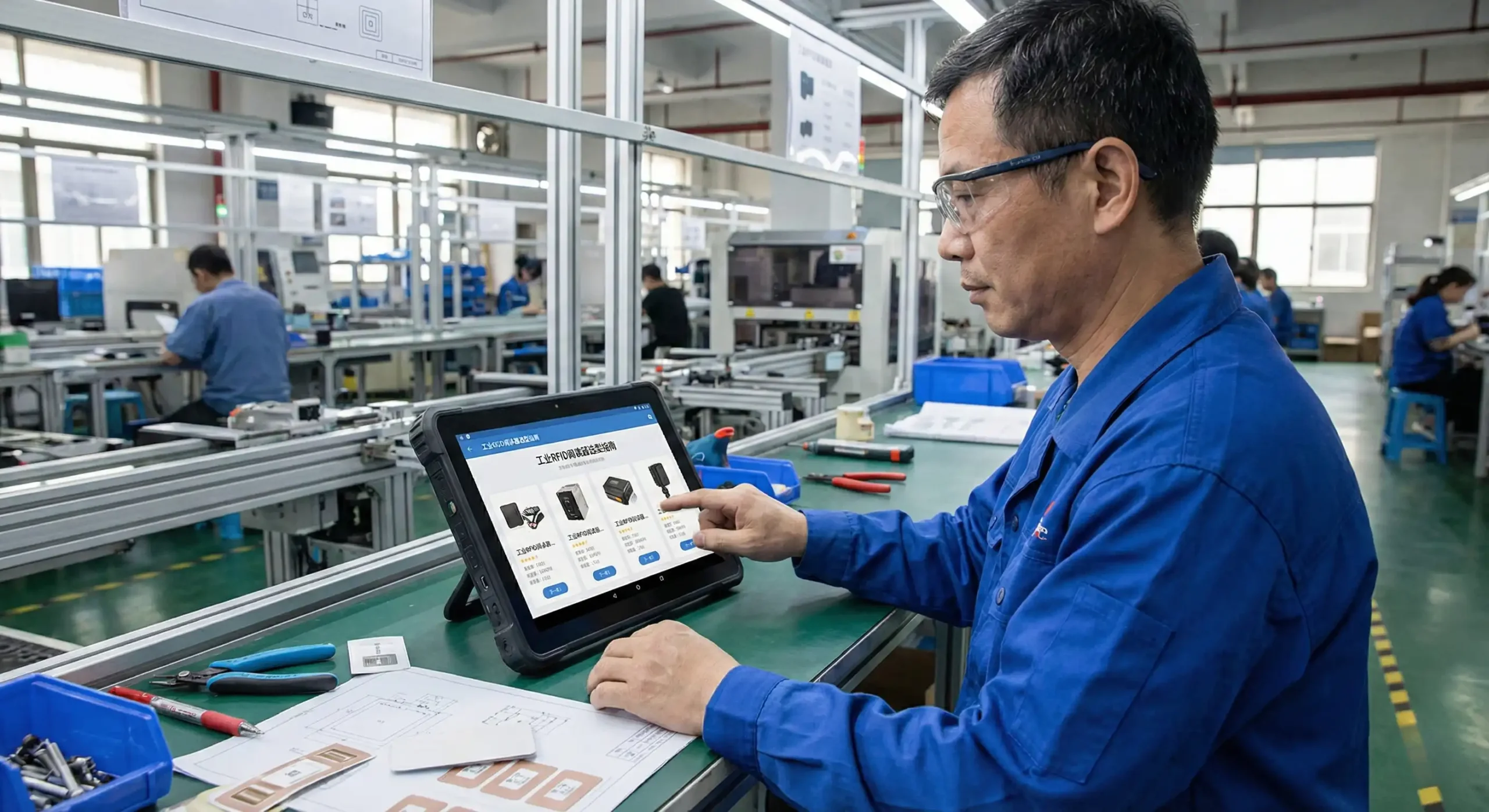
Buying the wrong reader halts production effectively. I see this happen often when managers look at price tags before specification sheets. Let's explore the right tools for your specific job.
Why Is the UHF Desktop RFID Reader / Writer Fongwah U6-CU-91 Essential for Data Entry?
Bad data at the start ruins the whole supply chain. If you encode the wrong info onto a tag, your expensive tracking system becomes useless immediately.
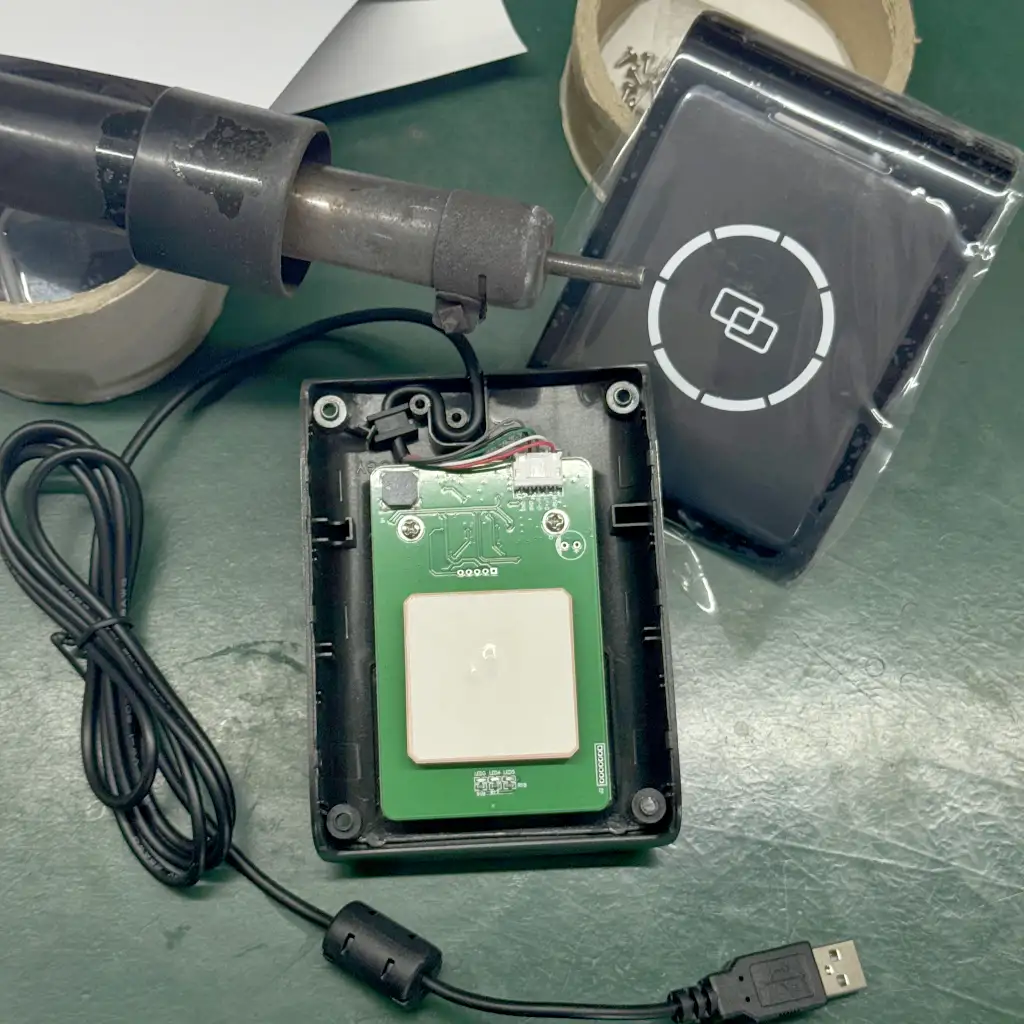
The UHF Desktop RFID Reader / Writer U6-CU-91 acts as your gatekeeper. It connects via USB, sits on your desk, and ensures every tag has accurate data before entering your workflow.
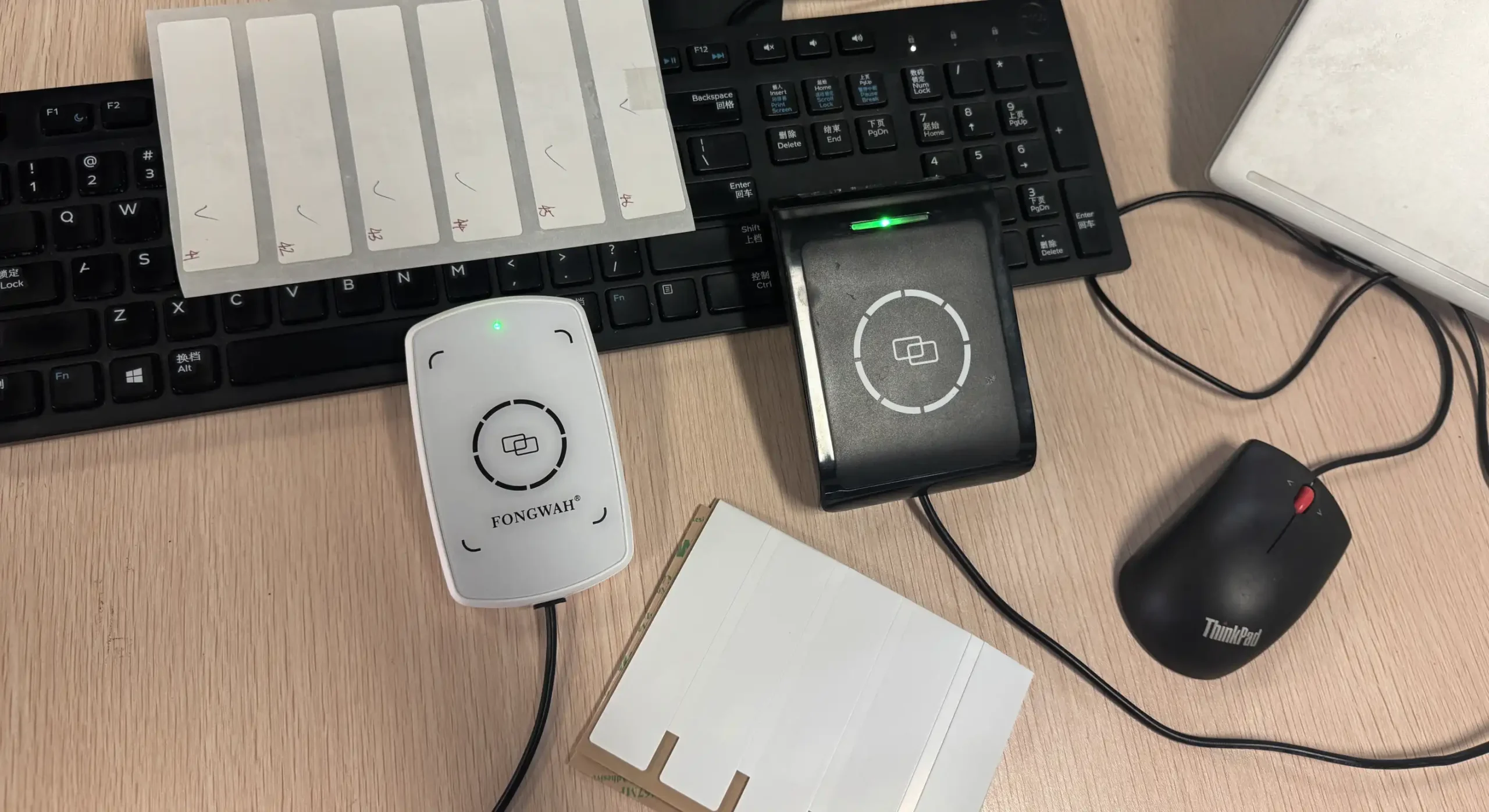
I often tell my clients that "Reading is silver, but Writing is gold." In a standard industrial setup, reading a tag is the easy part. The reader captures a signal and beeps. However, writing data—encoding the specific EPC code that identifies a product—requires stability. If the signal drops for a millisecond during writing, you corrupt the tag. You create a "ghost" item that no scanner will ever see again.
This is where a dedicated desktop writer like the UHF Desktop RFID Reader / Writer U6-CU-91 is necessary. It is designed for close-range, high-accuracy work. You place it next to your PC and connect it via USB. It simulates a keyboard or interacts directly with your issuance software.
I recall a project with a library system integrator. They tried to use handheld guns to initialize thousands of book tags. It was a disaster. The handhelds were too heavy for all-day desk work, and the batteries kept dying. We switched them to desktop writers. The process speed doubled. The desktop unit draws power from the computer, so it never dies. It focuses its energy on a small field, ensuring that when you write to one tag, you do not accidentally overwrite the tag sitting three feet away.
| Feature | Desktop Writer (U6-CU-91) | Handheld / Portable |
|---|---|---|
| Primary Function | Tag Encoding / Issuance | Cycle Counting / Search |
| Power Source | USB / Wall Outlet | Battery |
| Range | Short (0-100 cm) | Medium (1-5 m) |
| Stability | High (Stationary) | Variable (Motion dependent) |
| Risk of Cross-Read | Very Low | High |
When Should You Deploy a Fixed UHF RFID Long Range Reader?
Manual scanning slows down your conveyor belts. Stopping production to scan a box kills your efficiency and eats directly into your profit margins.
You need a UHF RFID Long Range Reader for automated zones. These devices read tags from 10-12 meters away, capturing moving data without human intervention or slowing down the line.
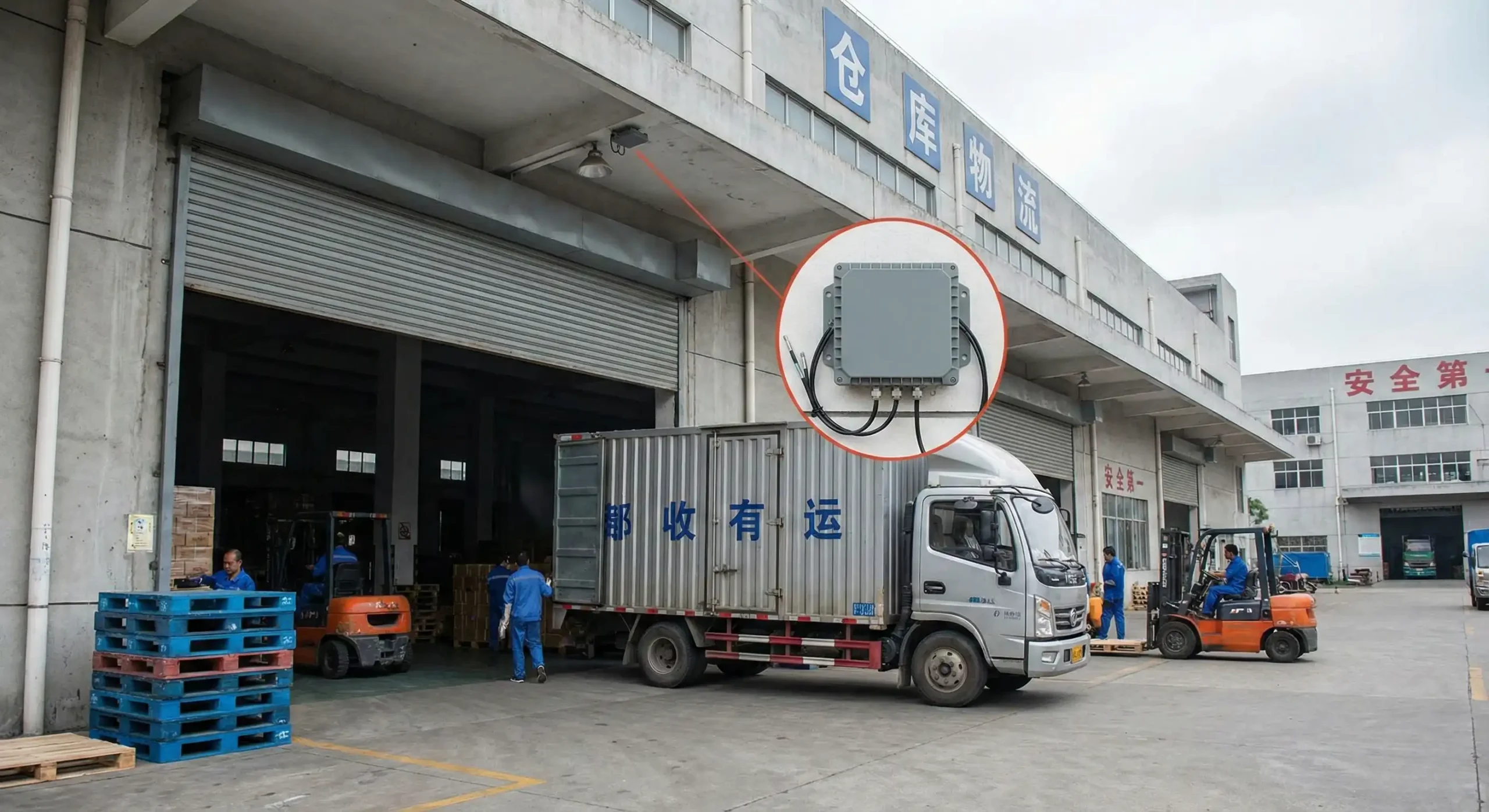
Once your tags are encoded by the desktop unit, they move into the wild. Now, the goal changes. You do not want to touch the item anymore. You want "passive tracking." This means the system sees the inventory moving without a worker pulling a trigger.
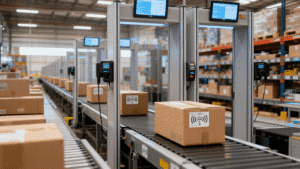
For conveyor belts, dock doors, or vehicle gates, you must use a fixed UHF RFID Long Range Reader. I recommend models like our U6-IE-02. The key metric here is the read range and anti-collision capability. In a logistics center, a pallet might carry 50 different items. As that pallet moves through a dock door at 5 miles per hour, the reader has about three seconds to identify all 50 tags.
A desktop reader cannot do this. A handheld reader relies on a human to aim it. The fixed reader uses high-gain antennas to create a "read zone." This zone can extend approx 10-12 meters. I have seen factory floors where forklifts simply drive past a pole, and the system updates the inventory location automatically. This is the definition of efficiency.
However, installation matters. You must mount these readers correctly. Metal shelving and concrete walls reflect radio waves. This creates "dead zones" or "hot spots." Unlike the plug-and-play desktop unit, the long-range reader requires a site survey. But once it is set up, it works 24/7. It does not take breaks, and it does not make mistakes due to fatigue.
| Scenario | Recommended Device | Why? |
|---|---|---|
| Assembly Line | Fixed Long Range | Automatic stage tracking |
| Truck Weighbridge | Fixed Long Range | Vehicle identification at 10m+ |
| Inventory Audit | Handheld | Roaming through aisles |
| Card Issuance | Desktop Writer | Precise data encoding |
Why Should You Avoid Consumer-Grade Devices from Generic Marketplaces?
Cheap hardware lacks the software support you need. You buy a reader online to save money, but it fails to talk to your system, leaving you with a useless paperweight.
Cheap readers usually lack not just SDKs, but also legal compliance. Using a non-certified reader can get your shipment seized. Check our guide on Global RFID Standards & LBT Compliance to see why 'cheap' can cost you thousands in fines.
Searching for "Uhf rfid reader read and write amazon" often leads to toys, not tools. You need industrial API and SDK support to integrate hardware into your ERP system effectively.

I understand the temptation. You open a web browser, search for a reader, and see an option for $50. It looks like a bargain. But strictly speaking, in the B2B world, hardware is only 50% of the solution. The other 50% is integration.
When you buy from a generic marketplace, you often get a box with a reader and a manual in a language you cannot read. There is no SDK (Software Development Kit). There is no API (Application Programming Interface). If you want this reader to send data to your SAP, Oracle, or custom warehouse software, you are stuck. You have to write the driver from scratch. That costs thousands of dollars in engineering time.
As a manufacturer at Fongwah, we provide the SDKs and the source code examples. We know that UHF RFID Reader Writers must talk to other machines. Also, consider the physical build. Consumer devices use cheap plastic. They shatter if you drop them on a concrete floor. Industrial environments are dirty, dusty, and hot.
We leverage Chinese manufacturing to offer "Superior performance & competitive pricing." This does not mean cheap quality. It means we control the supply chain. We use industrial-grade chips and durable casings, but we cut out the middleman markup. You get a device that survives a drop and comes with the code your IT team needs to get it running in hours, not weeks.
| Attribute | Generic Marketplace Device | Industrial (Fongwah) |
|---|---|---|
| SDK Availability | Rare or Non-existent | Full SDK & Support |
| Durability | Plastic / Consumer Grade | Rugged / Industrial |
| Integration | Standalone mostly | ERP/Database ready |
| Cost | Low initial / High hidden | Moderate / High value |
Conclusion
Desktop writers ensure accurate data entry, while fixed long-range readers automate tracking. Choosing industrial-grade hardware over consumer toys guarantees the software support needed for real efficiency.
---