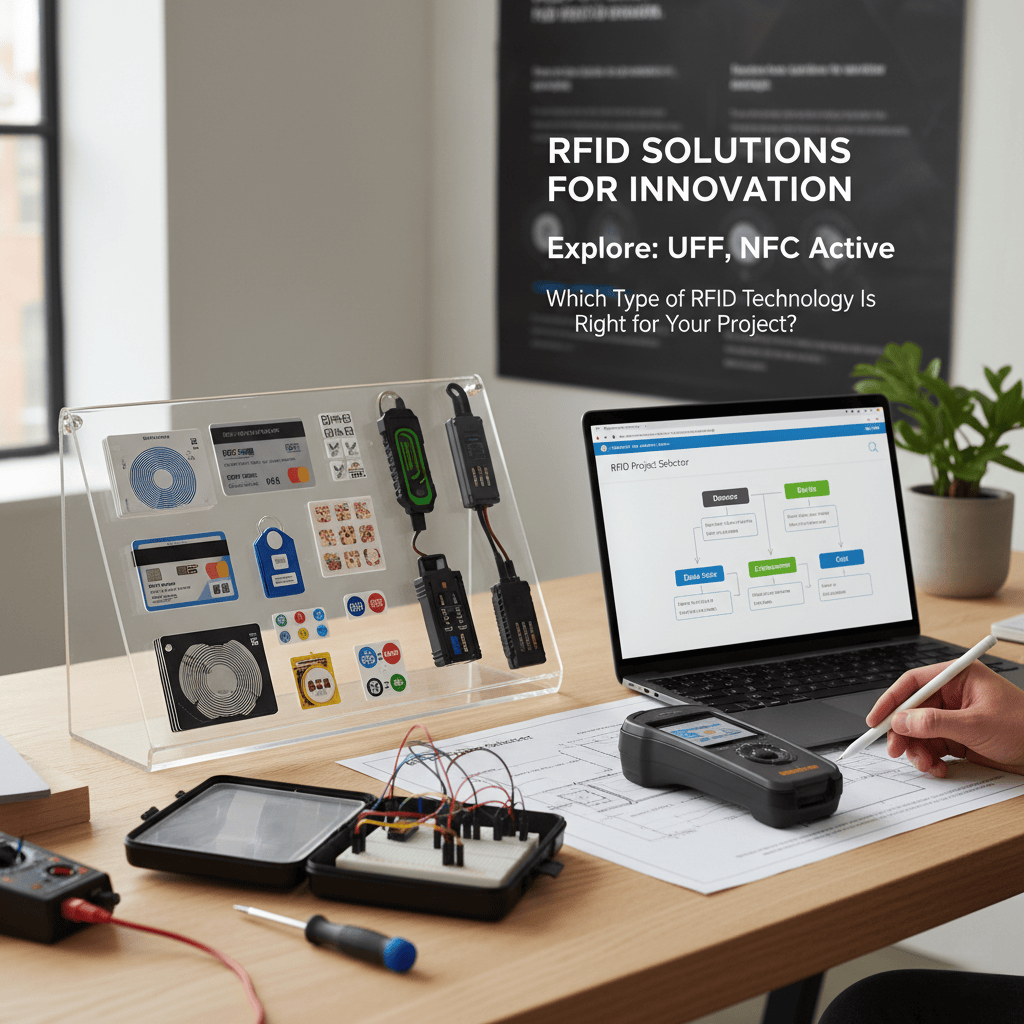
Your project is stalled because of the wrong RFID choice? It’s a costly mistake. Let’s explore the different RFID types to ensure you make the right choice the first time.
RFID technology1 is categorized by its frequency: Low Frequency (LF)2, High Frequency (HF)3, and Ultra-High Frequency (UHF)4. Each type has unique read ranges5 and costs, making them suitable for specific applications, from animal tracking to large-scale inventory management6.

I remember a client, a system integrator just like you, who was building a smart logistics platform. He initially chose a technology that couldn't handle the speed and volume of his warehouse. His project was delayed by three months. We had to go back to the beginning. This experience at Fongwah taught me how critical it is to understand the fundamentals. This is the kind of problem our 20 years of experience helps you avoid. Let's break down each type so you don't face the same setback.
Is Low-Frequency (LF) RFID Good for Tough Environments?
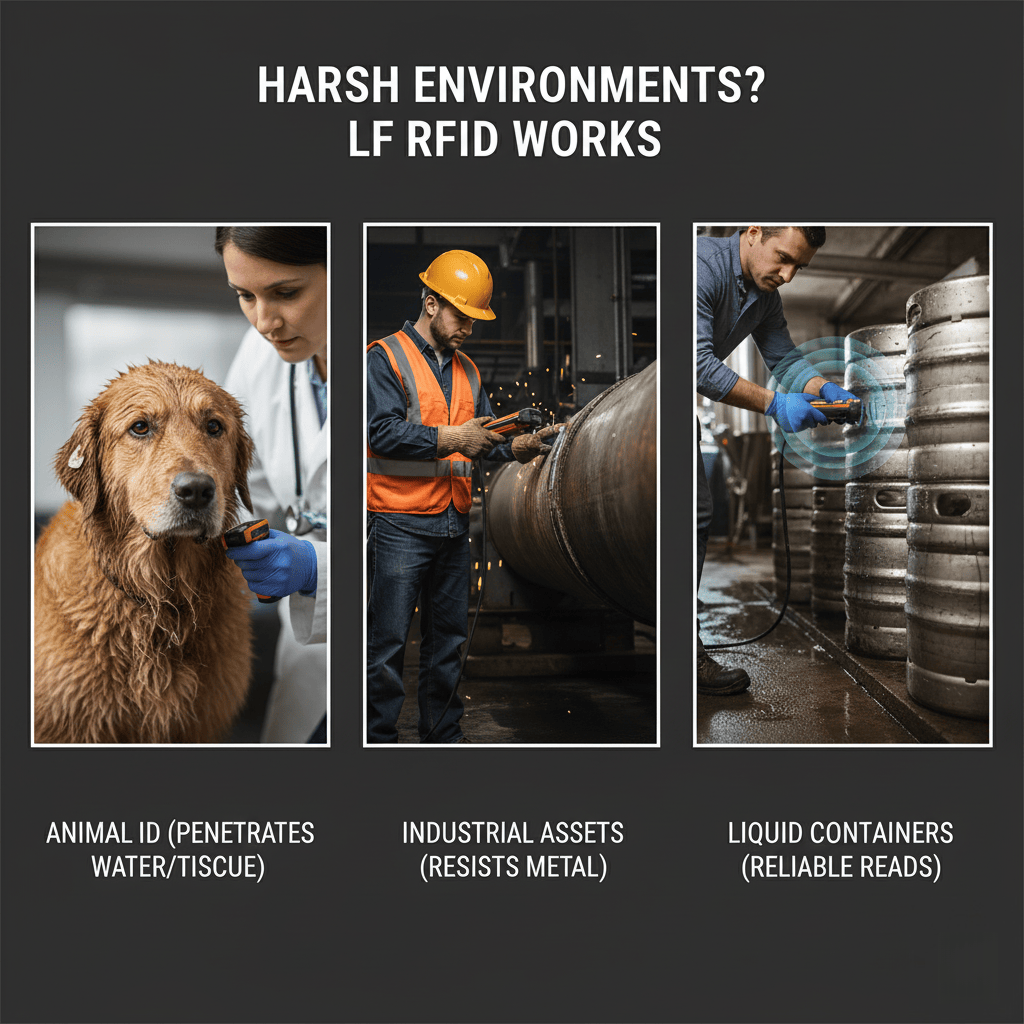
Tracking assets in harsh, metallic, or wet conditions? Other tags often fail. LF RFID is designed to perform reliably in these challenging environments, ensuring you always get a consistent read.
Yes, Low-Frequency (LF) RFID is excellent for tough environments. Its long wavelength allows it to penetrate non-metallic materials like water and animal tissue. It is also less affected by metal interference, making it ideal for tracking livestock, kegs, and industrial assets.
When I work with clients in industrial automation, the first thing they mention is reliability. Their equipment is often surrounded by metal or exposed to liquids. In these cases, I almost always start the conversation with LF RFID. It's a workhorse technology. It’s not flashy, but it gets the job done where other systems fail. It has a very short read range, but for applications like tool tracking or access control in a factory, that close proximity is actually a security feature. You know exactly what you are scanning. The slow data speed is a trade-off, but if you only need to read a unique ID number, it's more than enough.
Key Characteristics
The main strength of LF RFID is its stability. The 125-134 kHz frequency band is not easily disturbed by environmental factors. You can count on it for simple and direct identification tasks. This reliability is why it remains a popular choice for mission-critical asset management7 systems where a missed read could cause significant problems.
Common Applications
We see LF technology used everywhere from car key fobs to animal identification tags. Its ability to be read through an animal's body makes it the global standard for pet microchipping8. In your work, you might consider it for tracking high-value tools on a production line or for managing beer kegs, where tags are exposed to constant washing and rough handling.
Your Decision-Making Factors
| Feature | LF RFID Specification |
|---|---|
| Frequency | 125 - 134 kHz |
| Read Range | Up to 10 cm |
| Data Speed | Low |
| Interference | High resistance to water and metal |
| Cost | Tag cost is moderate, reader cost is low |
When Should I Use High-Frequency (HF) RFID for Data Transfer?
Need to handle secure, item-level data exchange for things like payments or access control? Barcodes are too slow and not secure. HF and NFC technology9 can provide the speed and security your system needs.
You should use High-Frequency (HF) RFID when your application requires a moderate read range (up to 1 meter) and more data storage. It is the global standard for applications that need secure data exchange10, such as library systems, event ticketing, and payment cards.
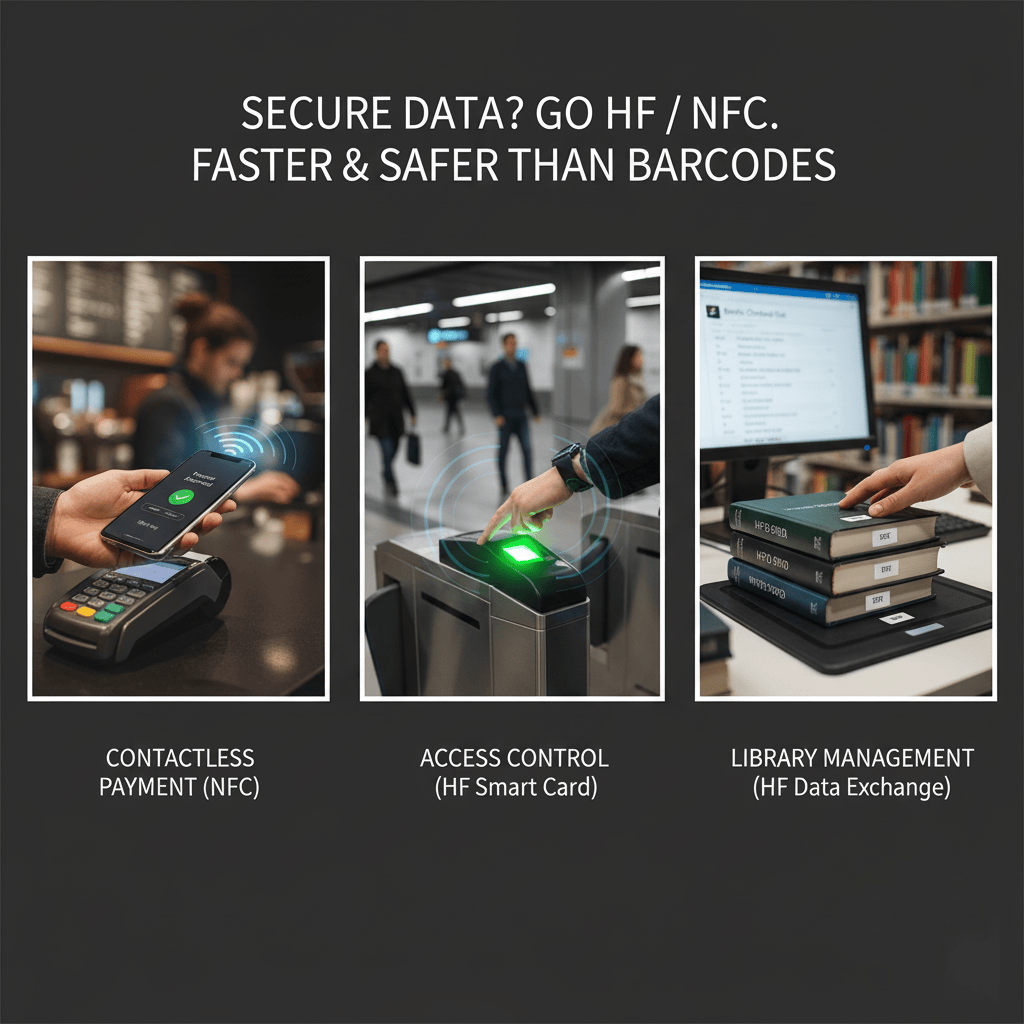
A systems integrator I know, Hussin, was developing a smart locker system for a large venue. He needed something that could handle payments and act as a secure key. This is a perfect use case for HF RFID. We talked about Near Field Communication (NFC), which is a special type of HF technology. It allows two-way communication between devices, which was perfect for his needs. The user could tap their phone to pay and unlock the locker. This is where HF shines. It offers a great balance between read range, data capacity, and security. It supports more advanced commands and security protocols than LF, which is vital for applications handling sensitive information.
Key Characteristics
HF operates at 13.56 MHz, giving it a good balance of features. It has a faster data transfer11 rate than LF and can store more information on the tag. The technology is governed by a wide range of international standards, including ISO/IEC 14443 (for proximity cards) and ISO/IEC 15693 (for vicinity items), which ensures interoperability between different manufacturers' products. This is a huge benefit for integrators like you, as it gives you more hardware choices.
Applications and Security
Beyond payments and access, we see HF in smart retail for item-level tagging of high-value goods like jewelry. It's also the backbone of modern library systems, allowing for quick checkout and return processing. For you, this means you can use HF for projects that need more than just an ID, like systems that store maintenance records or user credentials directly on a tag.
Your Decision-Making Factors
| Feature | HF RFID Specification |
|---|---|
| Frequency | 13.56 MHz |
| Read Range | Up to 1 meter |
| Data Speed | Low to Moderate |
| Interference | Sensitive to metal and liquids |
| Cost | Tag and reader costs are moderate |
Why Is Ultra-High-Frequency (UHF) RFID Best for Long-Range Tracking?
Need to scan hundreds of items in a warehouse without opening a single box? Manual scanning is a huge bottleneck. UHF RFID provides the long-range, high-speed bulk reading needed to transform your inventory management6.
UHF RFID is best for long-range tracking because it operates at a higher frequency (860-960 MHz). This allows for a much longer read range, up to 12 meters, and extremely fast data transfer11. It can read hundreds of tags simultaneously, making it perfect for supply chain12 and logistics.
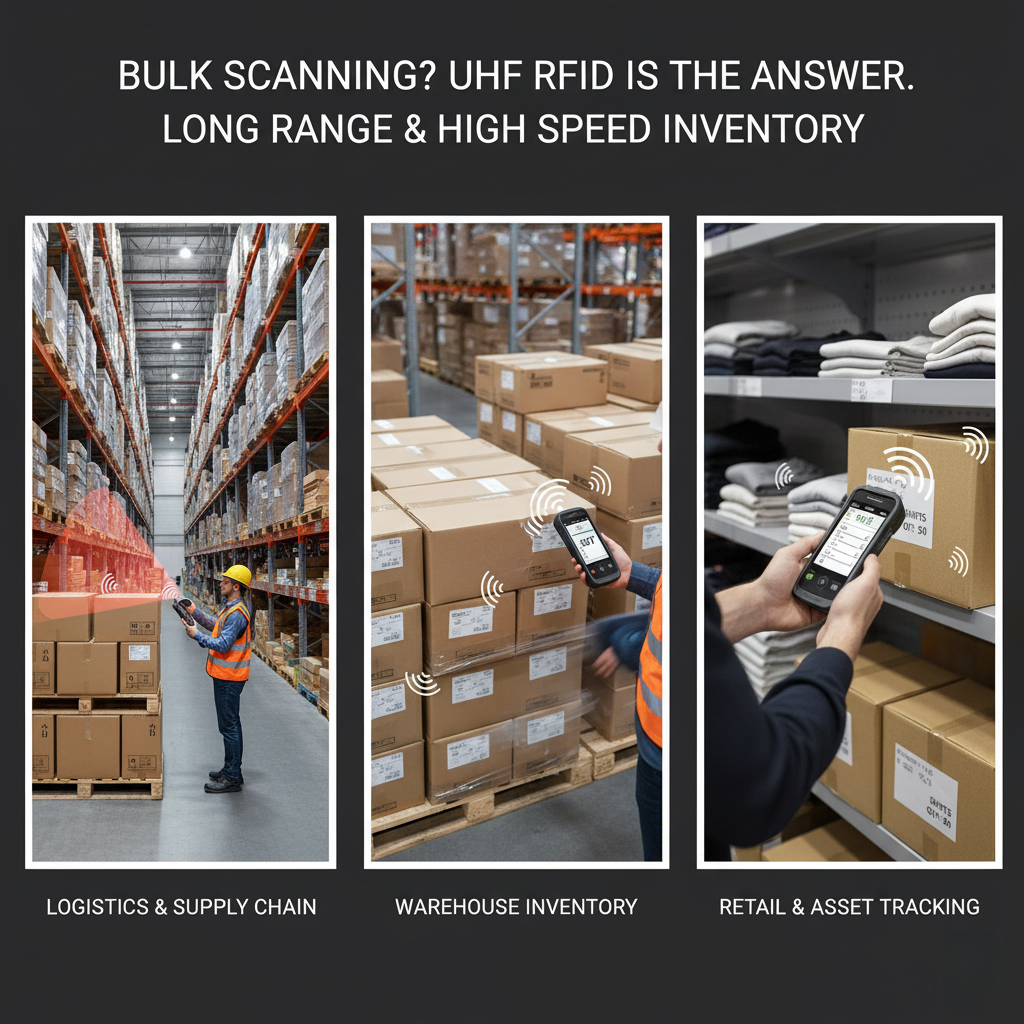
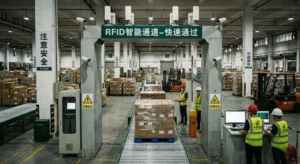
One of my biggest success stories at Fongwah involved helping a logistics company solve their shipping accuracy problem. They were losing money due to mis-shipments. We designed a solution using UHF RFID portals at their dock doors. As pallets passed through, the system automatically scanned every single box and verified the contents against the shipping order. The result? They reduced shipping errors by over 99%. This is the power of UHF. For system integrators working on smart warehousing, logistics platforms13, or even RFID parking management systems, UHF is often the technology you will turn to. It’s all about speed, volume, and distance.
Key Characteristics
UHF RFID is defined by its speed and range. The shorter wavelength allows it to bounce off surfaces, which can help in reading tags in challenging orientations. However, this same characteristic makes it more susceptible to interference from metals and liquids, which can absorb the radio waves. This is a critical factor you must account for during system design14. Selecting the right tag and reader placement is key to a successful UHF deployment.
System Design Considerations
Because of its sensitivity, a UHF system requires more careful planning. But the payoff is enormous. Imagine a retail store doing a full inventory count in minutes instead of days. Or a toll road system that processes cars at highway speeds. These applications are only possible with UHF. As an integrator, your value is in understanding how to manage its limitations to unlock its incredible potential. Our team at Fongwah provides the support you need to make sure your hardware choices are bulletproof.
Your Decision-Making Factors
| Feature | UHF RFID Specification |
|---|---|
| Frequency | 860 - 960 MHz |
| Read Range | Up to 12+ meters |
| Data Speed | High |
| Interference | Very sensitive to metal, wood and liquids |
| Cost | Tags are very cheap, but readers can be expensive |
Conclusion
Choosing the right RFID frequency is critical. LF works in harsh areas, HF is for secure data, and UHF is for long range. Match the tech to your project for success.
---Get a comprehensive overview of RFID technology types and their specific applications. ↩
Explore the benefits of LF RFID for tough environments and its reliability in asset tracking. ↩
Learn how HF RFID enhances secure data exchange and its use in various industries. ↩
Discover how UHF RFID revolutionizes inventory management with long-range and high-speed capabilities. ↩
Understand the read ranges of LF, HF, and UHF RFID to choose the right technology for your needs. ↩
Find out how RFID technology can transform your inventory management for better efficiency. ↩
Learn how RFID technology enhances asset management efficiency and accuracy. ↩
Understand the role of RFID in pet microchipping and its benefits for pet identification. ↩
Discover the benefits of NFC technology in secure transactions and data exchange. ↩
Explore the significance of secure data exchange in RFID systems for sensitive information. ↩
Explore the differences in data transfer speeds and capabilities among RFID types. ↩
Understand how RFID technology optimizes supply chain operations and reduces errors. ↩
Discover how RFID technology enhances logistics efficiency and accuracy in operations. ↩
Learn about key factors to consider when designing an effective RFID system. ↩