
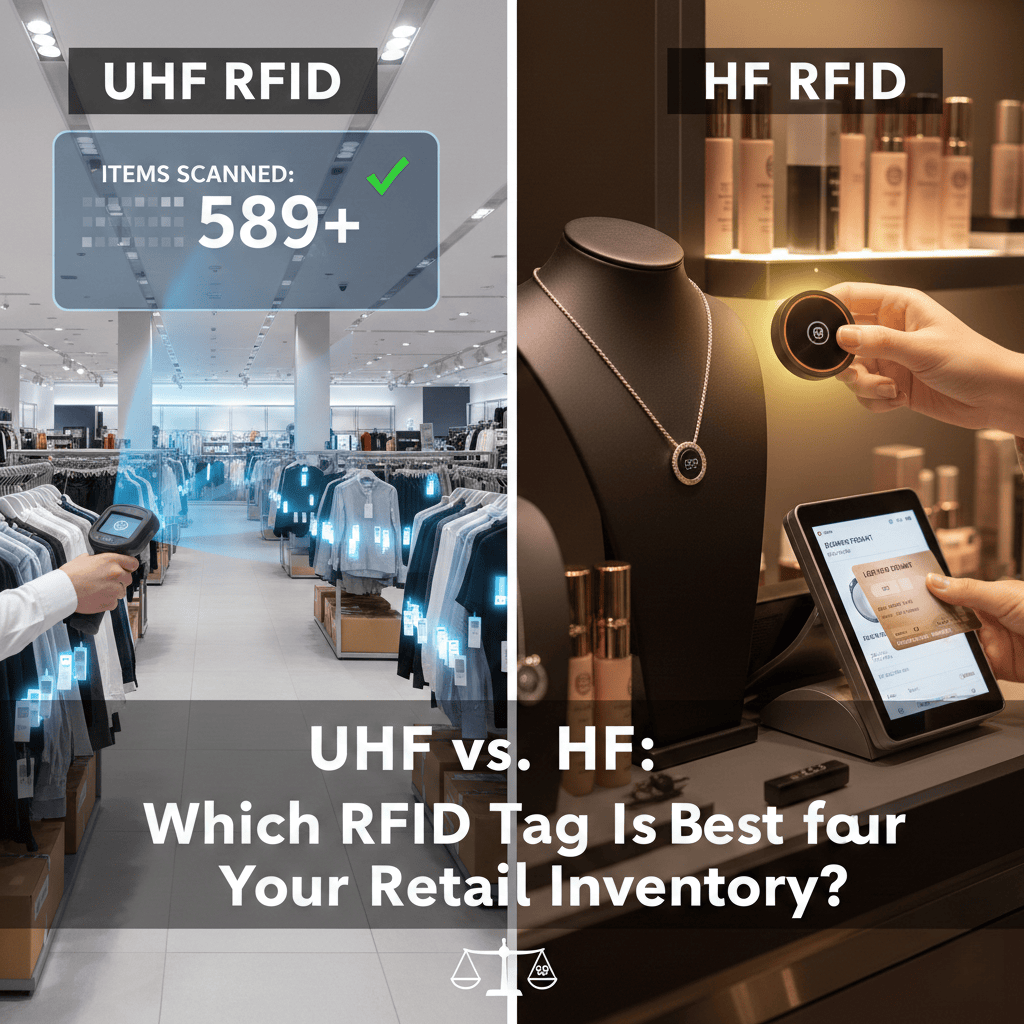
Choosing the wrong RFID tag causes costly errors. Your inventory data becomes unreliable. Let me help you pick the right one for perfect accuracy and efficiency.
For large-scale, rapid inventory counts1 in retail, UHF2 is superior due to its long read range3 and speed. But, HF2 offers better accuracy for item-level tagging, especially with liquids4 or metals5. The best choice depends on your specific products and store environment.
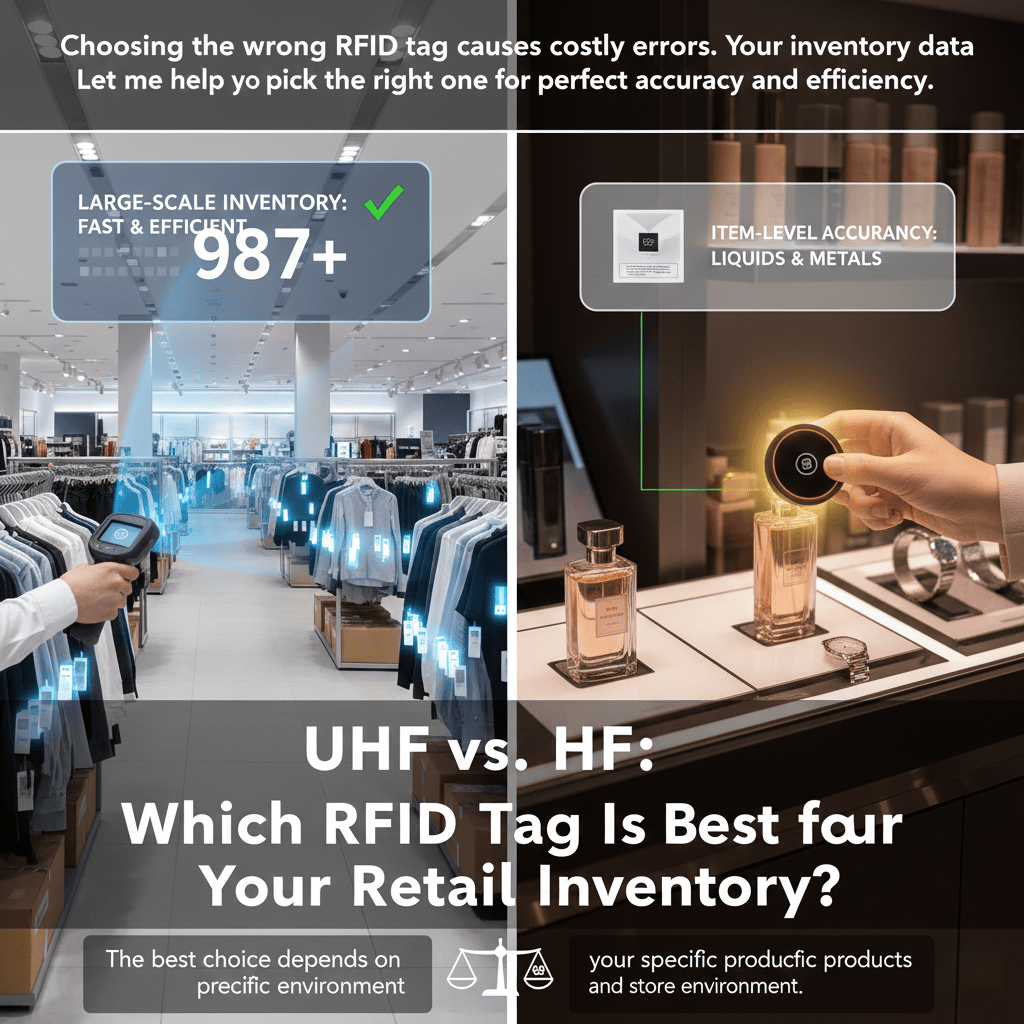
The choice isn't just about speed or distance. It's about matching the technology to your daily operations. I learned this firsthand when a client almost made a very expensive mistake. Let's break down the key differences so you can make the right decision for your business.
How Do Read Range and Speed Impact Day-to-Day Retail Tasks?
Manual barcode scanning is slow and frustrating. Staff waste hours counting items one by one. RFID promises speed, but which type actually delivers for a busy retail floor?
UHF RFID reads hundreds of tags per second from several meters away, perfect for quick warehouse or stockroom counts. HF reads tags one-by-one from a few centimeters, ideal for secure point-of-sale6 checkouts.
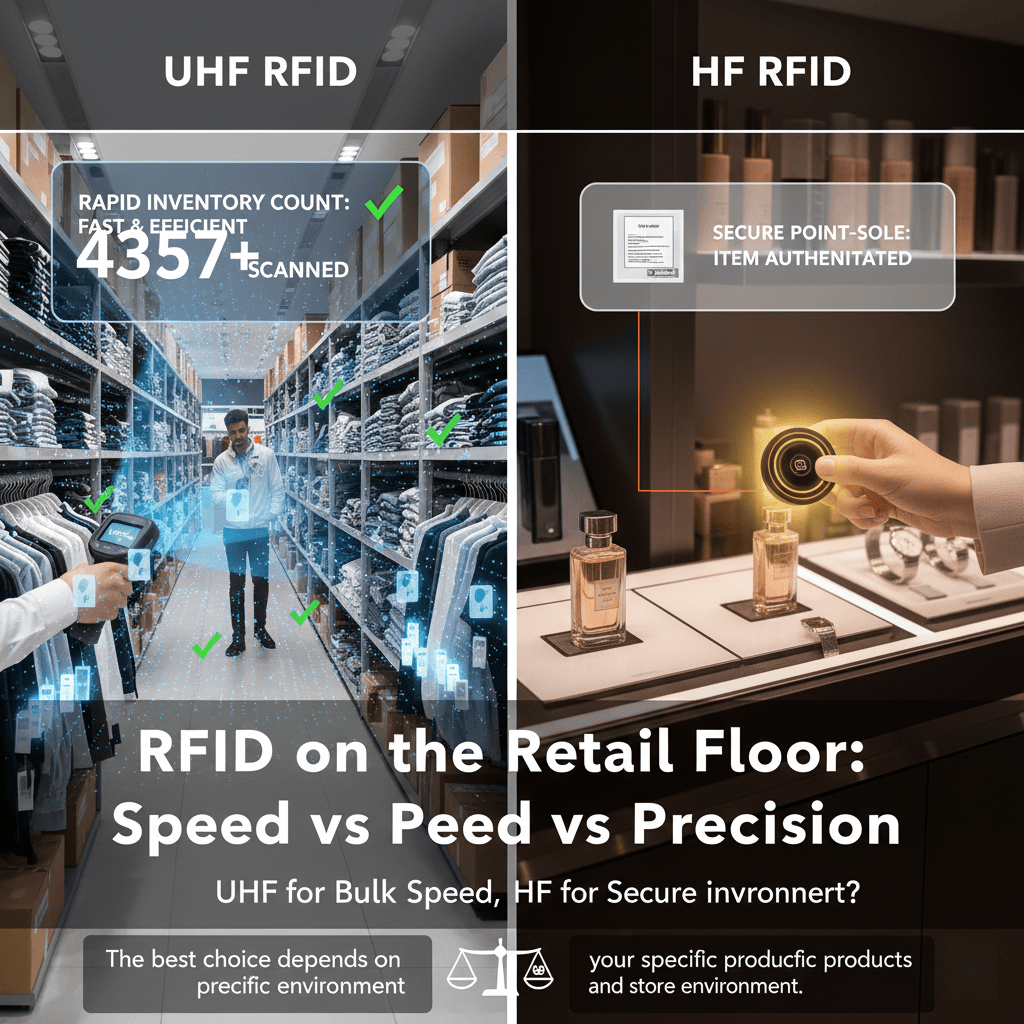
When I think about read range, I remember a large apparel retailer I worked with. They needed to count thousands of items in their stockroom daily. Imagine trying to do that with a technology that requires you to be inches from every tag. It’s not practical. This is where UHF shines. As someone making a purchasing decision, you have to picture your staff using the technology every day.
UHF: The Warehouse Workhorse
UHF operates at 860-960 MHz. This high frequency allows it to communicate over long distances. Your staff can use a handheld reader and simply walk down an aisle. The reader will capture every tagged item, even if they are inside a box. This is a game-changer for cycle counts and receiving shipments. You can verify an entire pallet of goods in just a few seconds. This is how you achieve 99%+ inventory accuracy.
HF: The Checkout Champion
HF operates at 13.56 MHz. Its short read range3 is a feature, not a bug, in some retail scenarios. At a point-of-sale6 (POS) terminal, you want to ensure you are only charging for the item the customer is buying. A long-range UHF reader could accidentally scan other items nearby. HF's proximity reading prevents these errors and improves checkout speed and accuracy. It’s perfect for a tap-and-pay style interaction.
| Feature | UHF RFID | HF RFID |
|---|---|---|
| Read Range | Up to 10-15 meters | Up to 30 cm |
| Read Speed | Hundreds of tags/sec | ~20-50 tags/sec |
| Best Use Case | Bulk inventory counts1, supply chain | Point-of-sale, item-level security7 |
| Staff Action | Walk-by scanning | Tap-and-go interaction |
For any buyer, the choice here depends entirely on the task. If your main pain point is slow inventory counts, UHF is your answer. If you need precise, individual interactions at checkout, HF provides the control you need.
Which Technology Works Better with Challenging Products and Store Environments?
You are excited about RFID, but your store sells liquids4 or electronics. These materials can block RFID signals, making your new system useless. We must find a solution that works reliably.
HF technology performs much better than UHF when tags are near liquids4 or metals5. Its magnetic coupling communication is less affected by signal issues, making it more reliable for cosmetics, beverages, or electronics.
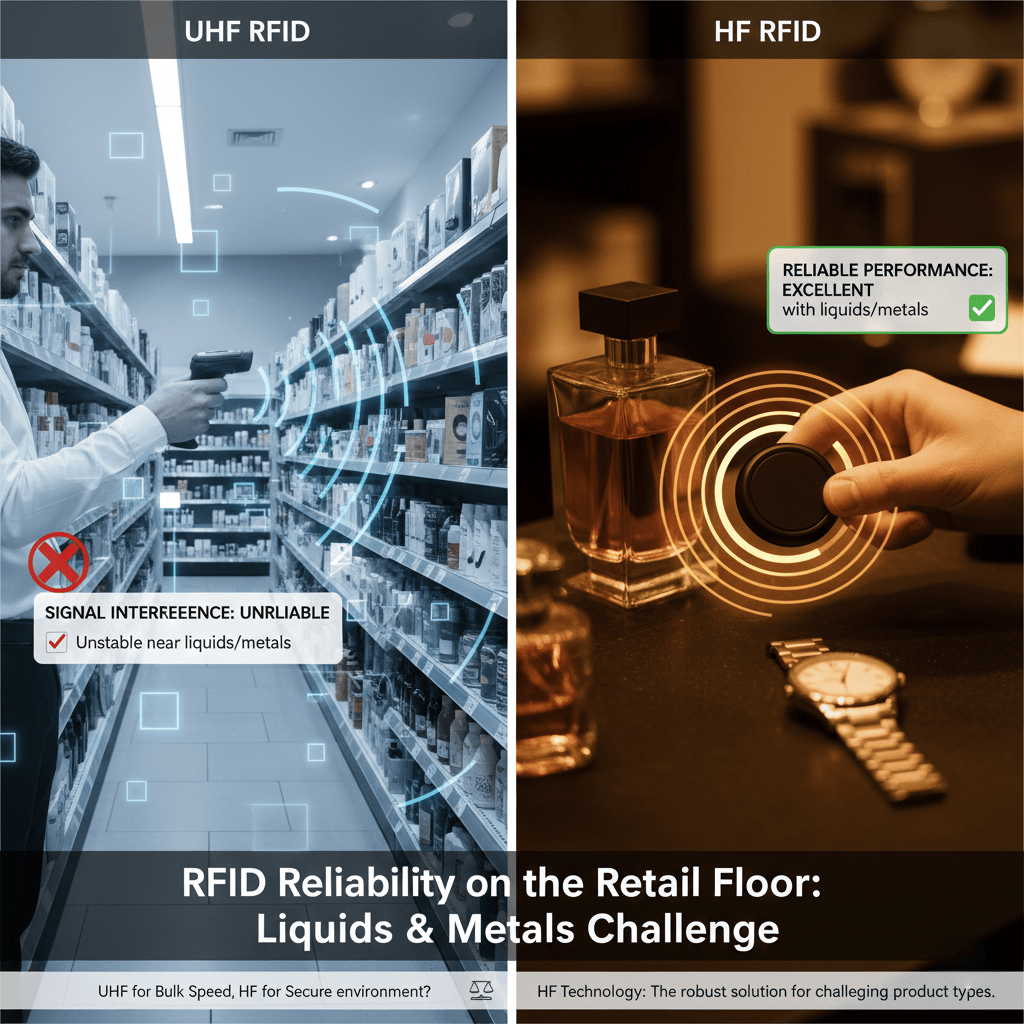
This is a critical technical detail that many buyers overlook. I once consulted for a high-end cosmetics company that was planning a full UHF rollout. During our pilot test, the read rates were terrible. The liquids4 and foil in their packaging were absorbing and reflecting the UHF radio waves. From my early days as an engineer, I knew this would happen. We quickly pivoted their strategy to HF, saving the project. You must test the technology with your specific products before you invest.
The UHF Challenge: Signal Interference
UHF RFID uses radio waves to communicate. Think of it like a tiny radio station. But water absorbs these waves, and sheets of metal reflect them. This creates dead zones where tags cannot be read. While you can buy special "on-metal" UHF tags, they are more expensive and don't completely solve the problem with liquids4. This can lead to frustration and inaccurate data.
The HF Advantage: Reliable Proximity
HF RFID uses magnetic inductive coupling. This is similar to the technology in your wireless phone charger. The reader and tag create a small, contained magnetic field to share data. This field is not easily disturbed by water or metal. This makes HF2 the most reliable choice for item-level tagging on difficult products like jewelry, pharmaceuticals, library books, and bottled goods.
| Material | UHF Performance | HF Performance | Buyer Recommendation |
|---|---|---|---|
| Liquids (e.g., Perfume) | Poor (Signal absorption) | Excellent | Choose HF tags for reliability. |
| Metals (e.g., Electronics) | Poor (Signal reflection) | Good | Use HF, or test on-metal UHF tags carefully. |
| Dense Items (e.g., Stacks of Jeans) | Good | Fair (Field may not penetrate deep) | UHF is better for bulk apparel and textiles. |
So, if your inventory contains many of these challenging materials, HF is the safer and more reliable investment. For standard apparel, shoes, or dry goods, UHF will work very well.
What Is the True Cost of a UHF vs. an HF RFID System?
Your budget is tight. You see that UHF tags are cheaper and think it's an easy choice. But the tag price is only one part of the total cost of ownership.
While individual UHF tags are cheaper than HF tags, the overall system cost can be higher. UHF readers and antennas are more complex and expensive. A full cost analysis8 must include hardware, tags, software, and implementation for an accurate picture.
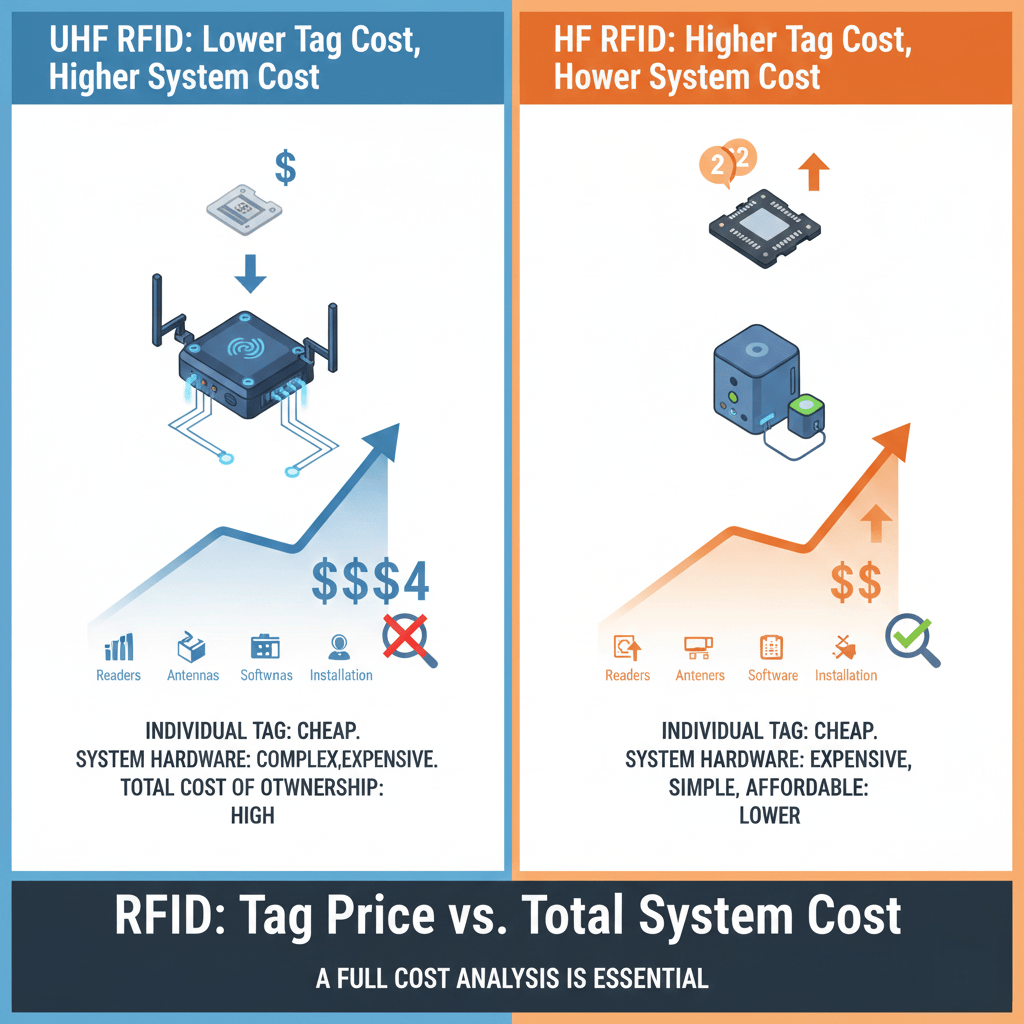
As a buyer, you must look beyond the per-tag price. I always advise my clients to calculate the Total Cost of Ownership9 (TCO). I worked with an electronics retailer who almost made this mistake. They focused on the low cost of UHF tags for their small, high-value items10. They did not realize that the infrastructure to make it work in their store would be complex, and that HF would have given them better reliability because of the metal in their products.
Breaking Down the Costs
An RFID system has several cost components. The tags are just the start of your investment.
The Infrastructure Investment
UHF systems need more powerful, and therefore more expensive, readers. If you want to use fixed readers to cover a stockroom, you will need multiple antennas. You will also need an expert to help you place them correctly to avoid dead zones. This installation requires expertise and adds to the initial cost. HF readers are generally simpler and cheaper. But, you may need more of them, such as one at every checkout station.
Here’s a simplified cost breakdown for your evaluation:
| Cost Component | UHF System | HF System | Key Consideration for a Buyer |
|---|---|---|---|
| Tags | Lower cost per tag ($0.04-$0.10) | Higher cost per tag ($0.10-$0.50) | UHF is cheaper for very high tag volumes. |
| Handheld Readers | More expensive | Less expensive | How many mobile scanners do your staff need? |
| Fixed Readers | High cost, complex design | Moderate cost, simpler design | What is the size and layout of the area to cover? |
| Implementation | Can be complex and costly | Usually more straightforward | Do you need to hire an RF planning expert? |
Your final cost depends on your scale and use case. If you need to tag millions of low-cost apparel items, the cheaper UHF tags make sense, even with higher reader costs. But if you are tagging thousands of high-value, metallic, or liquid-based items, the reliability and lower infrastructure cost of HF may result in a lower TCO and better ROI.
Conclusion
The right choice is not about which technology is better. It is about which is better for your specific retail need. Analyze your products, processes, and budget carefully.
---Find out how RFID technology can streamline and speed up inventory counts. ↩
Learn how HF RFID technology can enhance accuracy in item-level tagging. ↩
Understand the differences in read range between UHF and HF RFID technologies. ↩
Explore the performance of RFID tags when used with liquid products. ↩
Discover how metals affect RFID tag performance and reliability. ↩
See how RFID technology improves checkout speed and accuracy at POS terminals. ↩
Learn how RFID technology enhances security for individual items in retail. ↩
Understand how to conduct a thorough cost analysis for RFID investments. ↩
Understand the importance of TCO when evaluating RFID system investments. ↩
Find out the best RFID solutions for tagging high-value products. ↩