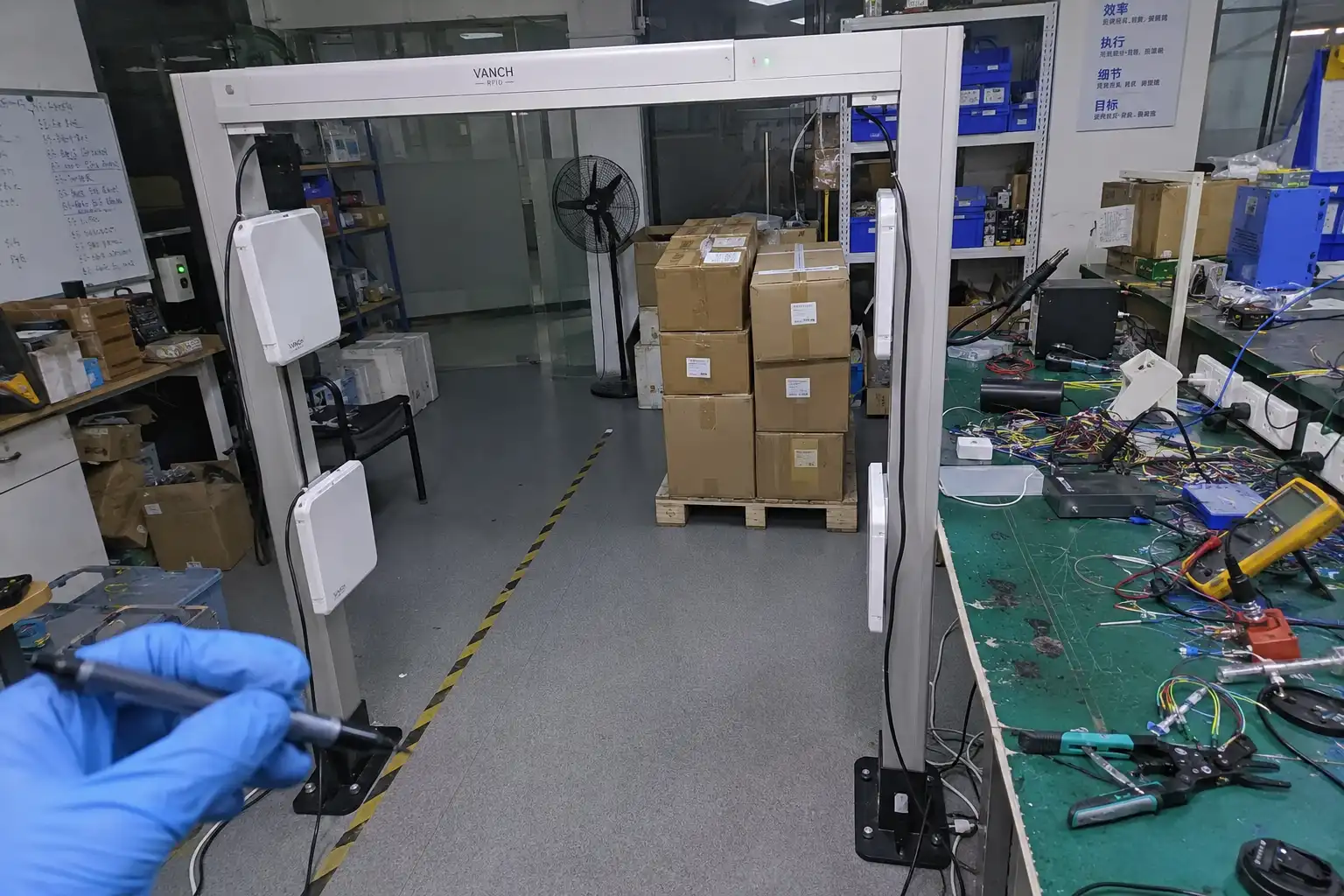
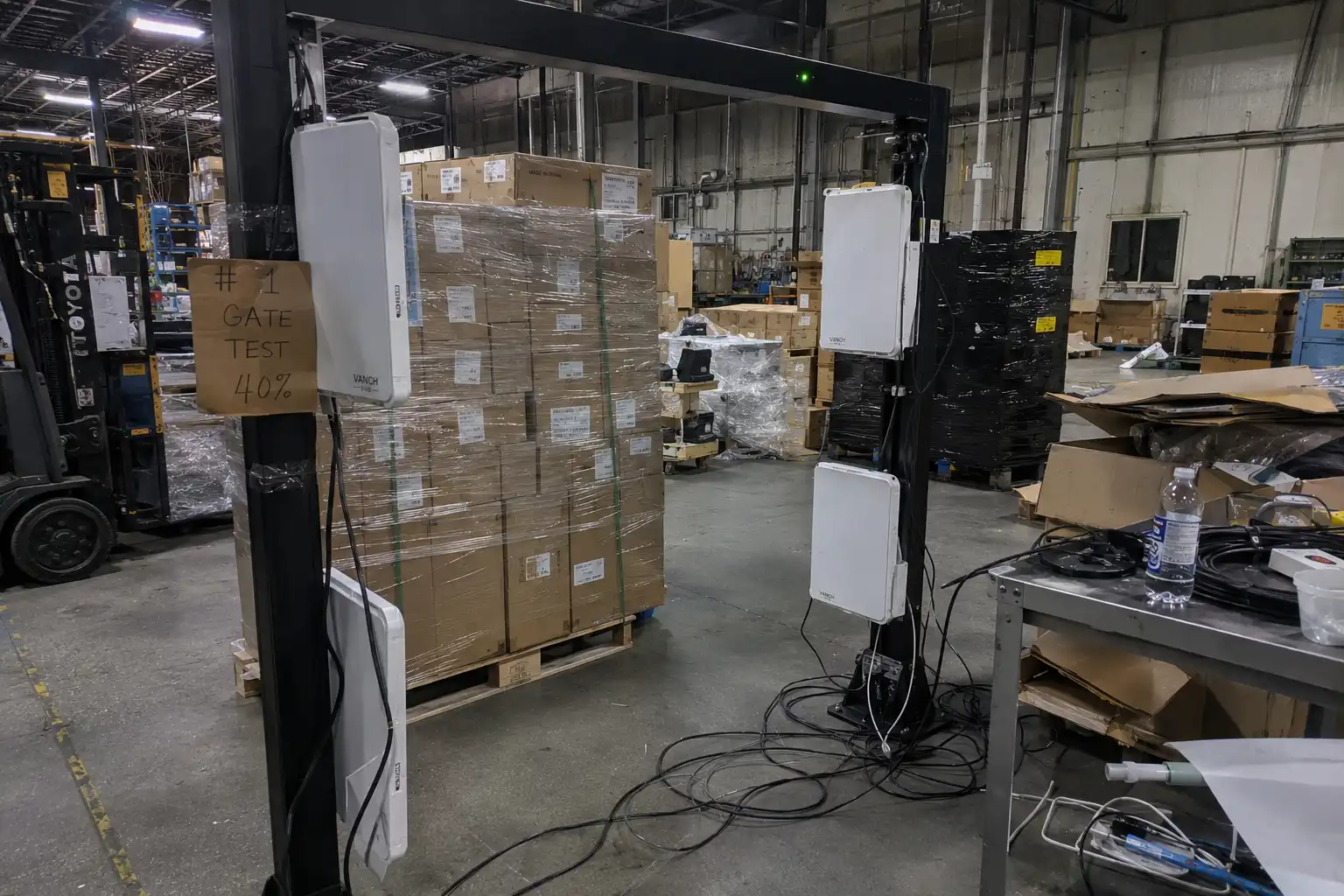
Your lab demo was flawless. The UHF reader, positioned perfectly, read a test tag from 10 meters away. You signed off on the PO for 50 portal gates. Now, at Gate 1 of your live warehouse deployment, a forklift loaded with a pallet of 200 tagged cartons drives through, and your read rate plummets to 40%. The system you sold as 99.9% accurate1 is a failure, your client is furious, and you're left wondering why your UHF RFID reader loses range in the real world.
A UHF RFID reader loses range in a warehouse not because of a single component failure, but due to a system collapse caused by two main factors: 1) Air interface collision from high tag density overwhelming the reader's anti-collision firmware, and 2) Signal absorption and antenna detuning from environmental materials like metal and liquid. Solving this requires an engineered system, not just a powerful reader.
Let's be very direct. You've fallen into the "Ideal Specs Trap." You bought a reader based on its maximum range in an empty room, not its ability to function in the chaos of a real distribution center. The problem isn't that your reader is broken; it's that your entire system architecture is fighting the laws of physics. The fix isn't a simple software patch; it's a fundamental change in how you select and configure your hardware.
I've seen this exact scenario play out with countless frustrated system integrators. Here’s how we fix it.
The Core Technical Trap: Air Interface Collision
Your reader was great at listening to one tag. Now you're asking it to listen to 200 tags all shouting at the same time in the 2-3 seconds the pallet is inside the portal. This is "air interface collision2," and it's the number one reason your reader goes deaf.
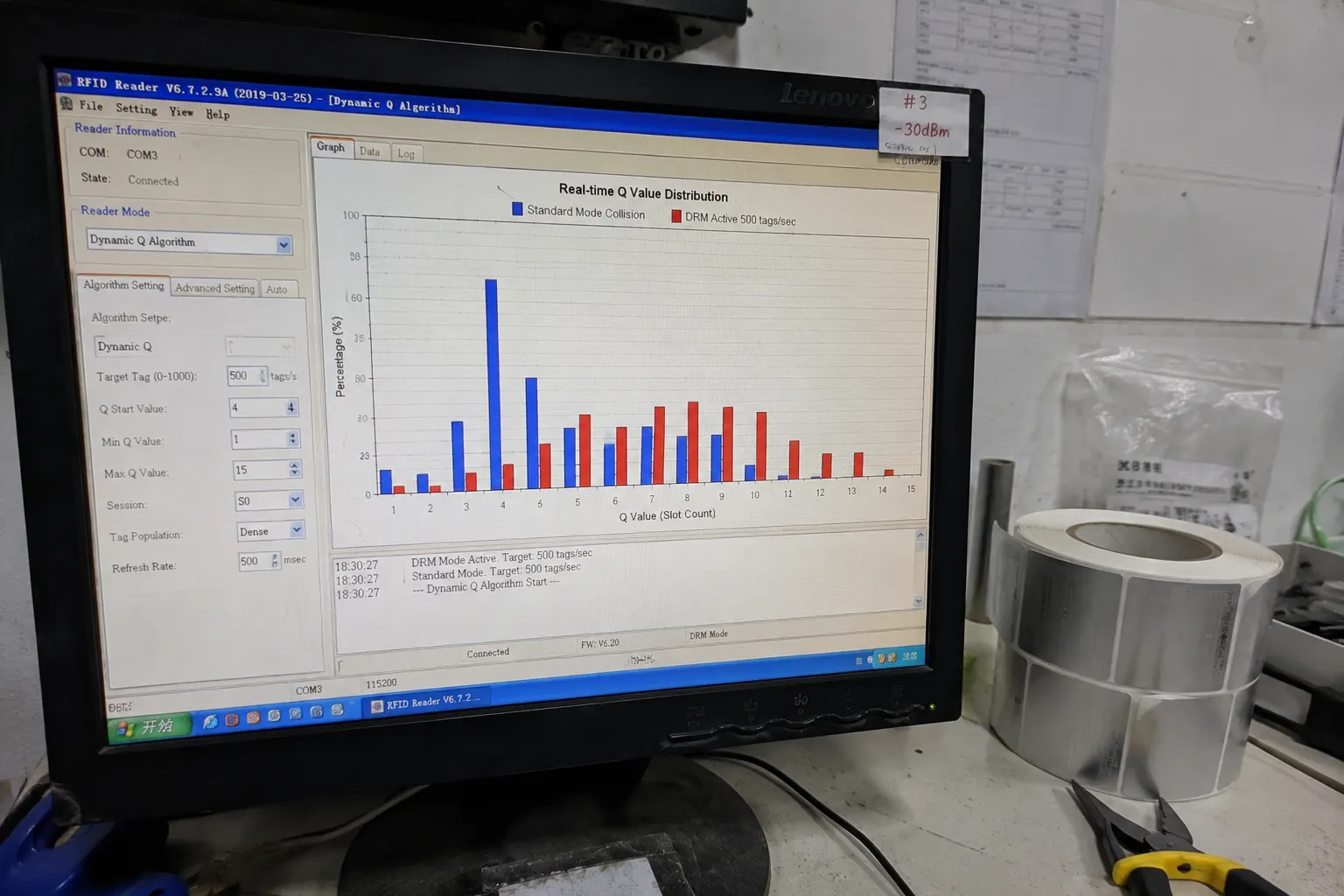
A standard reader uses a simple anti-collision algorithm that's easily overwhelmed. It can't manage the tsunami of data. The solution is firmware designed specifically for this chaos: Dense Reader Mode (DRM)3.
| Feature | Standard Reader Firmware | DRM-Enabled Firmware (Fongwah) |
|---|---|---|
| Anti-Collision Protocol | Basic Q-algorithm (Static) | Dynamic Q-algorithm4, session management |
| Tag Singulation Speed | Low (~50-100 tags/sec) | High (>500 tags/sec) |
| Channel Management | Prone to jamming, self-interference | Intelligent channel hopping to avoid noise |
| Real-World Performance | Read rate collapses under load | Maintains high read rates with 200+ tags |
Hardware Teardown: Behind the Datasheet
I was on a call with a systems architect overseeing a massive rollout in Chicago who was tearing his hair out over this. His expensive readers were useless. The issue is that DRM isn't just a buzzword; it's a resource-intensive process. A cheap reader's processor can't handle the real-time calculations needed to dynamically manage hundreds of tag sessions. It chokes. Our high-power UHF readers are built with powerful processors specifically to execute these complex algorithms without breaking a sweat. This capability is baked into our core architecture, which you can see in our Fongwah RFID SDK Integration & Firmware Matrix. It's not a patch; it's the engine's design.
Integration & Environment Realities: The Signal Killers
That 10-meter read range you saw in the lab was with a tag floating in clean air. Your warehouse is filled with metal shelving, steel-belted tires, and pallets of liquid—the two biggest enemies of UHF RFID5.
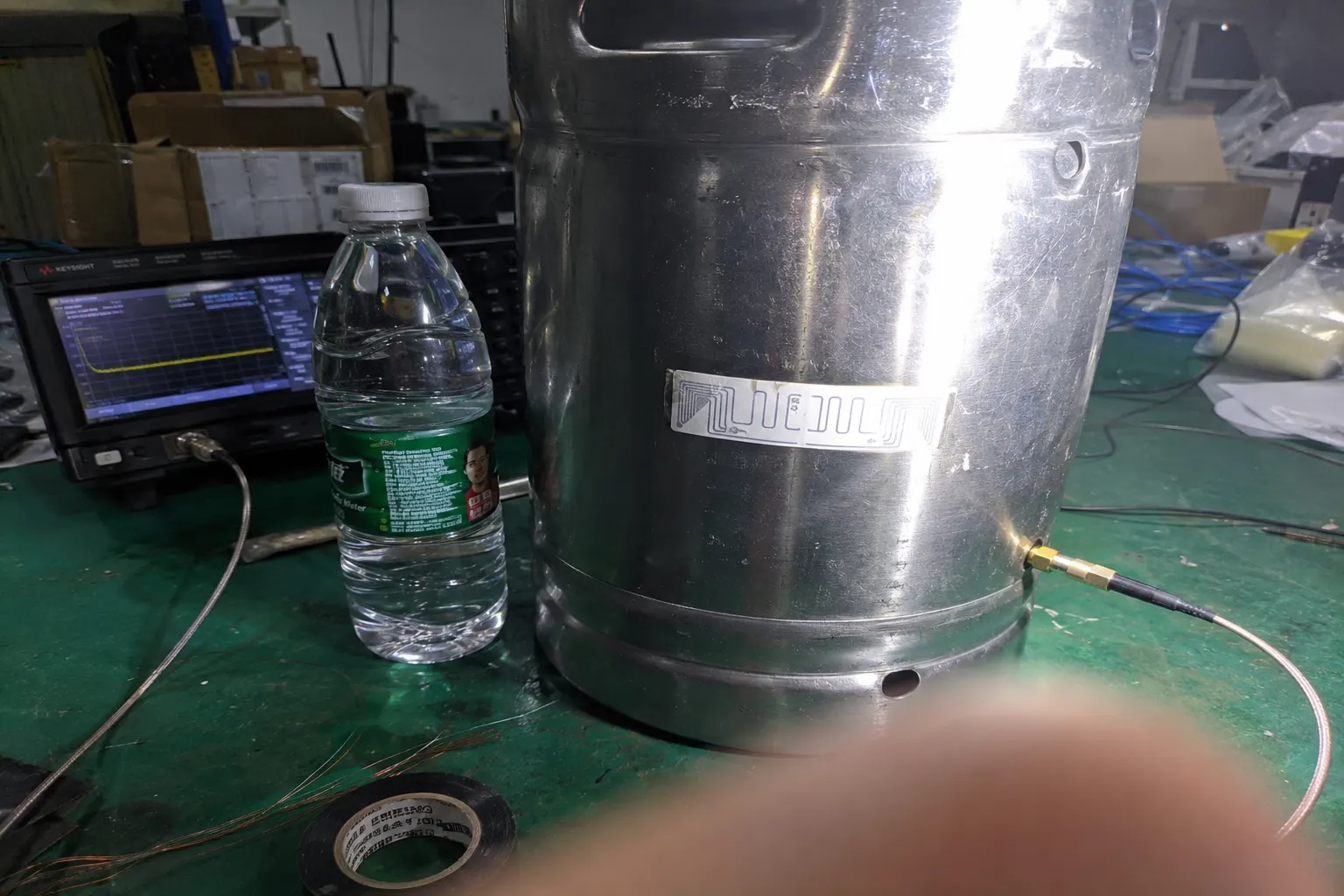
Slapping a generic paper tag onto a metal keg or a crate of bottled water is like trying to shout underwater. The signal is either reflected and distorted (by metal) or absorbed entirely (by liquid). Your reader isn't losing range; the tag's antenna is being physically detuned and silenced by its surroundings.
The solution is to match the tag to the item and use a reader smart enough to adapt.
| Tag Type | Generic PET Label | On-Metal Tag | Liquid-Resistant Tag |
|---|---|---|---|
| Construction | Thin paper/plastic | Thick, foam spacer6, modified antenna | Encapsulated, specific tuning |
| Read Range on Metal | Near zero | Excellent | Poor |
| Read Range on Liquid | Near zero | Poor | Good |
Engineer's Insight: What the Specs Don't Tell You
When an integrator tells me "my uhf rfid reader loses range," the first thing I ask is, "What tag are you using, and what are you sticking it on?" 90% of the time, that's the real problem. You cannot fix a physics problem with a software setting. At Fongwah, we approach this from the other direction. We don't just sell you a reader. We ask what you're tracking and help you select the correct tag-reader-antenna combination for that specific asset. Our catalog isn't just a list of boxes; the products in our Fongwah High-Power UHF RFID Reader Supplier Catalog are solutions engineered for these exact tough environments, with features like dynamic polarization tuning that actively search for the best signal path to a tag, even in a compromised environment.
Sourcing, Compliance & Risk Mitigation: Building a Resilient System
The final mistake is fragmented sourcing. You bought a reader from Vendor A, tags from Vendor B, and middleware from Vendor C. Now that it's failing, they are all blaming each other, and you are stuck in the middle with a non-functional system.
A successful warehouse deployment is a single, cohesive system, not a pile of parts. The reader's firmware must be tuned to the antennas, which must be positioned correctly for the tags that have been selected for the specific products passing through the portal.
| Sourcing Strategy | Component-Level Sourcing | System-Level Partnership (Fongwah) |
|---|---|---|
| Responsibility | Fragmented, leads to blame game | Single point of accountability |
| Performance | Unpredictable, "best effort" | Guaranteed, based on system simulation |
| Troubleshooting | "Is it the tag, reader, or antenna?" | "Let's analyze the system data." |
Technical Deep-Dive: Pre-Order Verification FAQs
Q1: Will implementing Dense Reader Mode (DRM) drastically increase latency when integrated into our existing warehouse management software (WMS) API middleware?
Answer: Absolutely not. While DRM requires intensive processing to manage dynamic Q-algorithm slot allocations and multi-channel hopping, these calculations are executed entirely at the hardware layer by our high-power readers' onboard processor. Because the singulation and anti-collision filtering occur at the firmware edge, the reader only streams clean, deduplicated tag data blocks to your WMS API. This actually reduces middleware compute overhead and latency compared to a standard reader that floods the network with corrupted, colliding data packets.
Q2: How to prevent UHF RFID signal reflection and ghost reads caused by warehouse metal racking?
Answer: Relying on single-element linear polarization is a guarantee for failure in a warehouse. Fongwah's portal gates utilize high-gain circularly polarized antennas7 paired with our reader's dynamic polarization tuning. This architecture ensures that regardless of the tag's physical orientation on the carton, the helical RF field maintains energy transfer. To combat multi-path reflections from steel racking, our firmware analyzes RSSI (Received Signal Strength Indicator)8 and phase angles9 in real time to isolate actual tag responses from environmental wave reflections, preventing ghost reads and maintaining a stable zone.
Conclusion: Choosing Reliability Over Risk
Your UHF RFID reader isn't losing range because it's faulty. It's losing range because it's the most visible part of a broken system. The failure is predictable and preventable. By shifting your focus from a single component's datasheet to a holistic system architecture—one that accounts for tag density with DRM and environmental factors with proper tag selection—you can build the resilient, high-performance system your client was promised.
Stop Debugging a System That Was Never Engineered
Is your UHF RFID reader losing range on high-density pallets or near metal and liquid? Don't waste another week tweaking software settings. Send me the details of your portal setup, the tags you're using, and the assets you're tracking. I'll tell you exactly where the physics is breaking your system. At Fongwah Technology, we build predictable success. Get a direct engineering analysis and quote through the Fongwah Direct Factory RFQ Portal.
"Radio-frequency identification - Wikipedia", https://en.wikipedia.org/wiki/Radio-frequency_identification. Industry implementations of RFID in supply chain and warehouse environments commonly target read rates above 99% for successful operation, with specific requirements varying based on application criticality, though achieving such performance requires proper system design and environmental consideration. Evidence role: general_support; source type: institution. Supports: typical accuracy requirements or expectations for warehouse RFID systems. Scope note: Performance targets vary significantly by application and no single universal standard defines required accuracy ↩
"Survey of Standardized ISO 18000-6 RFID Anti-collision Protocols", https://www.academia.edu/11487208/Survey_of_Standardized_ISO_18000_6_RFID_Anti_collision_Protocols. Air interface collision in RFID systems occurs when multiple tags respond simultaneously to reader interrogation, creating signal interference that prevents successful data transmission, a fundamental challenge addressed by the EPC Gen2 protocol's anti-collision mechanisms. Evidence role: mechanism; source type: paper. Supports: the technical mechanism by which simultaneous tag transmissions create interference in RFID systems. Scope note: Source describes the general phenomenon but may not quantify specific performance degradation percentages ↩
"[PDF] Guidelines for Securing Radio Frequency Identification (RFID ...", https://nvlpubs.nist.gov/nistpubs/legacy/sp/nistspecialpublication800-98.pdf. Dense Reader Mode is defined in the EPC Gen2 RFID protocol as a configuration that enables readers to operate in environments with multiple nearby readers by implementing specific interference mitigation techniques including listen-before-talk and frequency hopping. Evidence role: definition; source type: institution. Supports: the standardized definition and purpose of Dense Reader Mode in RFID systems. Scope note: The standard defines DRM primarily for reader-to-reader interference rather than tag density management specifically ↩
"Adaptive and dynamic RFID tag anti-collision based on secant ...", https://pmc.ncbi.nlm.nih.gov/articles/PMC6281215/. Research on RFID anti-collision protocols demonstrates that dynamic Q-algorithm implementations, which adjust the frame size based on tag population estimates, achieve higher throughput and lower collision rates compared to static Q-parameter approaches in variable tag density scenarios. Evidence role: expert_consensus; source type: paper. Supports: the performance advantages of dynamic versus static Q-algorithm implementations in RFID systems. ↩
"Electromagnetic absorption by water - Wikipedia", https://en.wikipedia.org/wiki/Electromagnetic_absorption_by_water. Metal surfaces reflect and detune UHF RFID signals by altering antenna impedance and creating multipath interference, while liquids with high dielectric constants absorb electromagnetic energy at UHF frequencies, both effects significantly reducing read range and reliability. Evidence role: mechanism; source type: paper. Supports: the physical mechanisms by which metal and liquid interfere with UHF RFID signals. ↩
"RFID Label Tag Design for Metallic Surface Environments - PMC", https://pmc.ncbi.nlm.nih.gov/articles/PMC3274061/. On-metal RFID tags incorporate dielectric spacer materials (such as foam) between the antenna and metal surface to create physical separation that prevents the metal from acting as a direct ground plane, which would otherwise short-circuit the antenna and eliminate radiation. Evidence role: mechanism; source type: education. Supports: the technical function of spacer materials in on-metal RFID tag design. ↩
"A Handheld Fine-Grained RFID Localization System with Complex ...", https://www.media.mit.edu/publications/a-handheld-fine-grained-rfid-localization-system-with-complex-controlled-polarization/. Circularly polarized RFID antennas provide orientation-independent performance because they radiate electromagnetic fields that rotate through all linear polarization angles, reducing sensitivity to tag orientation and mitigating polarization mismatch losses that occur with linearly polarized systems. Evidence role: expert_consensus; source type: paper. Supports: the performance advantages of circular polarization in RFID systems with variable tag orientations. ↩
"A Machine Learning Multipath Mitigation Approach for ...", https://ece.osu.edu/sites/default/files/2022-09/A_machine_learning_multipath_mitigation_approach_for_opportunistic_navigation_with_5G_signals.pdf. RSSI measurements in RFID systems can provide indicators of signal quality and multipath effects, as reflected signals typically exhibit different amplitude characteristics and temporal patterns compared to direct-path transmissions, though distinguishing these requires sophisticated signal processing. Evidence role: mechanism; source type: paper. Supports: methods by which RSSI analysis can help identify multipath interference in RFID systems. Scope note: RSSI alone is often insufficient for reliable multipath discrimination and is typically combined with phase analysis and temporal filtering ↩
"[PDF] A Universal Method to Combat Multipaths for RFID Sensing", https://users.soe.ucsc.edu/~qian/papers/CPIX-INFOCOM2020.pdf. Phase measurements in RFID systems capture the temporal relationship between transmitted and received signals; multipath reflections introduce phase shifts due to different path lengths, enabling signal processing algorithms to identify and potentially suppress reflected components. Evidence role: mechanism; source type: paper. Supports: the use of RF phase measurements to detect and mitigate multipath interference in RFID systems. ↩