
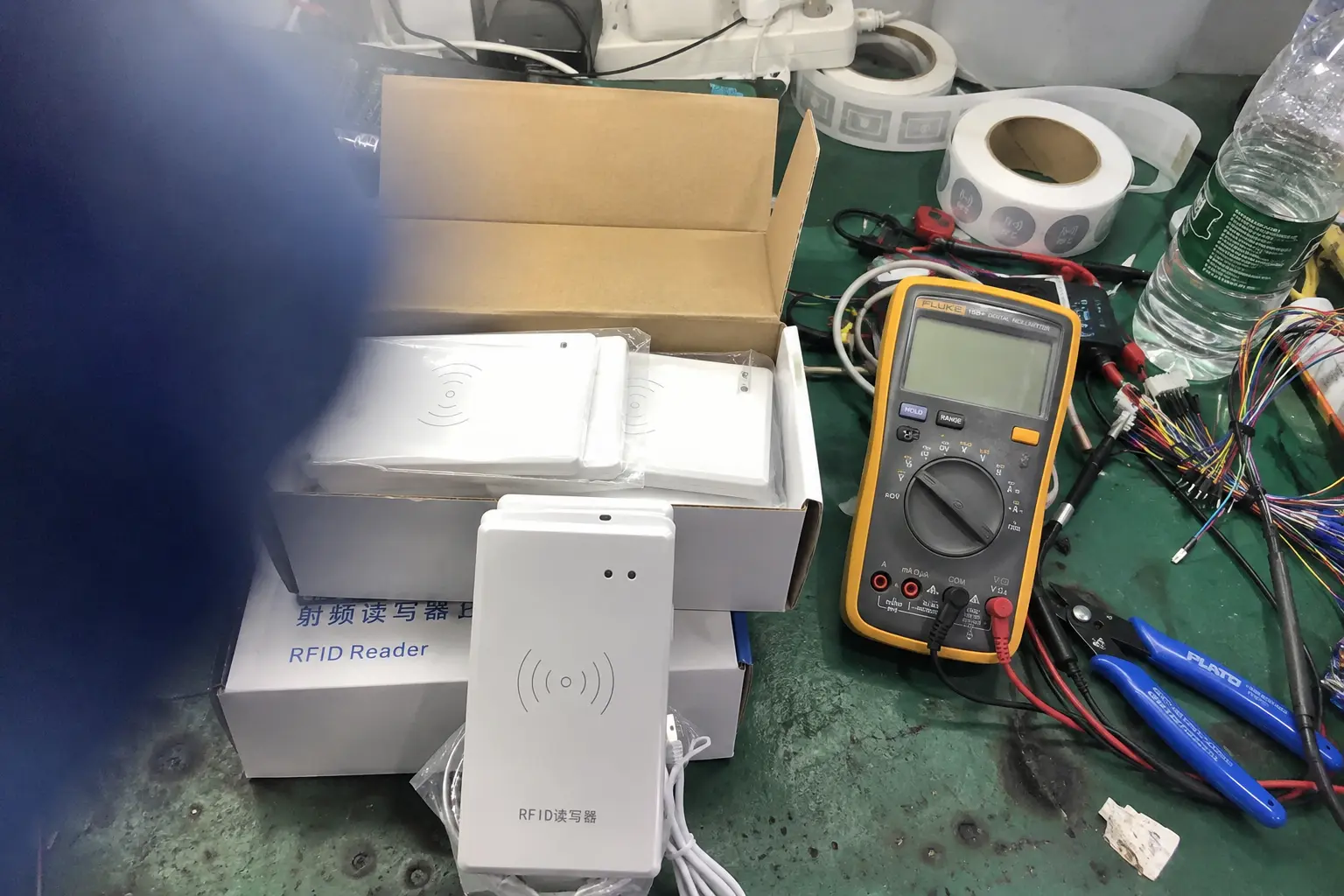
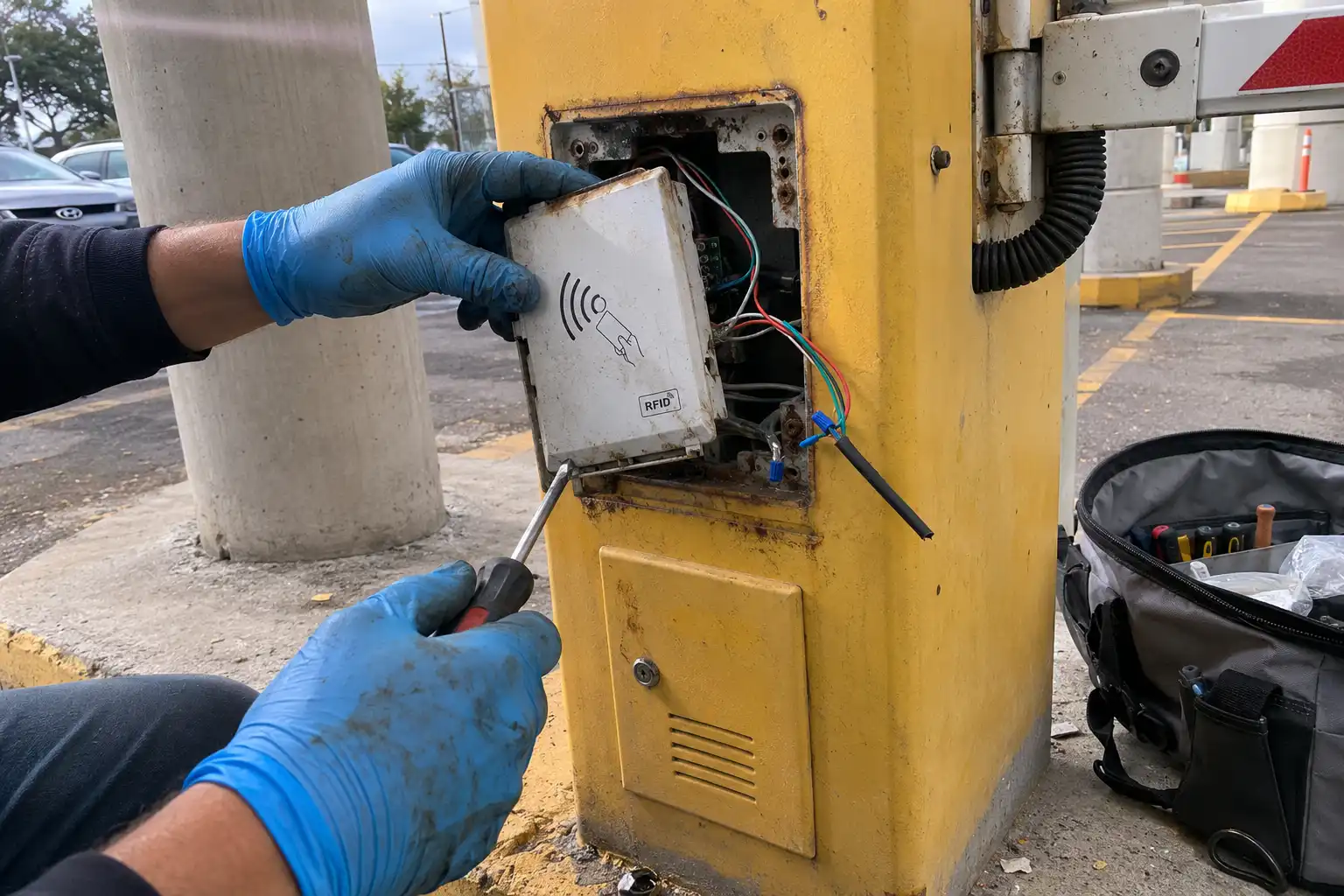
Your new smart parking system is live, but the support calls are flooding in. Gates aren't opening. The logs show corrupted Wiegand data. Your client is threatening to pull the contract, and you’re facing thousands in labor costs to diagnose the 200 "bargain" RFID readers you sourced directly from a factory in China. The problem isn't your software; it's hiding inside the reader's plastic case.
When buying RFID readers from China, especially for high-EMI environments like parking gates, the lowest price is a trap. You must verify the hardware includes specific defenses against motor interference, such as internal EMI shielding and isolated power filtering circuits. Without these, your reader will fail in the field, turning a low unit cost into a massive project loss.
Let me be brutally honest: that rock-bottom quote is a direct indicator of missing components. Cheap white-label readers fail next to barrier gate motors because the manufacturers strip out the internal EMI shielding and power filtering circuits to save 50 cents. The data corruption you're seeing isn't a random glitch—it's a predictable hardware failure you can and must screen for before you buy.
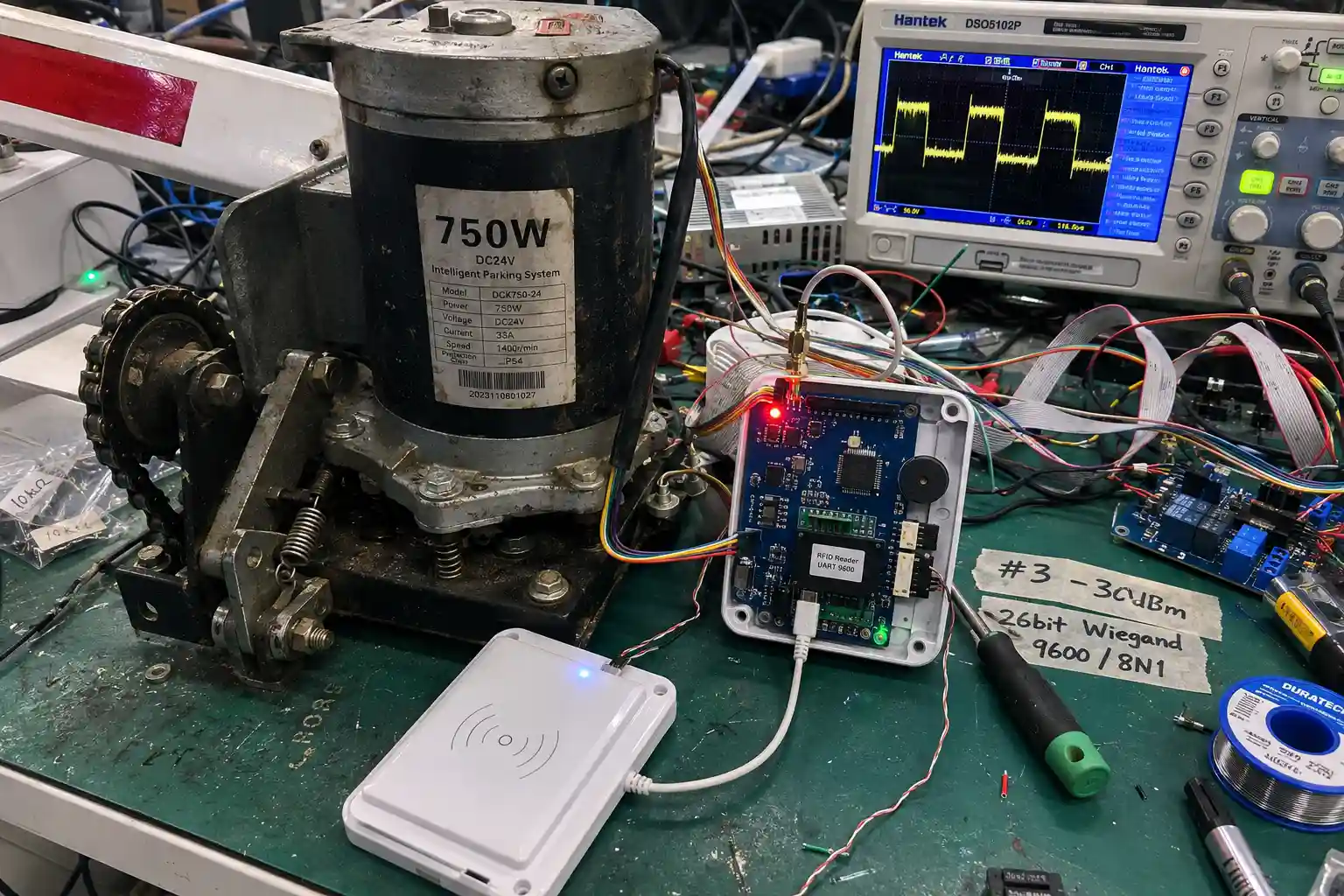
As an engineer who has seen the inside of these failed units, let me show you exactly what to demand from any potential factory supplier.
The 'Wiegand Data Corruption' Black Box
The demo unit worked perfectly on your clean workbench. It read cards instantly. But a workbench doesn't have a 750-watt motor right next to it, generating a massive spike of electromagnetic noise1 every time the gate arm moves.
This electrical noise is the killer. It floods the unshielded data lines between your reader and the controller, turning clean Wiegand or RS485 signals into garbage2. This is the "Wiegand Data Corruption Black Box" that so many integrators fall into.
The solution isn't in the firmware; it's in physical, hardware-level defenses that cheap readers simply don't have.
| Feature | Cheap White-Label Reader | Fongwah Industrial-Grade Reader |
|---|---|---|
| EMI Shielding | None (exposed PCB) | Dual-layer metal can over core circuits |
| Power Supply Circuit | Simple, unfiltered | Optoelectronic isolation3, transient filter |
| Data Line Integrity | High Risk of corruption | Low Risk, signal is hardened |
| Field Failure Rate | High, especially near motors | Extremely low, designed for industry |
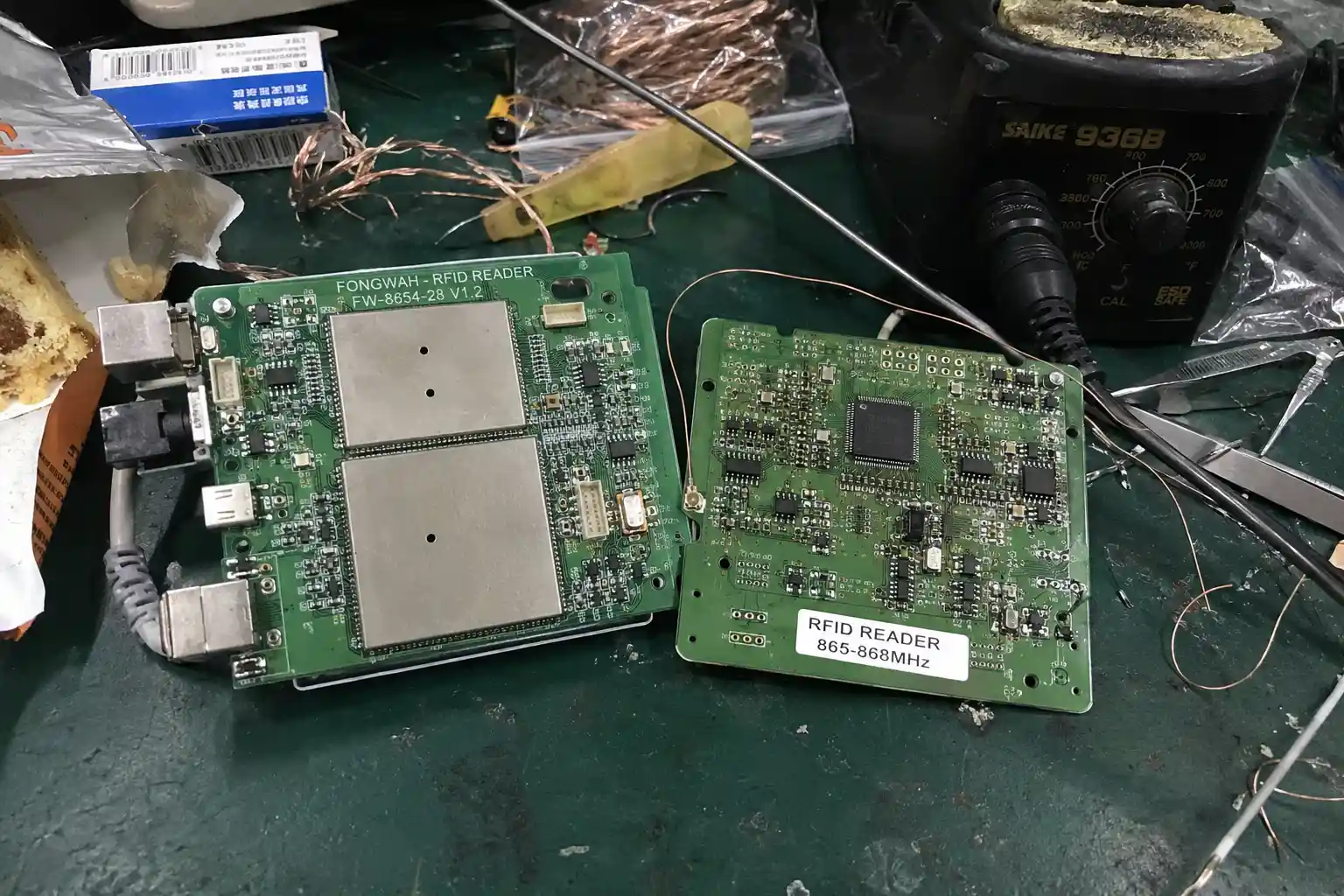
Hardware Teardown: Behind the Datasheet
I see these cost-cut boards every week. The first thing a factory does to win on price is remove the metal EMI shielding can that should sit over the processor4. The second is to use a bare minimum power circuit without proper filtering capacitors and inductors. It saves them less than a dollar, but it makes the reader completely defenseless. When that parking gate motor kicks on, the electromagnetic pulse jumps directly onto the PCB traces. Your access controller receives gibberish, and the gate stays shut. This isn't a defect; it's a design choice. Before you buy, demand a photo of the internal PCB. If it looks bare, walk away.
Verifying Real Compliance vs. Fake Logos
Every supplier website has FCC and CE logos on it. Many of them are fake. Placing a JPEG on a homepage is free; passing rigorous emissions and immunity testing in a certified lab costs tens of thousands of dollars.
A legitimate manufacturer is proud of their compliance and will provide proof. A fraudulent one will make excuses. Don't take their word for it—verify it yourself.
Pre-Purchase Verification Checklist:
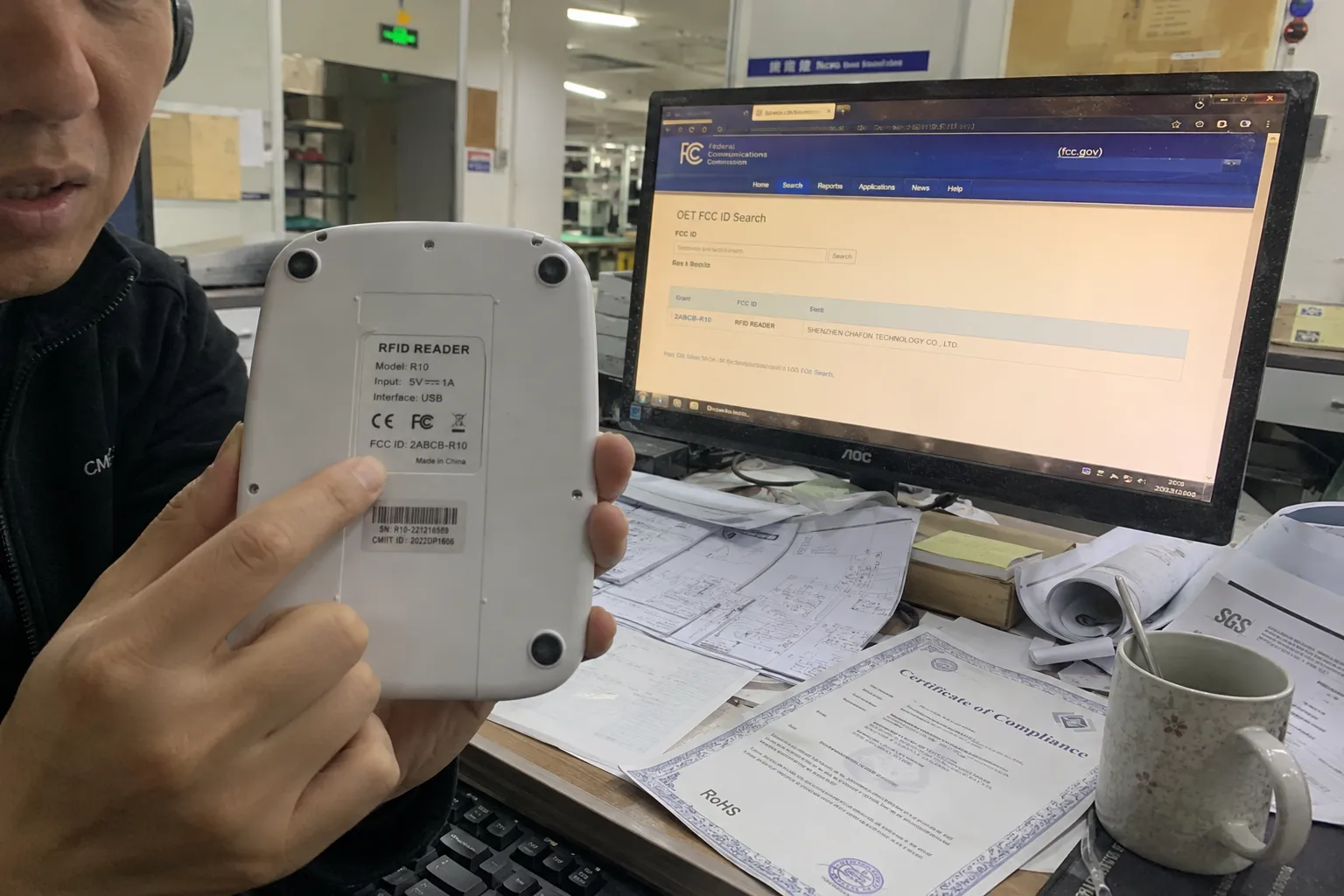
- Demand the FCC ID: Ask for the specific alphanumeric FCC ID printed on the product label.
- Search the Database: Go to the official FCC ID database online5 and enter the number.
- Cross-Reference: Does the company name ("Grantee") and product description in the database match what you're being sold? If not, it's a fake ID.
- Request the CE DoC: For Europe, ask for the full Declaration of Conformity document6. It should list the specific EN standards the product was tested against7.
Engineer's Insight: What the Specs Don't Tell You
If a potential supplier hesitates, delays, or gets defensive when you ask for their FCC ID or CE test reports, end the conversation. It's the biggest red flag in this business. A real factory that has invested in proper engineering wants to show it off. We've spent the money to ensure our hardware won't interfere with other systems and, just as importantly, that other systems won't interfere with it. Our compliance documentation is an open book. You can start by reviewing the technical files in the Fongwah Official Product Catalog & Datasheets to see what a real submission looks like.
Sourcing for Total Cost of Ownership, Not Price
The $25 reader seems like a much better deal than the $45 one. But this simple math is what puts system integrators out of business. The true cost of a component isn't its purchase price; it's the total cost over its lifetime, including the cost of failure.
Let's do the real math for a 100-reader installation.
| Cost Item | "Cheap" $25 Reader | Reliable $45 Reader |
|---|---|---|
| Initial Purchase | $2,500 | $4,500 |
| Field Failure Rate (Est.) | 20% (20 units) | <1% (1 unit) |
| Replacement Cost (Labor) | 20 units x $150/truck roll = $3,000 | 1 unit x $150 = $150 |
| Total Cost (Year 1) | $5,500 | $4,650 |
Pre-Order Sourcing Verification: FAQs
Q1: Will your reader's Wiegand line stability degrade if run alongside high-voltage AC cables in the same conduit?
- Answer: No. While standard readers suffer from cross-talk and induction glitches, Fongwah readers feature dedicated optoelectronic isolation and transient filters on the communication lines. For long-distance runs parallel to AC lines, we implement shielded twisted pairs and differential signaling to completely suppress common-mode noise8, ensuring zero-bit data corruption.
Q2: How can we verify your batch-produced readers actually match the hardware layout of the sample PCB?
- Answer: Every single shipment from Fongwah is accompanied by a standardized Quality Assurance (QA) testing report linked to your batch number. We lock down our Bill of Materials (BOM) upon sample approval. We welcome third-party pre-shipment inspections at our Shenzhen facility, and our production lines utilize Automated Optical Inspection (AOI)9 to guarantee that every shielding can, capacitor, and inductor is flawlessly populated exactly like the approved engineering sample.
Conclusion: Choosing Reliability Over Risk
Buying RFID readers from China directly is a smart strategy to control costs and get closer to the engineering source. But success depends entirely on your vetting process. You must shift your focus from the price tag to the internal hardware resilience. Choose a manufacturing partner who can prove their device is hardened against the electrical chaos of the real world, not just a trader who promises the lowest price.
Stop Gambling on Unshielded Hardware
Planning a smart parking or access control rollout? Don't let a 50-cent component decision lead to a $50,000 project failure. Before you commit to a supplier, let's talk. Send me the environmental details of your installation site. I'll give you a checklist of technical questions to ask that will instantly expose a low-quality factory. At Fongwah Technology, we build hardware you can trust. Get a transparent, engineering-focused quote directly from our team at the Fongwah Direct Factory RFQ Portal.
"Effects of medically generated electromagnetic interference from ...", https://pmc.ncbi.nlm.nih.gov/articles/PMC9453256/. Electric motors, particularly inductive loads like barrier gate actuators, are documented sources of electromagnetic interference across a broad frequency spectrum, with transient spikes occurring during switching events that can couple into nearby signal lines through both radiated and conducted pathways. Evidence role: mechanism; source type: paper. Supports: Electric motors generate electromagnetic interference during operation. Scope note: The cited source establishes the general mechanism of motor-generated EMI but does not specifically quantify interference levels for 750-watt barrier gate motors or their specific impact on RFID reader data integrity. ↩
"Characteristic mode analysis of electromagnetic interference ... - PMC", https://pmc.ncbi.nlm.nih.gov/articles/PMC12216417/. Both Wiegand interface signals (typically operating at low voltage levels) and RS485 differential signaling are subject to corruption from electromagnetic interference when proper shielding and grounding practices are not implemented, though RS485's differential architecture provides inherently greater noise immunity than single-ended Wiegand implementations. Evidence role: mechanism; source type: education. Supports: Wiegand and RS485 protocols can experience signal degradation in high-EMI environments. Scope note: This describes the theoretical vulnerability of these protocols to EMI but does not provide field failure data specific to parking gate installations or quantify the threshold at which corruption becomes likely. ↩
"Design Guidelines for Optocoupler Safety Agency Compliance", https://www.mouser.com/applications/high-voltage-design-guidelines-for-optocoupler/?srsltid=AfmBOop1e9Kj5pBFL0m_hANgzMs-CykOugsk4Bgj8klP5u61C5XpMvyg. Optoelectronic isolators (optocouplers) provide galvanic isolation between circuit sections by transmitting signals via light rather than electrical connection, thereby breaking ground loops and blocking common-mode noise propagation, a technique widely specified in industrial control standards for harsh electromagnetic environments. Evidence role: mechanism; source type: education. Supports: Optoelectronic isolation provides electrical separation that reduces interference coupling. Scope note: This explains the general protective mechanism of optoelectronic isolation but does not specifically validate its effectiveness in RFID reader applications or quantify the degree of EMI immunity it provides in parking gate scenarios. ↩
"Enclosure Design for EMI - Electromagnetic Compatibility Laboratory", https://emclab.mst.edu/research/enclosure-design-for-emi/. Metal shielding cans soldered to printed circuit boards provide localized electromagnetic shielding for sensitive components such as processors and RF circuits, offering shielding effectiveness typically ranging from 40 to 100+ dB depending on material, seam quality, and frequency, and are widely specified in EMC design guidelines for commercial electronics. Evidence role: general_support; source type: education. Supports: Metal shielding enclosures are a recognized EMI mitigation technique in PCB design. ↩
"FCC ID Search | Federal Communications Commission", https://www.fcc.gov/oet/ea/fccid. The Federal Communications Commission maintains an official Equipment Authorization Search system accessible at fcc.gov/oet/ea, where any FCC ID can be verified against the agency's records of certified devices, including grantee information, test reports, and authorization dates. Evidence role: general_support; source type: government. Supports: The FCC maintains a public database for verifying equipment authorization. ↩
"EU Legislation and CE Marking - International Trade Administration", https://www.trade.gov/country-commercial-guides/eu-eu-legislation-and-ce-marking. Under EU Regulation 765/2008 and applicable New Approach directives, manufacturers must draw up an EU Declaration of Conformity stating that a product meets all applicable requirements, including identification of harmonized standards applied (such as EN standards for electromagnetic compatibility), before affixing the CE marking. Evidence role: definition; source type: government. Supports: The Declaration of Conformity is a mandatory document for CE marking. ↩
"ISO/IEC TR 20017:2011(en), Information technology", https://www.iso.org/obp/ui/en/#!iso:std:50964:en. RFID readers and access control equipment placed on the EU market must demonstrate compliance with harmonized standards such as EN 55032 (electromagnetic emissions) and EN 55035 (electromagnetic immunity) under the EMC Directive 2014/30/EU, with specific test requirements depending on the intended installation environment (residential, commercial, or industrial). Evidence role: general_support; source type: government. Supports: RFID readers must comply with harmonized EN standards for electromagnetic compatibility. ↩
"Common-mode rejection ratio - Wikipedia", https://en.wikipedia.org/wiki/Common-mode_rejection_ratio. Differential signaling architectures achieve common-mode rejection ratios typically ranging from 40 to 80 dB depending on implementation quality, while shielded twisted pair cabling provides additional attenuation of external electromagnetic fields, together forming a highly effective but not absolute defense against common-mode interference in industrial environments. Evidence role: mechanism; source type: education. Supports: Differential signaling and shielded twisted pair cabling provide substantial common-mode noise rejection. Scope note: This validates the effectiveness of these techniques but contradicts the article's claim of 'complete' suppression, as no practical implementation achieves infinite noise immunity and performance depends on frequency, shielding integrity, and grounding practices. ↩
"Automated optical inspection - Wikipedia", https://en.wikipedia.org/wiki/Automated_optical_inspection. Automated Optical Inspection systems use high-resolution cameras and image processing algorithms to detect component placement errors, missing parts, polarity mistakes, and solder defects on printed circuit board assemblies, serving as a standard quality control method in electronics manufacturing per IPC-A-610 acceptability standards. Evidence role: definition; source type: education. Supports: AOI is an established technology for detecting PCB assembly defects. ↩