You bid on a major government contract. You win. You install the hardware. Then, the system fails inspection because the readers interfere with local radio towers. You face fines, delays, and a ruined reputation.
Compliance is not optional in the security industry. A professional RFID Access Control System must adhere to strict ISO protocols and regional frequency regulations. Understanding these standards is the only way to ensure your installation is legal, secure, and compatible with existing infrastructure.
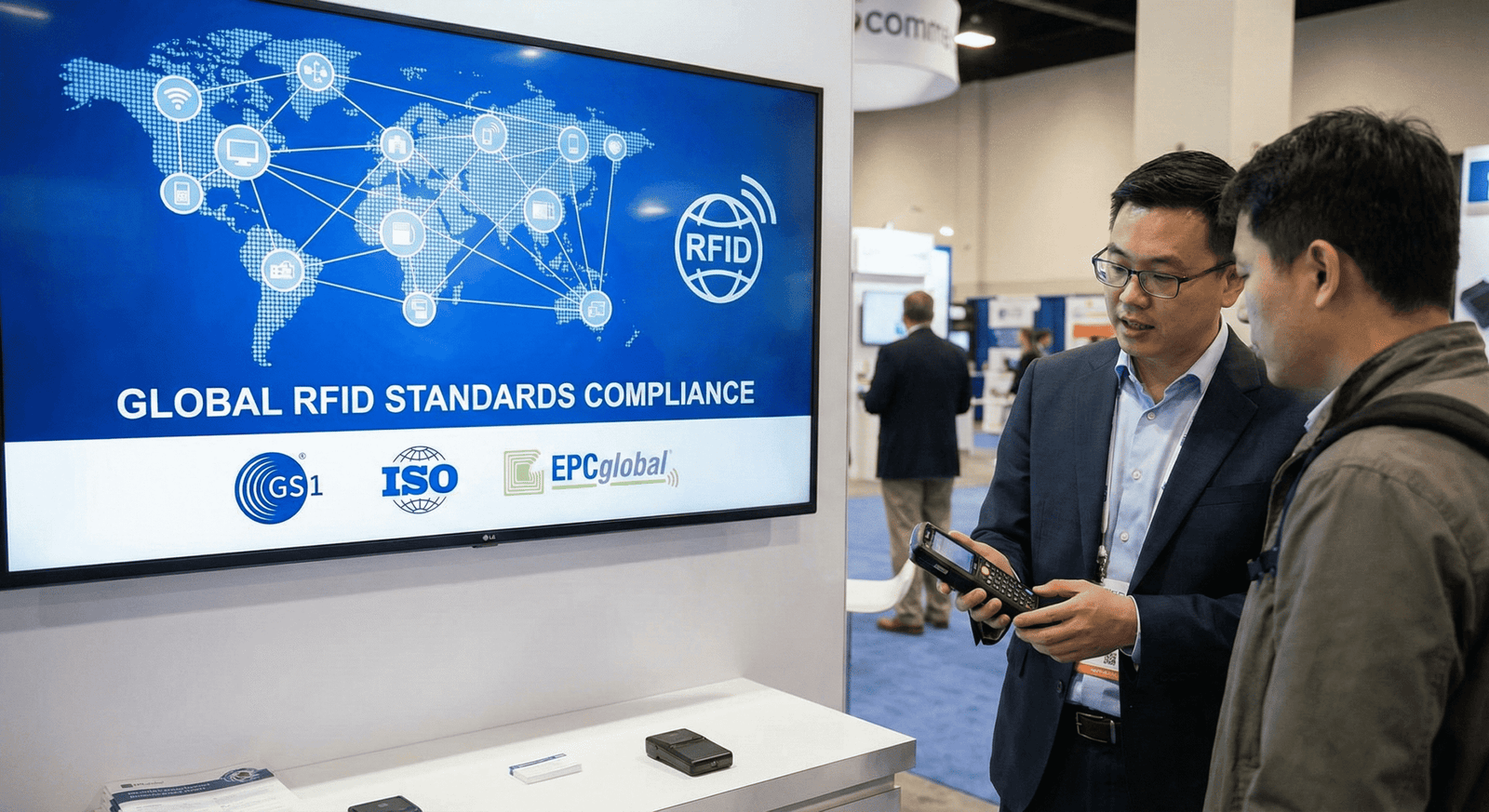
I have been in the RFID industry for five years. I started on the assembly line, soldering components. Now, as a Marketing Manager, I talk to system integrators all over the world. I see a pattern. The successful integrators ask about certifications first. The struggling ones ask about price first. If you are importing hardware for a commercial project, you cannot ignore the rules. You need to know why a reader works in New York but is illegal in Berlin. You need to know why one card is secure and another is easily copied. This guide is for the professionals who build systems that last.
Which protocol dictates the success of your security architecture?
You cannot mix and match RFID technologies like you mix paint. If you choose the wrong standard, your turnstiles will not open, and your parking gates will stay closed.
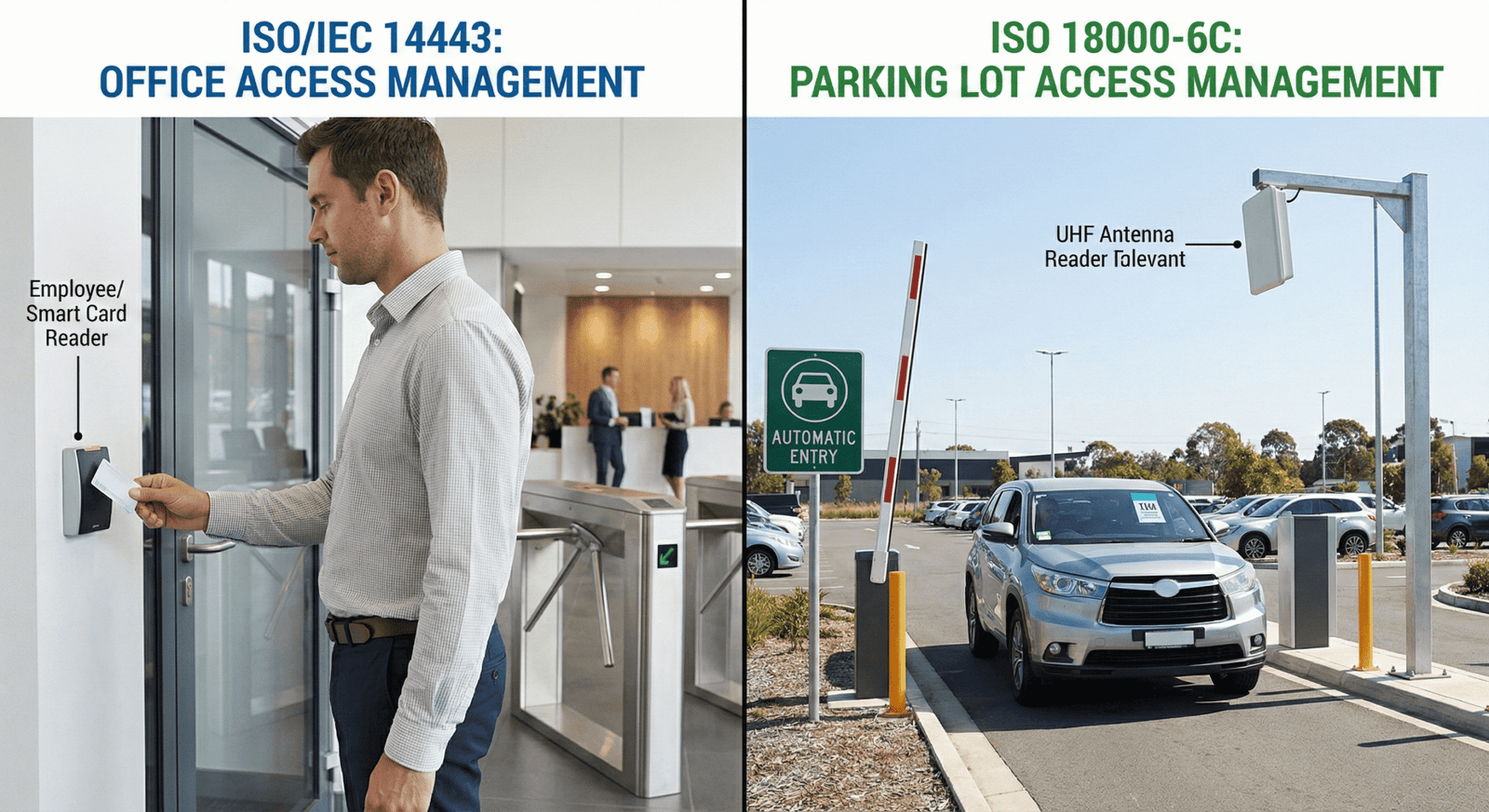
Adhering to specific RFID Reader Standards like ISO/IEC 14443 for personnel and ISO 18000-6C for vehicles ensures your hardware communicates correctly. This compatibility is the foundation of a reliable security ecosystem.
When I worked as an engineer, I often had to troubleshoot "broken" systems. Often, the system was not broken. The integrator was simply trying to force two different languages to speak to each other. In the world of RFID, "Standard" means "Language."
There are two main giants you need to know:
- ISO/IEC 14443 (High Frequency / NFC): This is the standard for close-range security. It operates at 13.56 MHz. You see this in employee badges, passports, and credit cards. It is designed to be read from a few centimeters away. It carries a lot of data and supports high encryption.
- ISO/IEC 18000-6C (Ultra High Frequency / UHF): This is the standard for long-range logistics and parking. It operates between 860 and 960 MHz. It is designed to be read from meters away. It is fast, but it handles security differently.
If you are building an RFID Access Control System for a secure server room, you want ISO 14443. You need that close interaction. If you are building a system for a trucking depot, you need UHF RFID Compliance.
| Standard | Frequency | Read Range | Typical Use | Data Speed |
|---|---|---|---|---|
| ISO/IEC 14443 A/B | 13.56 MHz | < 10 cm | ID Badges, Payments | Fast (106-848 kbit/s) |
| ISO/IEC 15693 | 13.56 MHz | < 1 meter | Library Books, Tickets | Slower |
| ISO/IEC 18000-6C | 860-960 MHz | > 10 meters | Parking, Supply Chain | Very Fast (Bulk Read) |
As an OEM manufacturer, Fongwah ensures our readers meet stringent global standards to seamlessly integrate into your existing security infrastructure. We do not guess. We build exactly to the spec. This means when you buy our writer, it will work with any compliant card from any other vendor.
Can your imported hardware legally operate in your target market?
You might find a cheap reader online that looks perfect. But if it transmits on the wrong frequency, you are breaking federal laws.
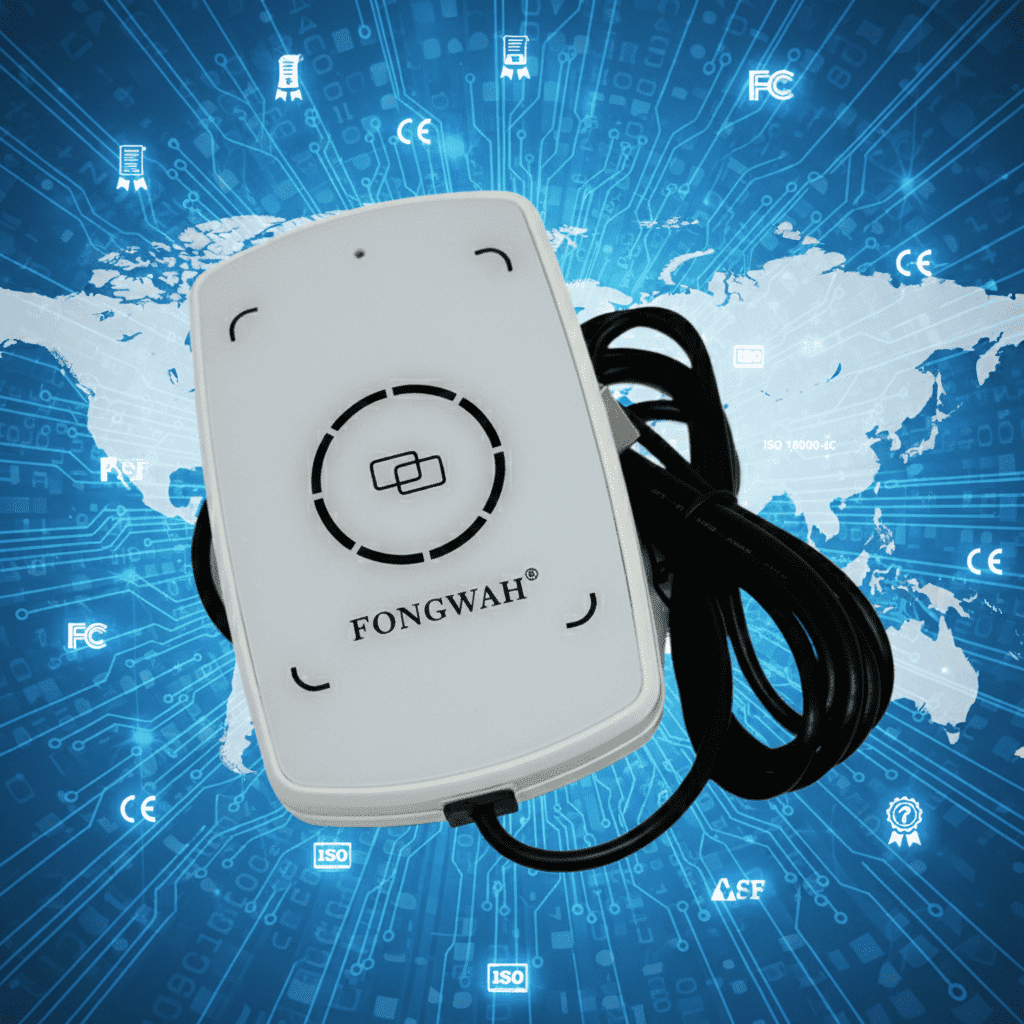
You must navigate regional certifications like FCC and CE to ensure your UHF RFID Compliance. Operating outside these bands can cause interference with emergency services and cellular networks, leading to immediate equipment seizure.
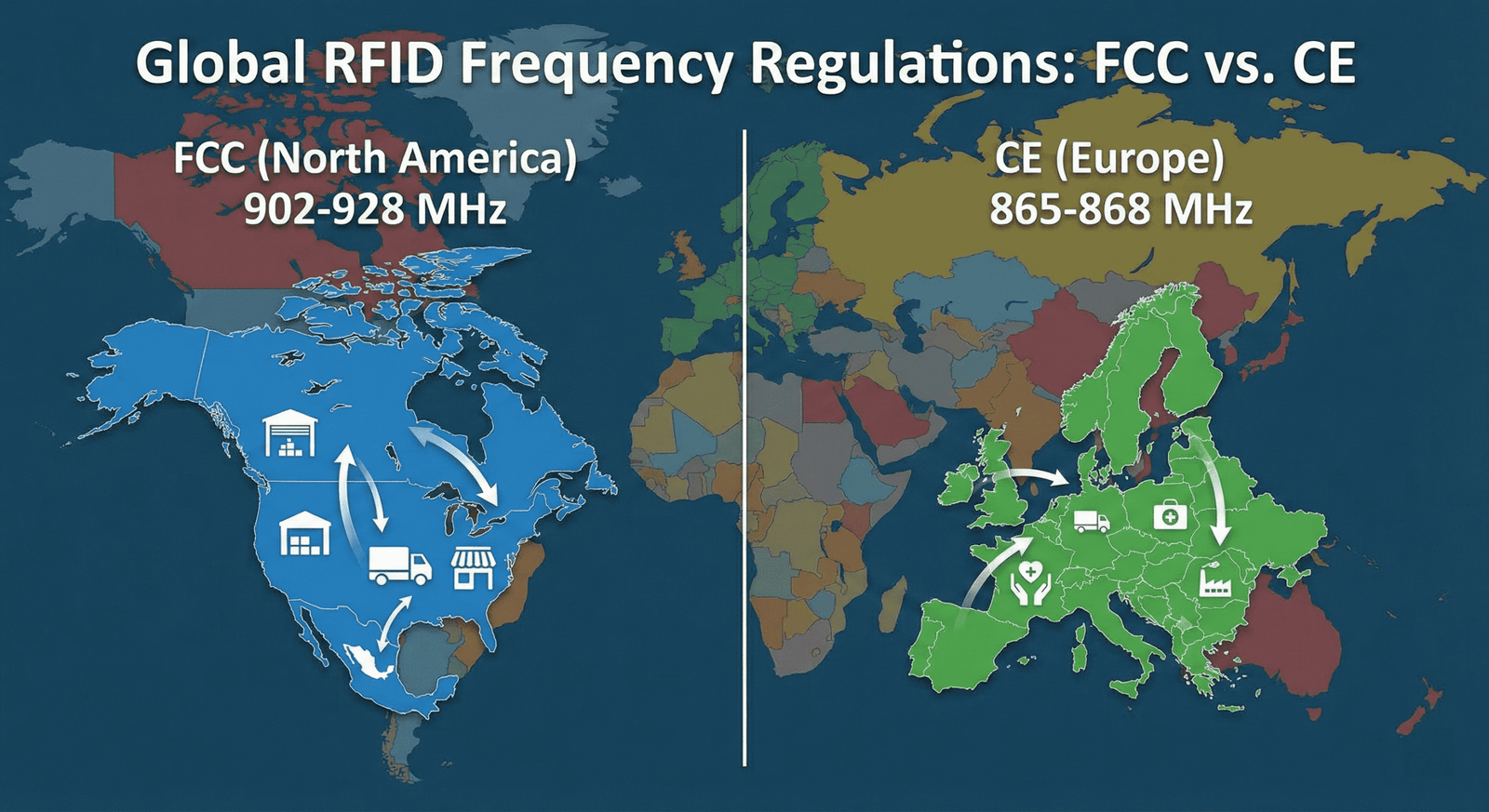
I remember a specific case with a client in Germany. They bought 500 UHF readers from a random seller on a marketplace. The seller said the readers were "Universal." There is no such thing as "Universal" in UHF. The readers were tuned to 915 MHz (the US standard). In Europe, the legal band is 865-868 MHz. When they turned the system on, it started interfering with the local GSM network. The authorities tracked the signal. The client had to rip out every single reader. They lost thousands of Euros.
This is why I emphasize certifications.
- FCC (Federal Communications Commission): This is for the USA. We test our readers to ensure they stay within the 902-928 MHz band. We also ensure they do not emit too much power.
- CE (Conformité Européenne): This is for the European Economic Area. The rules here are stricter regarding power and frequency width.
At Fongwah, we produce hardware that can be software-configured. However, we also label our hardware clearly. When you import from us, you get the documentation. You get the test reports. If you are a distributor, this paperwork is your shield. If a customs officer stops your shipment, you show them the FCC ID or the CE declaration. The box clears. Without that paper, your investment sits in a warehouse until it is destroyed. We solve practical problems from the customer's perspective. We know you want to sell, not argue with customs agents. So we do the certification work for you.
Is your data actually safe or just broadcasting to thieves?
Old RFID cards are like writing your password on a postcard. Anyone can read it. Modern security requires advanced encryption to protect your client's facility.
A robust RFID Access Control System must move beyond reading simple serial numbers (UID). It should utilize encrypted memory sectors and secure keys, such as AES-128, to prevent cloning and unauthorized access.
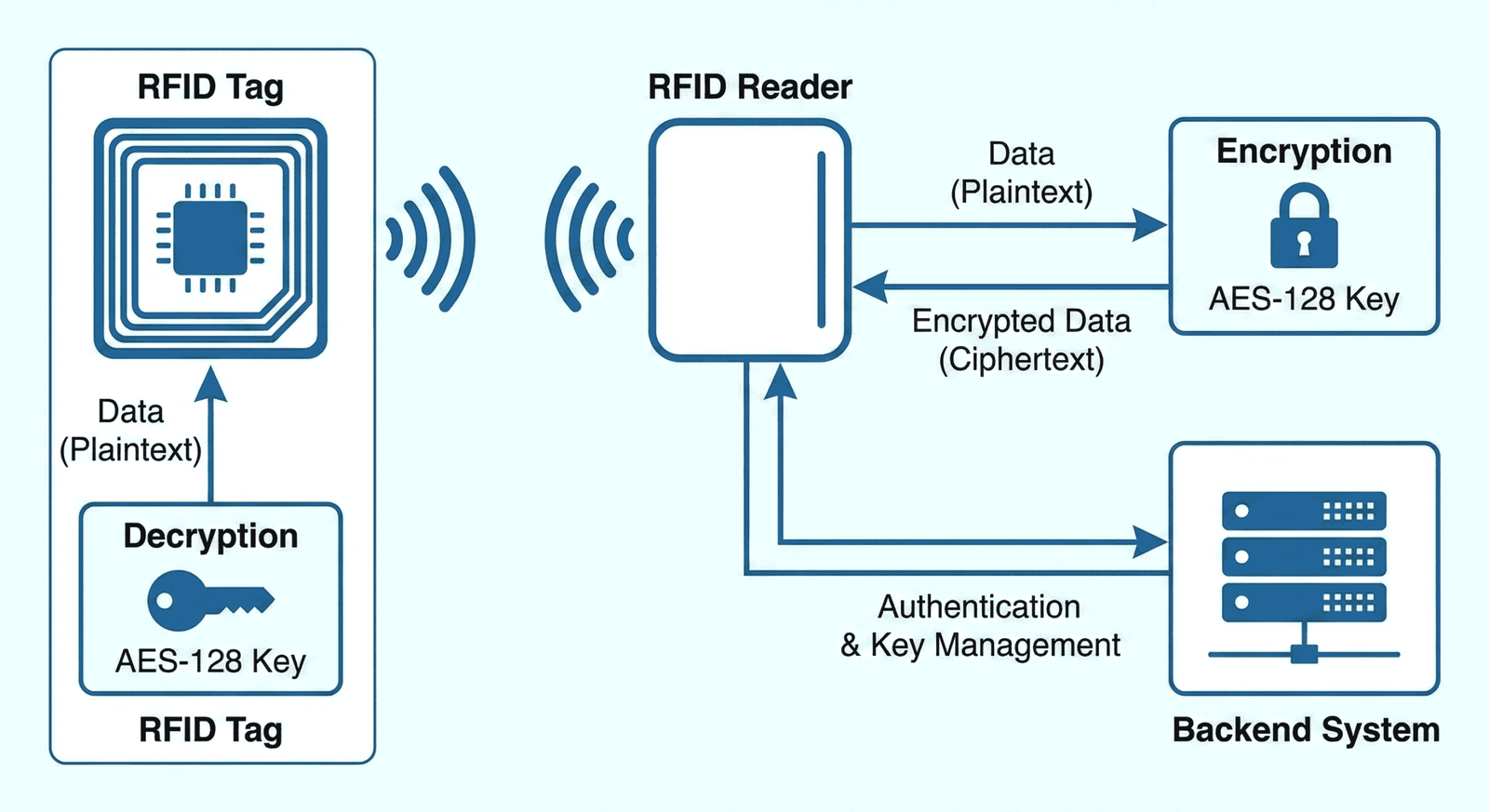
Security is an arms race. Ten years ago, it was enough to read the Unique Identifier (UID) of a card. The reader would say, "I see card number 12345," and the door would open. Today, you can buy a tool on the internet for $20 that clones "card number 12345" in two seconds. If you install a system based only on UID, you are selling your client a false sense of safety.
This is where advanced standards come in. We focus on supporting chips like MIFARE DESFire. These chips use encryption engines. When our reader talks to the card, they do a "handshake."
- Reader: "Are you really Card 12345?"
- Card: "Prove you are the authorized reader."
- Reader: Sends a challenge encrypted with a secret key (like AES-128).
- Card: Decrypts it and sends a response.
If the keys do not match, the card stays silent. The door does not open. A cloner cannot copy this because they do not have the secret key.
Implementing this is hard for some developers. That is why we provide a comprehensive SDK (Software Development Kit). We give you the tools to write these keys into the cards and configure the readers to check for them. We move you away from "Open Mode" to "Secure Mode." As an integrator, offering this level of security allows you to charge more. You are not just installing a lock; you are installing a bank-vault grade digital defense.
Technical FAQ for System Integrators
Q1: Which RFID standards are essential for commercial access control systems?
Answer: For short-range high-security applications, ISO/IEC 14443 (Type A/B) is the industry standard for 13.56MHz (NFC) proximity systems. For long-range vehicle or asset tracking in commercial yards, ISO/IEC 18000-6C (EPC Gen2) is the primary protocol for UHF RFID. Ensuring your hardware complies with these standards is critical for cross-manufacturer tag compatibility.
Q2: Why is FCC Part 15 certification mandatory for RFID readers in the US?
Answer: The FCC (Federal Communications Commission) regulates radio frequency emissions. Any RFID reader imported into the U.S. must comply with FCC Part 15 to ensure it doesn't cause harmful interference to other wireless services. As a professional OEM manufacturer, we provide FCC-certified hardware to guarantee legal and stable operation for our American B2B partners.
Q3: Does your RFID access control hardware support data encryption like AES-128?
Answer: Yes. For high-security environments, standard UID reading is insufficient. Our advanced RFID readers support secure communication protocols, including AES-128 bit encryption and DesFire EV2/EV3 capabilities, to prevent card cloning and "man-in-the-middle" attacks during data transmission.
Conclusion
Global standards protect your business. By choosing hardware that respects ISO protocols, FCC/CE regulations, and advanced encryption, you deliver a system that is legal, durable, and truly secure.
---