
You sold the client on a "Smart Laundry System," but now the inventory numbers don't match the physical count. The hotel manager isn't mad about a missing $5 towel; he's furious that his million-dollar ERP system is feeding him garbage data. When data trust collapses, the project dies.
A "Ticking Time Bomb" in RFID projects occurs when low-cost readers cannot handle high-concurrency environments like laundry chutes. To prevent system paralysis, you must utilize industrial fixed readers (like the Fongwah U8) that offer 4-port antenna diversity, -80dBm sensitivity, and 500 reads/sec throughput. This hardware foundation ensures 99.9% accuracy even when tags are wet, shielded, or moving at speed.
Let’s perform a technical post-mortem on why cheap readers fail in the field and how to engineer a solution that actually survives the laundry room.
The Hidden Cost of Collision: Can Your Reader Handle 500 Wet Towels?
Testing five dry tags on your office desk is meaningless. The real world is a steel chute with 50 wet, heavy linens tumbling down at 3 meters per second. This is where "lab specs" go to die.
You need a reader capable of dense reader mode and high-speed anti-collision algorithms. The Fongwah U8 Fixed Reader processes 500 tags per second, ensuring that even in a chaotic "tag storm," every single unique EPC is captured before it hits the bin.
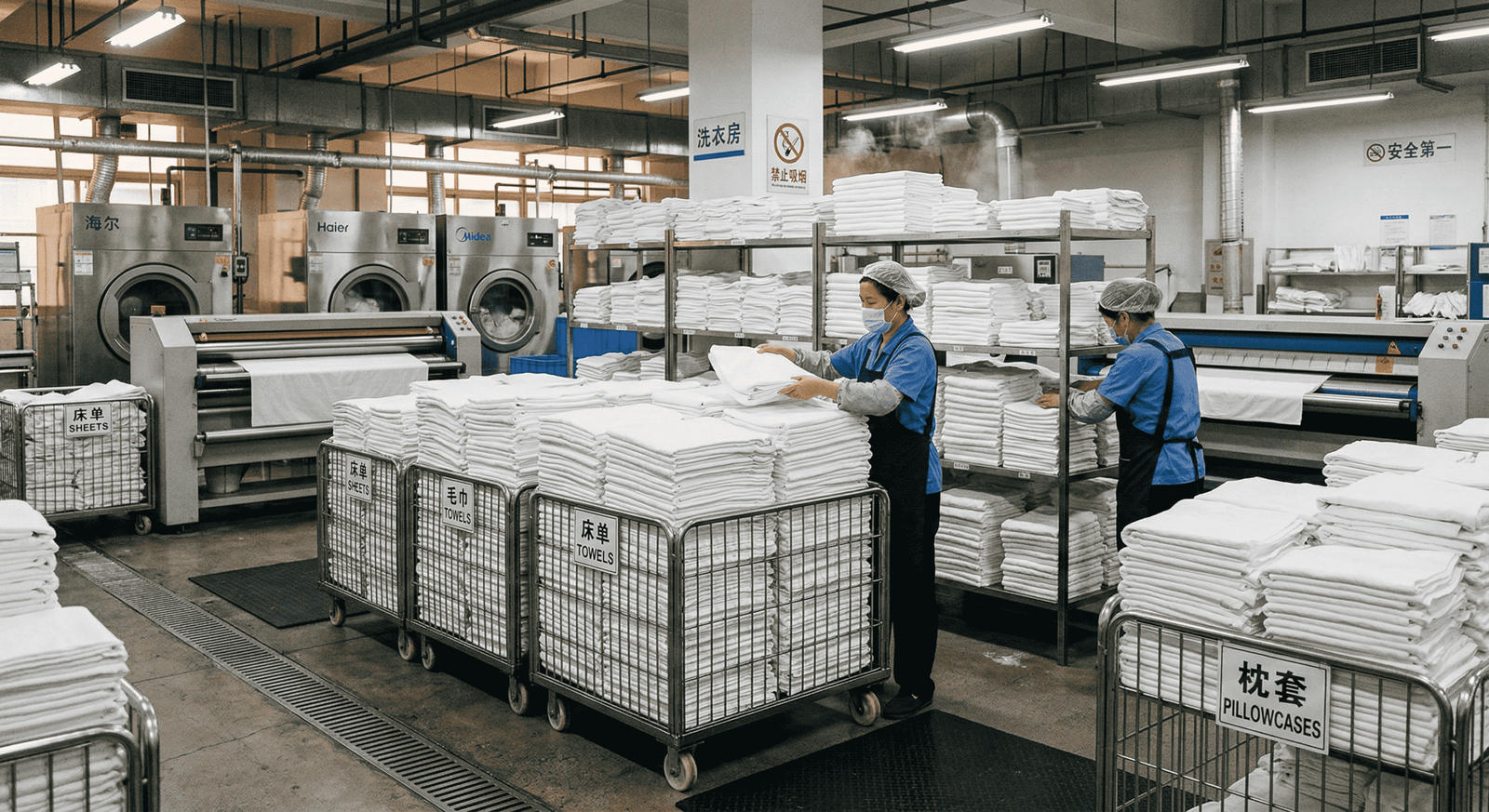
William, I’ve seen this happen a dozen times. A system integrator wins a bid for a hotel chain by using a $150 generic UHF reader. It works fine during the demo with a stack of dry pillowcases.
Then, deployment day comes. The housekeeping staff dumps a laundry bag containing 40 towels and 10 bathrobes down the chute. The bag is damp. The tags are crumpled. They are screaming for attention simultaneously.
- The Failure: The cheap reader chokes. Its processor cannot switch between tags fast enough (low Q-value adjustment). It reads 35 tags and misses 15.
- The Consequence: The hotel's ERP says "400 towels sent to laundry." The laundry facility scans them on the other end and says "We only received 385."
- The War: Who pays for the missing 15? The hotel blames the laundry. The laundry blames the hotel. They both blame you.
The Fongwah Fix: We built the U8 Fixed Reader for this exact hostility.
- Throughput: It isn't just "up to" 500 reads/sec; it sustains that rate.
- Power: It pushes 6-32dBm (adjustable). In a laundry chute, you crank that power to punch through the mass of fabric.
- Stability: It uses an industrial chipset designed to isolate individual tag signals from the background noise of a metal chute.
Sensitivity Gap: Why -60dBm Hardware Fails in Laundry Chutes?
Water absorbs RF energy. Metal reflects it. A laundry chute is essentially a Faraday cage filled with RF-absorbing sponges. If your reader lacks sensitivity, it's deaf.
Standard commercial readers often have a reception floor of -60dBm. In contrast, the Fongwah U8 features -80dBm sensitivity. This logarithmic difference allows the reader to detect the faint backscatter signal of a tag buried in the center of a wet laundry bag.
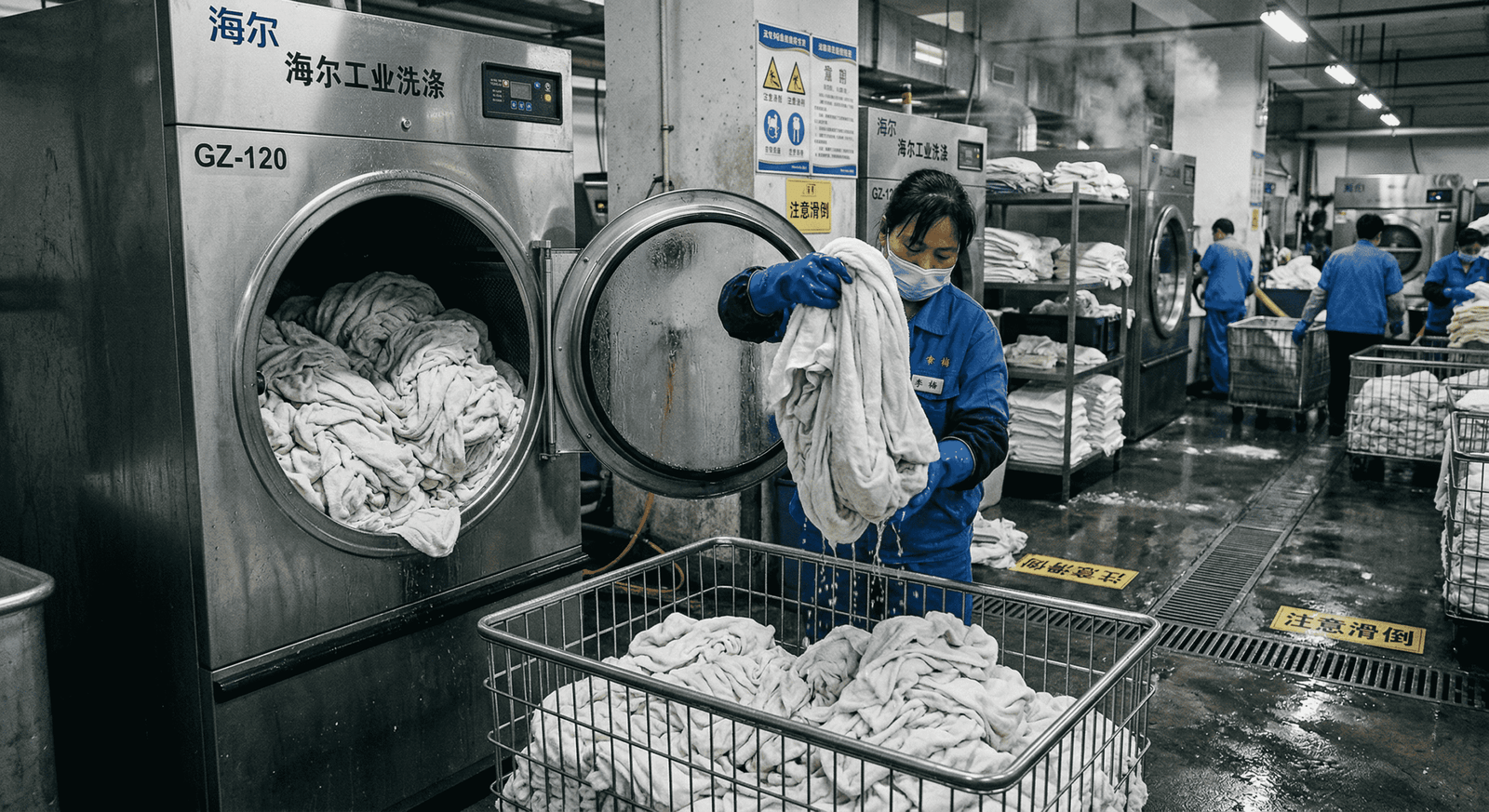
Let’s talk physics, not marketing. When a passive RFID tag is buried in wet linen, the water detunes the antenna. The signal that bounces back to the reader is microscopic.
- The Generic Reader: It blasts power out (Talks loud) but has poor ears (Listens bad). It shouts at the tags, but can't hear the whisper returning from the bottom of the cart.
- The Fongwah U8: We prioritize Receive Sensitivity (-80dBm). We can hear a tag that is barely reflecting energy.
Furthermore, laundry rooms are hot. Cheap readers in plastic cases overheat. When RF amplifiers get hot, they introduce thermal noise, further reducing sensitivity. The U8 uses a heavy-duty aluminum alloy casing. It acts as a massive heat sink. I have clients running these in non-AC laundry docks in Southeast Asia, 24/7. The read rate at hour 24 is the same as minute 1.
- Compliance: We back this up with CE, FCC, and TELEC certifications. This ensures that while we are listening hard, we aren't broadcasting illegal noise that shuts down the hotel's WiFi.
The Industrial Fix: Why 4 Antenna Ports Are Non-Negotiable?
A single antenna creates blind spots. If a tag falls "edge-on" to the reader antenna, it becomes invisible. In a chaotic laundry pile, you cannot control tag orientation.
Spatial diversity is the only cure for orientation blindness. The U8 provides 4 SMA ports, allowing you to mount antennas at different angles (top, sides, bottom). This creates a 360-degree "RF Curtain" that eliminates null zones.

William, if you try to cover a laundry conveyor or chute with a customized "Integrated Reader" (antenna built-in), you are gambling. You need the U8 Fixed Reader because it separates the brain from the eyes.
You don't just put one antenna on the ceiling.
- Port 1: Circular Polarized Antenna on the Left.
- Port 2: Circular Polarized Antenna on the Right.
- Port 3 & 4: Linear Antennas at the choke point.
This setup ensures that no matter how the towel is crumpled, at least one antenna hits the tag's dipole at a favorable angle.
The TCO Decision Matrix (Generic vs. Fongwah U8) Show this to your stakeholders. This is the difference between a "Pilot Project" and a "Production System."
| Feature | Generic "White Box" Reader | Fongwah U8 Fixed Reader |
|---|---|---|
| Peak Read Rate | < 100 tags/sec | 500 tags/sec (Sustained) |
| Antenna Ports | 1 (Integrated) or 2 | 4 SMA Ports (Spatial Diversity) |
| Sensitivity | -60dBm (Deaf in wet conditions) | -80dBm (High Penetration) |
| Connectivity | USB/Serial only | RS232, TCP/IP, RJ45 (Network Ready) |
| Compliance | "Factory Tested" (Unverified) | CE, RoHS, FCC, TELEC Certified |
| SDK Support | DLL file only | C#, Java, Python SDK + Demo Code |
| Outcome | Data Paralysis (Manual Counting) | 99.9% Automation Trust |
Technical FAQ: Engineering a Reliable RFID Laundry System with Fongwah U8
A: Yes, but sensitivity is key. Standard -60dBm readers often fail because water absorbs RF energy. The Fongwah U8 features -80dBm sensitivity, allowing it to "hear" the faint backscatter of wet tags buried deep in a laundry chute.
Q: How do 4-antenna ports prevent "blind spots"?
A: In a chaotic laundry pile, tag orientation is unpredictable. By using the U8’s 4 SMA antenna ports, you can create spatial diversity, mounting antennas at different angles to ensure at least one antenna hits the tag's dipole.
Q: Does the system support integration with hotel ERPs?
A: Absolutely. We provide a professional SDK including C#, Java, and Python development examples. This reduces integration time from weeks to days, ensuring data trust between the hardware and your software.
Conclusion & CTA (Call to Action): Stop bleeding engineering hours on cheap hardware. The true cost of an RFID reader is integration time. Prioritize robust SDKs and industrial stability to protect your actual project margins.Jay’s Final Warning: Don't neglect the data entry point. A professional deployment starts with a desktop writer like the Fongwah U1-CU-71 to ensure every asset has a clean, unique ID before it ever hits the high-speed chute. Stuck on integration or sick of buggy DLLs? Ping me on WhatsApp. I'll send you a working C# sample code snippet right now.
---