
Finding real value in RFID1 is hard. Vague examples don't help you choose the right solution. Let's explore concrete examples from top industries to see how they truly benefit.
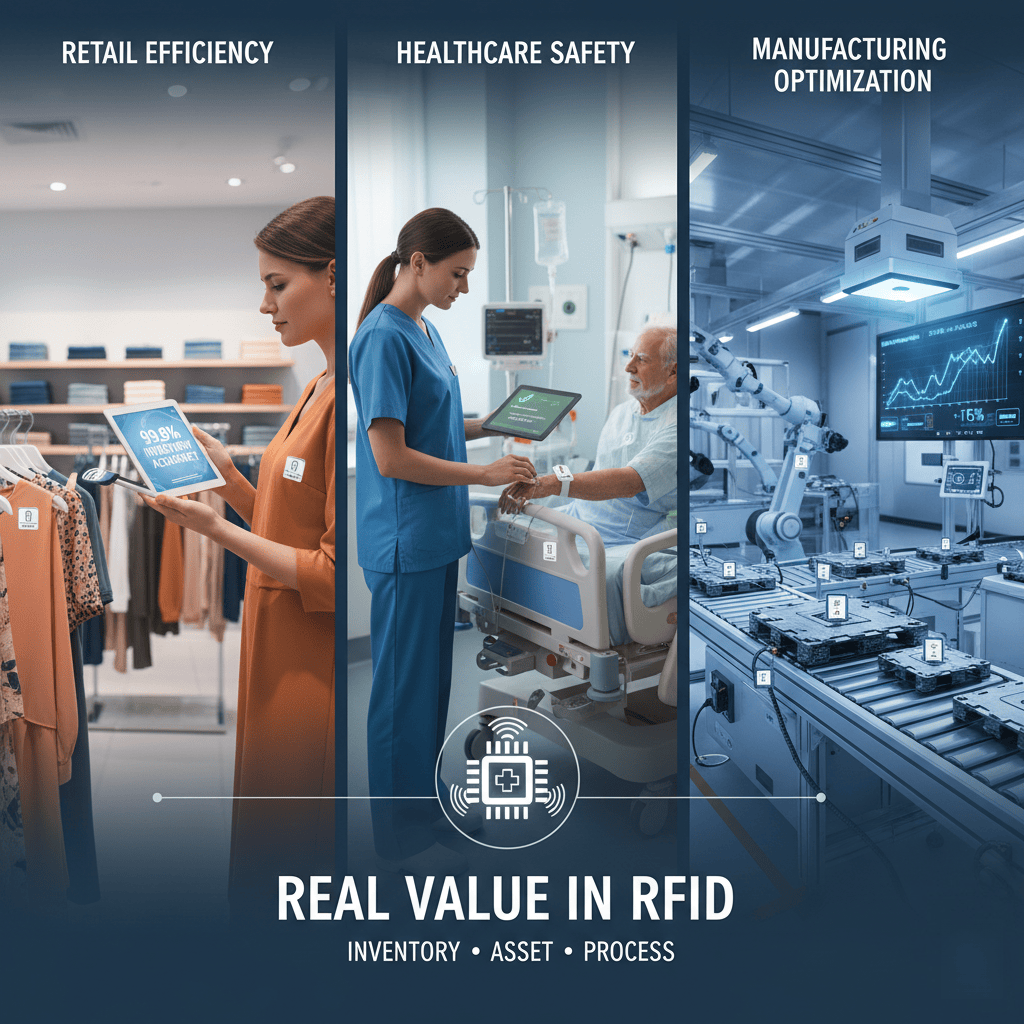
Industries use RFID1 for inventory accuracy2, asset tracking3, and process automation4. Retail gains efficiency, healthcare5 improves patient safety6, and manufacturing7 optimizes production lines with specific tag technologies for measurable results.
As an expert, you already know the basics of RFID1. You understand frequencies and the difference between active and passive tags. But I want to go deeper. I've spent 20 years in this industry, starting on the factory floor and now helping clients worldwide. My journey has taught me one thing: RFID1 is not about technology for technology's sake. It's about solving specific, costly problems. I want to show you exactly how this is happening in the real world. Let's look beyond the buzzwords and see how different industries are using RFID1 to make a tangible impact.
How Does RFID1 Revolutionize Retail and Supply Chain Management?
Inaccurate inventory costs you sales and customers. Manual counts are slow, expensive, and full of human error. RFID1 offers real-time, near-perfect inventory accuracy2, directly solving this core problem.
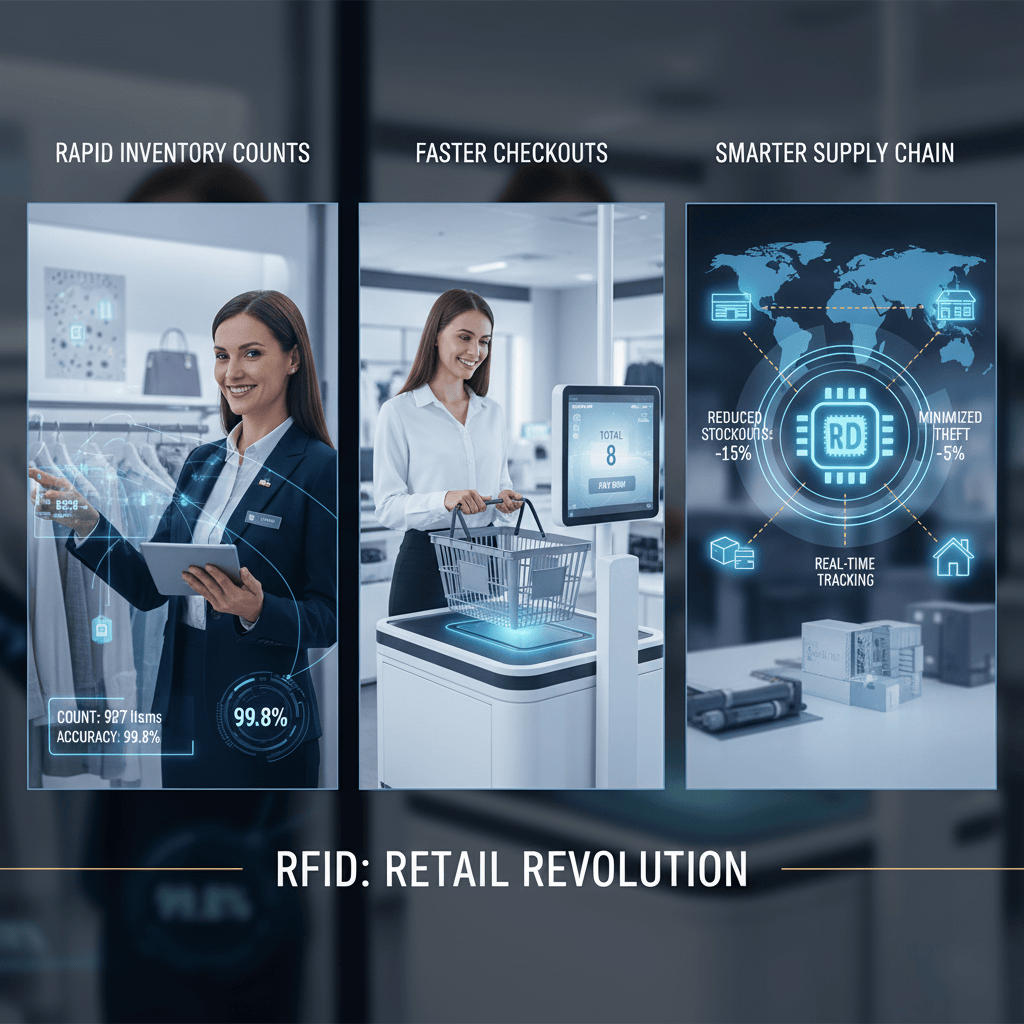
RFID1 transforms retail with rapid inventory counts, faster checkouts, and smarter supply chains. It reduces stockouts, minimizes theft, and provides valuable data on product movement from the warehouse to the customer.
I remember working with a large apparel client years ago. They were losing millions annually to "shrinkage" and stockouts. They knew what they had on paper, but it never matched what was on the shelves. This gap was destroying their profit margins. By implementing a simple, item-level UHF RFID tag8ttps://rainrfid.org/rfids-role-in-managing-inventory-for-medical-devices-and-critical-supplies/)1 tag system, they achieved 99%+ inventory accuracy2 within three months. This wasn't a minor tweak; it was a fundamental change in how they ran their business. They could finally trust their data. This trust enabled them to confidently sell online from store inventory and reduce safety stock, freeing up huge amounts of capital. The technology's real power is unleashing this kind of operational confidence9.
From Warehouse to Sales Floor
The journey of a product is complex. RFID1 provides a single point of truth throughout this journey. A handheld reader can count a box of tagged shirts in seconds, not minutes. This speed gain scales massively. Pallet-level scanning at the warehouse door automatically verifies shipments, eliminating manual checks and paperwork.
The Customer Experience
This efficiency extends to the customer. RFID1-enabled checkout stations can scan an entire basket of goods at once, no barcode hunting required. It makes the buying process smoother and faster. Returns are also simplified, as the item's history is embedded in its tag.
| Application | Common RFID1 Tag Type | Key Benefit |
|---|---|---|
| Inventory Management | Passive UHF (EPC Gen 2) Label | 99%+ accuracy, rapid cycle counts |
| Point of Sale (POS) | Passive UHF Label | Faster, contactless checkout |
| Loss Prevention | Dual-tech (RFID1 + EAS) Tag | Item-level theft identification, not just alerts |
What Are the Critical RFID1 Applications Improving Healthcare?
Losing track of medical assets is dangerous. Wasted staff time searching for pumps or wheelchairs hurts efficiency, and potential patient identification10 errors can have severe consequences. RFID1 provides precise, automated tracking.
Key RFID1 applications in healthcare5 include tracking mobile medical equipment, ensuring patient identification10 safety, and managing pharmaceuticals11. This increases staff efficiency, reduces critical errors, and improves overall patient care.

A hospital director once shared his biggest recurring nightmare with me: a code blue situation where staff couldn't locate a vital infusion pump in time. It wasn't that the hospital didn't have enough pumps; they just didn't know where they were. Some were in patient rooms, others in storage, and some were waiting for cleaning. This is a problem of visibility, not inventory. We helped them attach active RFID1 tags to their high-value mobile assets. Almost overnight, their staff could locate any piece of equipment on a digital map in seconds. This didn't just save time; it reduced staff stress and directly contributed to better patient outcomes. It showed me that in healthcare5, RFID1 is often a critical safety tool, not just an efficiency booster.
High-Value Asset Tracking
Hospitals own thousands of mobile assets, from IV pumps to wheelchairs. RFID1 tags allow staff to instantly find the nearest available device, reducing search time and optimizing the use of existing equipment. This prevents unnecessary new purchases and ensures equipment is available when needed.
Patient and Staff Safety
RFID1 wristbands are a simple way to ensure patient safety6. They can be linked to a patient's electronic health record, ensuring the correct medication and treatment are administered. They can also be used to control access to sensitive areas or to automatically call for help if a patient falls.
| Application Area | Recommended Tag Solution | Primary Outcome |
|---|---|---|
| Surgical Tool Tracking | Autoclavable Passive UHF On-Metal Tag | Ensures complete sterilization & tracking |
| Patient Identification | Passive HF/UHF Wristband | Reduces medical errors, automates data entry |
| Pharmaceuticals | Passive HF/NFC Label | Prevents counterfeiting, tracks chain of custody |
How Does RFID1 Drive Efficiency in Modern Manufacturing?
Hidden bottlenecks disrupt your entire production flow. You can't optimize a process you can't see. Manual tracking of tools and components is slow and hides the real problems holding you back.
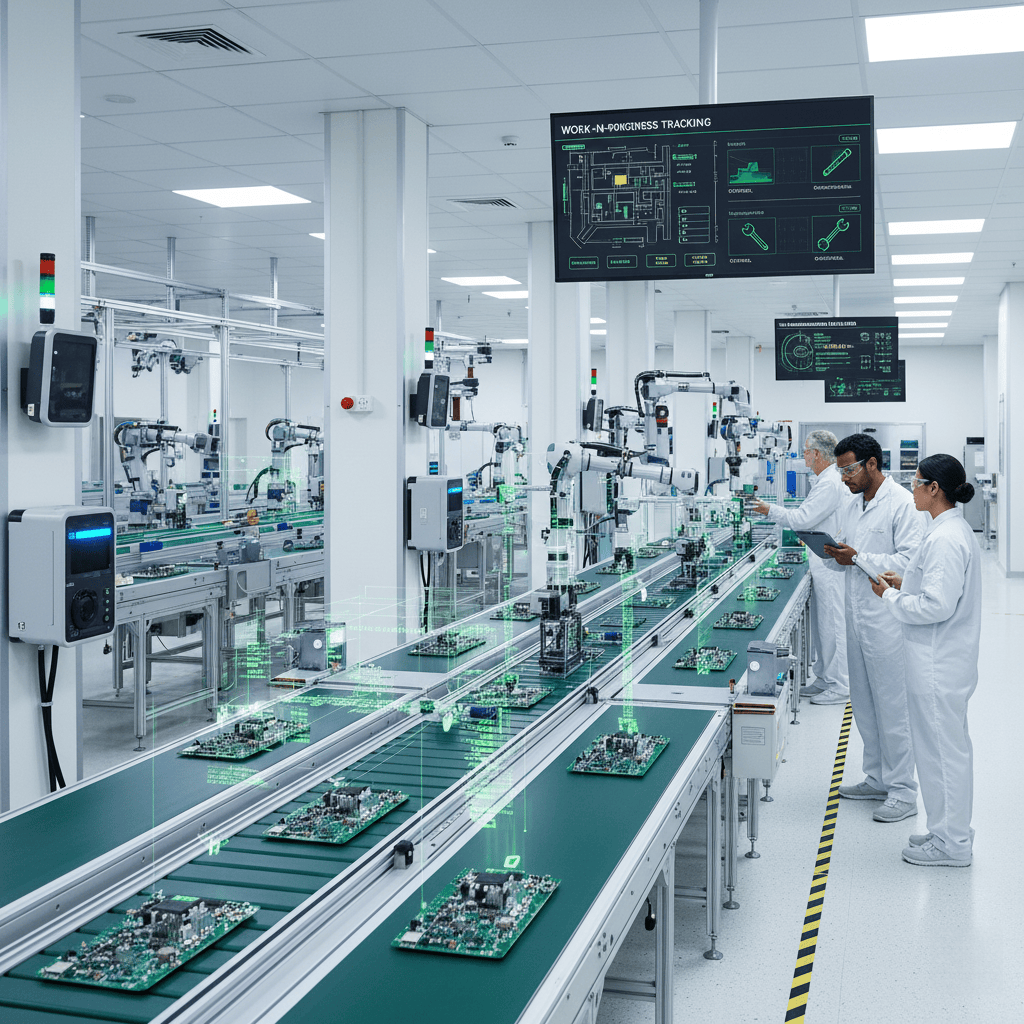
RFID1 drives manufacturing7 efficiency by automating work-in-progress (WIP) tracking, managing tool lifecycles, and ensuring correct component usage. This visibility reduces downtime, improves quality, and enables smart factory automation12.
Early in my career, I worked on a production line. One of our biggest sources of delay was tool management13. A specific jig or calibrated wrench would go missing, and the entire line would stop until someone found it. The paper checkout system was useless. This is exactly the kind of costly, frustrating problem that RFID1 is built to solve. Now, as a provider, I see companies put durable on-metal RFID1 tags on these tools. The system automatically tracks who has what tool and for how long. Even better, it tracks usage cycles, automatically flagging a tool for recalibration or maintenance before it fails. This proactive approach prevents downtime instead of just reacting to it. It’s a simple change that transforms a reactive, chaotic process into a predictable, controlled one.
Work-in-Progress (WIP) Visibility
Tagging bins, pallets, or even individual sub-assemblies provides a live view of your entire production process. As a product moves past fixed RFID1 readers at each station, its status is updated automatically. This data reveals the true bottlenecks in your line, allowing you to address the root cause of delays.
Tool and Asset Management
In manufacturing7, tools are valuable assets. RFID1 tags help manage their location, usage, and maintenance schedules. This ensures that the right tools are available and properly calibrated, which is critical for maintaining quality standards like ISO 9001.
| Manufacturing Challenge | RFID1 Tag Application | Benefit |
|---|---|---|
| Process Bottleneck ID | Passive UHF Tag on WIP carriers/pallets | Real-time production visibility, lean manufacturing7 |
| Tool Tracking & Calibration | Durable Passive UHF On-Metal Tag | Reduced search time, automated maintenance alerts |
| Finished Goods Dispatch | Passive UHF Label on cases or pallets | Automated shipping verification, error-proof logistics |
Conclusion
RFID1 offers specific solutions for diverse industry problems. From retail stock to patient safety6, the right tag is key. It's about solving real-world challenges with targeted, practical technology.
---Explore how RFID technology is transforming industries by improving efficiency and accuracy. ↩
Learn about the significant impact of RFID on inventory management and accuracy in retail. ↩
Discover effective strategies for utilizing RFID in asset tracking across different sectors. ↩
Understand the role of RFID in automating processes and enhancing productivity in manufacturing. ↩
Explore the various ways RFID is improving patient safety and operational efficiency in healthcare. ↩
Learn how RFID technology is crucial for enhancing patient safety and care in healthcare settings. ↩
Discover how RFID technology is revolutionizing manufacturing processes and efficiency. ↩
Get insights into UHF RFID tags and their applications in various industries. ↩
Find out how RFID technology builds trust in data and operations for businesses. ↩
Understand the importance of RFID in ensuring accurate patient identification and safety. ↩
Explore how RFID technology is used to track pharmaceuticals and prevent counterfeiting. ↩
Learn about the integration of RFID in smart factories and its benefits for automation. ↩
Discover how RFID enhances tool management and reduces downtime in manufacturing. ↩