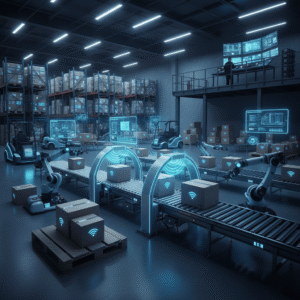

Inventory inaccuracies cause operational headaches and lost revenue. You want efficiency in your warehouse, but choosing the wrong RFID hardware1 leads to wasted budget and poor data.
The decision relies on automation levels and asset movement2. Use handheld readers3 for mobile, ad-hoc cycle counting4 where workers walk to items. Choose fixed readers5 for automated, hands-free tracking at choke points6 like dock doors or conveyor belts where assets move past the reader.

I remember my early days on the production line. We had a client who insisted on installing fixed readers5 everywhere, even for static storage shelves. It cost a fortune in cabling and ultimately failed because the signal overlap was too high. It was a hard lesson. Today, at Fongwah, I help clients avoid these traps. We need to look at your specific workflow, not just the technology. The following sections will guide you through this critical operational choice.
Do your assets move through specific choke points6 or stay stationary?
Missed scans at doorways destroy your shipping accuracy. You need to capture every single item leaving your facility to ensure customer satisfaction.
If your inventory moves through a defined path, like a dock door or conveyor, use fixed readers5 to create a "read zone." If your inventory sits on shelves and requires verification, use handheld readers3 to bring the scanner to the tag.

Analyzing the Physical Flow of Goods
To make the right choice, you must map the physical journey of your products. This is about physics and logistics, not just electronics. We need to apply critical thinking to how materials flow through your building.
The Choke Point Logic
Fixed readers act like toll booths. They are stationary. They wait for the tag to come to them. This is ideal for "choke points6." A choke point is a narrow area where all items must pass.
- Loading Docks: Pallets pass through a portal.
- Conveyor Belts: Boxes move at a set speed.
- Doorways: Staff move files or tools between rooms.
If you install a fixed reader here, you get 100% coverage without human labor. The reader does not move; the tag moves.
The "Go-to-the-Tag" Method
Handheld readers turn this logic around. Here, the tag is stationary, and the reader moves. Think about a warehouse aisle. Pallets sit there for weeks. A fixed reader system to cover a whole warehouse is too expensive and complex. Instead, a worker walks down the aisle. They hold the trigger. They collect the data.
This distinction also impacts how we handle exceptions. If an item is lost, a fixed reader cannot "find" it unless it moves past a gate. A handheld reader has a "Geiger counter" function. You can walk around and locate a specific missing item.
| Feature | Fixed RFID Reader | Handheld RFID Reader |
|---|---|---|
| Asset Movement | The Asset moves (Dynamic) | The Asset stays (Static) |
| Reader Movement | The Reader stays (Static) | The Reader moves (Dynamic) |
| Primary Use Case | Automated tracking at gates | Cycle counting and finding items |
| Human Interaction | Zero (Hands-free) | High (Manual trigger) |
Do you require real-time visibility7 or is periodic cycle counting4 sufficient?
Old data makes smart decision-making impossible. Waiting for a monthly audit creates dangerous gaps in your supply chain visibility and stock levels.
If you need zero-latency data updates, fixed readers5 are mandatory as they scan continuously. For periodic updates, such as weekly inventory audits or end-of-day checks, handheld readers3 provide a cost-effective solution without constant monitoring.

The Value of Time in Inventory Management
We must evaluate the "freshness" of your data. How old is the information in your system? The answer defines your hardware needs. This is a trade-off between data velocity and operational cost8.
The "Always-On" Ecosystem
Fixed readers are always on. They draw power from the wall. They connect to the network via Ethernet or Wi-Fi constantly. As soon as a tag enters the field, the database updates. This is "Real-Time." Use this if:
- You need immediate theft alerts.
- You run a Just-In-Time (JIT) manufacturing line.
- You need to trigger an automatic action (like opening a door).
The "Snapshot" Approach
Handheld readers take a "snapshot" of your inventory. The data is only as fresh as the last scan. If I scan the warehouse on Monday, and an item moves on Tuesday, I won't know until the next scan on Wednesday. For many businesses, this is acceptable. If you sell furniture, your stock doesn't change every second. A daily or weekly walk-through with a handheld device is sufficient. It saves energy and server bandwidth.
Application Scenarios
- Smart Shelves (Fixed): High-value items like jewelry. You need to know the second it is removed.
- Retail Floor (Handheld): Clothing stores. Staff scan the floor each morning to replenish sizes. Real-time tracking of every shirt is often overkill.
| Requirement | Fixed Reader Solution | Handheld Reader Solution |
|---|---|---|
| Data Latency | 0 Seconds (Real-time) | Hours or Days (Periodic) |
| Power Source | Continuous (AC/PoE) | Battery (Rechargeable) |
| Network Need | Constant Connection | Syncs periodically (Wi-Fi/USB) |
| Event Trigger | Immediate (e.g., Alarm) | Delayed (Post-process) |
Is your facility infrastructure ready to support complex hardware installations?
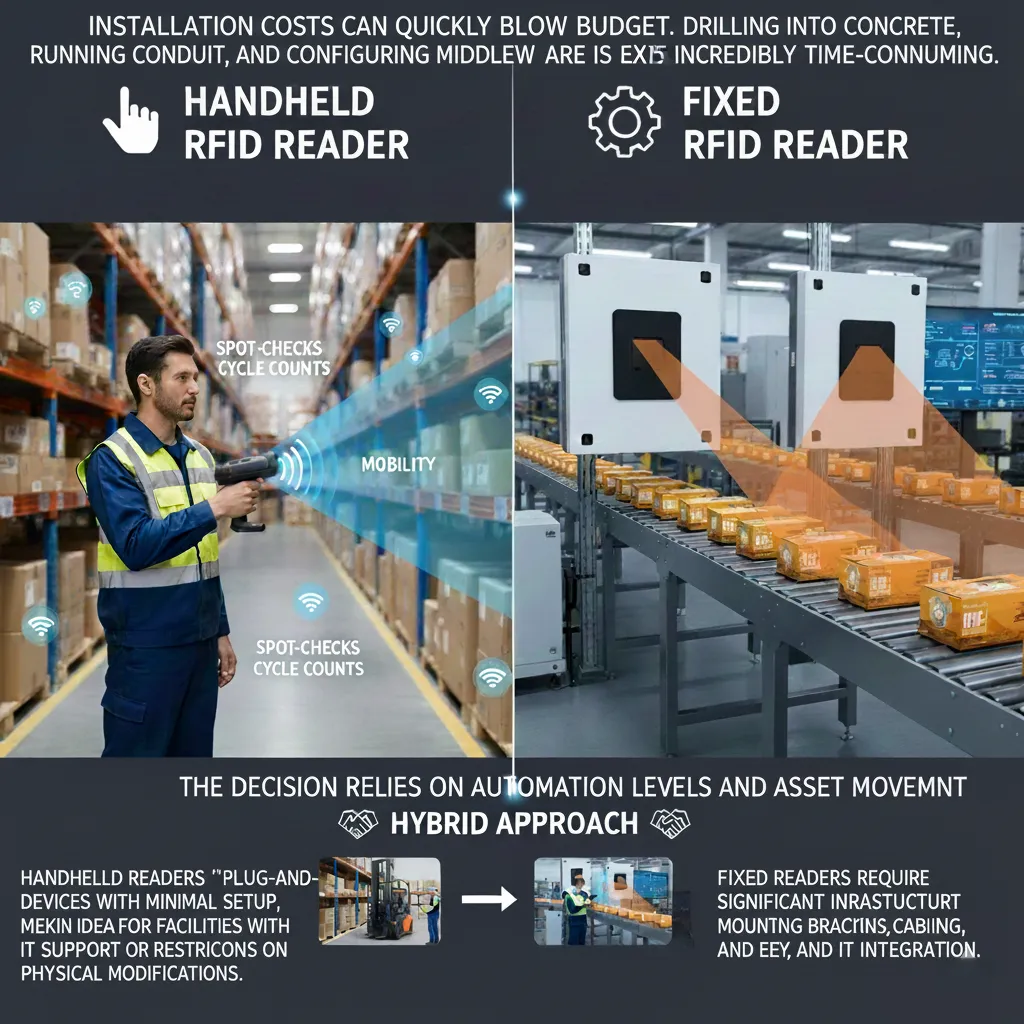
Installation costs can quickly blow your budget. Drilling into concrete, running conduit, and configuring middleware is expensive and incredibly time-consuming.
Fixed readers require significant infrastructure, including mounting brackets, cabling, and IT integration. Handheld readers are "plug-and-play" devices with minimal setup, making them ideal for facilities with limited IT support or restrictions on physical modifications.
Assessing Total Cost of Ownership (TCO)
When I advise clients at Fongwah, I ask them to look beyond the price of the reader. The "price tag" is just the tip of the iceberg. The real cost lies in the implementation environment.
The Infrastructure Burden
Fixed readers are like servers. You cannot just buy them and set them on a table.
- Cabling: You need Power over Ethernet (PoE) or electric outlets near the ceiling or doors.
- Mounting: You need brackets and antennas. These must be angled perfectly.
- Middleware: You need software that runs constantly to filter the data (filtering out stray reads). This represents a high Capital Expenditure (CapEx). If you rent your warehouse, you might not be allowed to drill holes or run cables.
The Flexibility of Handhelds
Handheld readers are mobile computers. They function like your smartphone.
- Setup: Charge the battery, install the app, and start scanning.
- Portability: You can move the device between store locations.
- Low Barrier: Small businesses can start with one handheld reader. This shifts the cost to Operating Expense (OpEx) because you pay for the labor of the person walking around.
Scalability and Risk
If your process changes, moving a fixed reader is hard. You have to unbolt it and rewire it. Moving a handheld reader is as simple as walking to the new area. However, handhelds introduce human error. A fixed reader is programmed; a human might forget to scan a shelf.
| Factor | Fixed Reader Infrastructure | Handheld Reader Infrastructure |
|---|---|---|
| Installation | Complex (Cabling, Mounting) | None (Charge & Go) |
| IT Requirement | High (Middleware, Network) | Low (App-based) |
| Flexibility | Low (Hard to relocate) | High (Anywhere, Anytime) |
| Cost Type | High Upfront (CapEx) | High Labor (OpEx) |
Conclusion
Your choice depends on flow, data speed, and infrastructure. Fixed readers automate real-time tracking, while handhelds offer mobile flexibility. Contact Fongwah for quality readers that fit your needs.
---Explore this link to discover top RFID hardware solutions that enhance warehouse efficiency and accuracy. ↩
Understanding asset movement is crucial for effective inventory management; explore this resource. ↩
Learn how handheld readers can streamline your inventory processes and reduce errors. ↩
Learn how cycle counting can improve inventory accuracy and reduce discrepancies. ↩
Find out how fixed readers can optimize logistics operations and ensure accurate tracking. ↩
Discover how identifying choke points can enhance your supply chain efficiency. ↩
Explore the significance of real-time visibility for making informed inventory decisions. ↩
Discover strategies to manage operational costs effectively in your inventory processes. ↩