Struggling with slow, manual inventory counts? This inefficiency costs you time and money. RFID technology1 provides an automated, accurate way to track everything instantly.
RFID, or Radio-Frequency Identification2, uses radio waves for wireless communication. A system has a tag with data and a reader that captures it. This allows for quick, automatic identification of objects without needing to see them or scan them one by one.
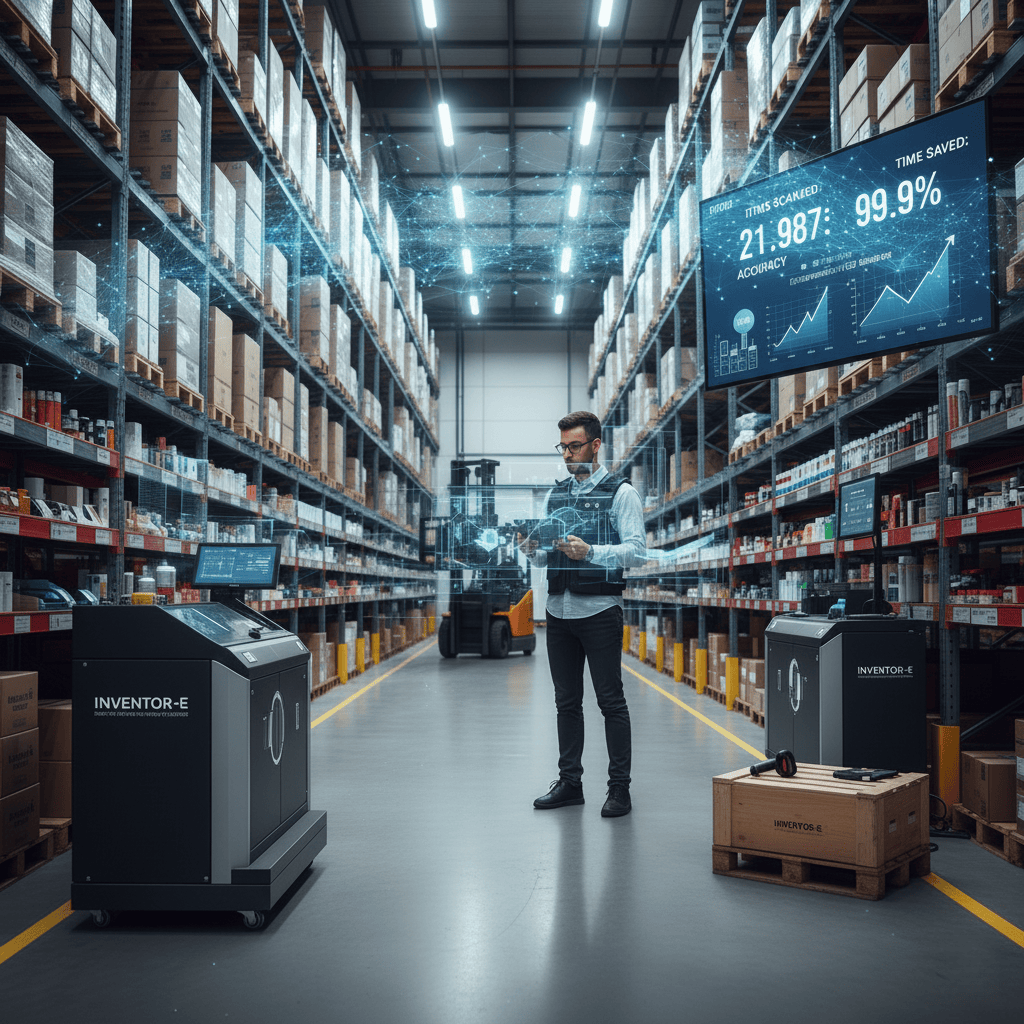
That is the basic idea of RFID. But to use it effectively, you need to understand the parts that make it work. I learned this early in my career, not in a classroom, but on the factory floor at Fongwah. Seeing how each component interacted taught me that a successful system is more than just a tag and a reader. It’s about building a complete solution. We need to look at how these parts come together to solve a real problem for the user.
How are the components of an RFID system put together?
An RFID system has several moving parts. Choosing the wrong ones can lead to project failure. Let's break down the four essential components for a successful setup.
An RFID system needs four key parts. The RFID tag3 stores the data on the item. The antenna sends and receives signals. The reader powers the tag and decodes the signal. Finally, software processes this data for your business.
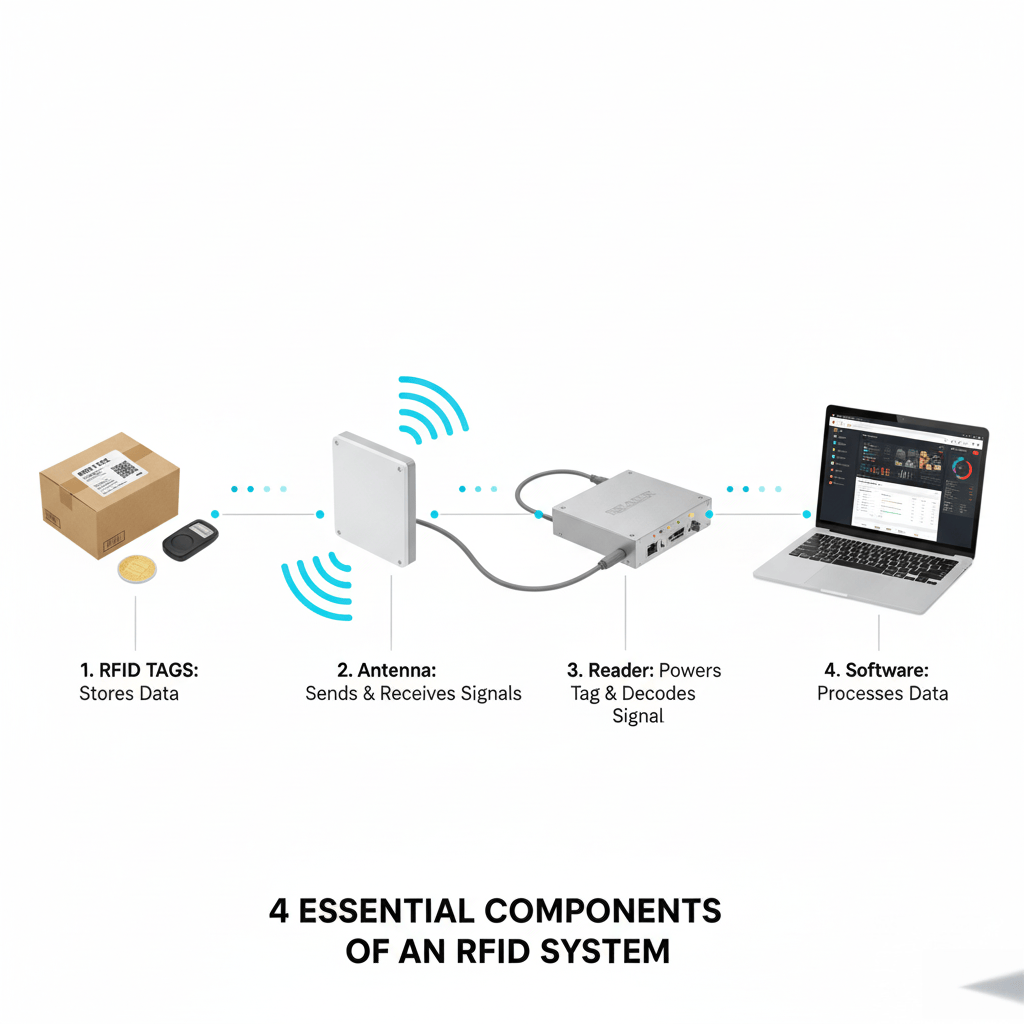
When I first started managing projects, we had a client who was brilliant with software but new to RFID hardware. They bought powerful readers but paired them with the wrong antennas for their specific space. The result was a system with huge blind spots. This experience taught me that every component is equally important. Think of it like a team where each player has a specific role. You need all four working together perfectly.
The Tag and Reader
The tag is the starting point. It's a small chip with an antenna that you attach to an object. Tags can be passive, meaning they are powered by the reader's radio waves, or active, with their own battery. The reader is the brain. It sends out a signal, powers up any passive tags in its range, and listens for their response. The reader then converts these radio waves into digital data.
The Antenna and Software
The antenna is connected to the reader. Its job is to shape the radio frequency field. This creates the "read zone" where tags can be detected. Choosing the right antenna is critical for covering the exact area you need. Finally, software, often called middleware, takes the raw data from the reader. This software filters out duplicate reads, makes sense of the information, and sends it to your main business systems, like an inventory management platform.
| Component | Primary Function | Key Consideration for a Buyer |
|---|---|---|
| RFID Tag | Stores object identification data. | Passive vs. Active, size, material, attachment method. |
| RFID Reader | Powers tags and captures their data. | Fixed vs. Mobile, number of antenna ports, connectivity. |
| Antenna | Shapes the RF field to create a read zone. | Polarization (Linear vs. Circular), gain, physical size. |
| Software | Processes raw data into useful information. | Integration with existing systems (ERP, WMS), filtering capability. |
What are the main types of RFID, and which one should I choose?
The terms LF, HF, and UHF can be confusing. Choosing the wrong frequency for your application is a costly mistake. Let's clarify the differences to help you decide.
RFID systems mainly use three frequencies. Low Frequency (LF) is for very short distances like pet chips. High Frequency (HF) is for things like payment cards. Ultra-High Frequency (UHF) is best for long-range scanning, like in warehouses.
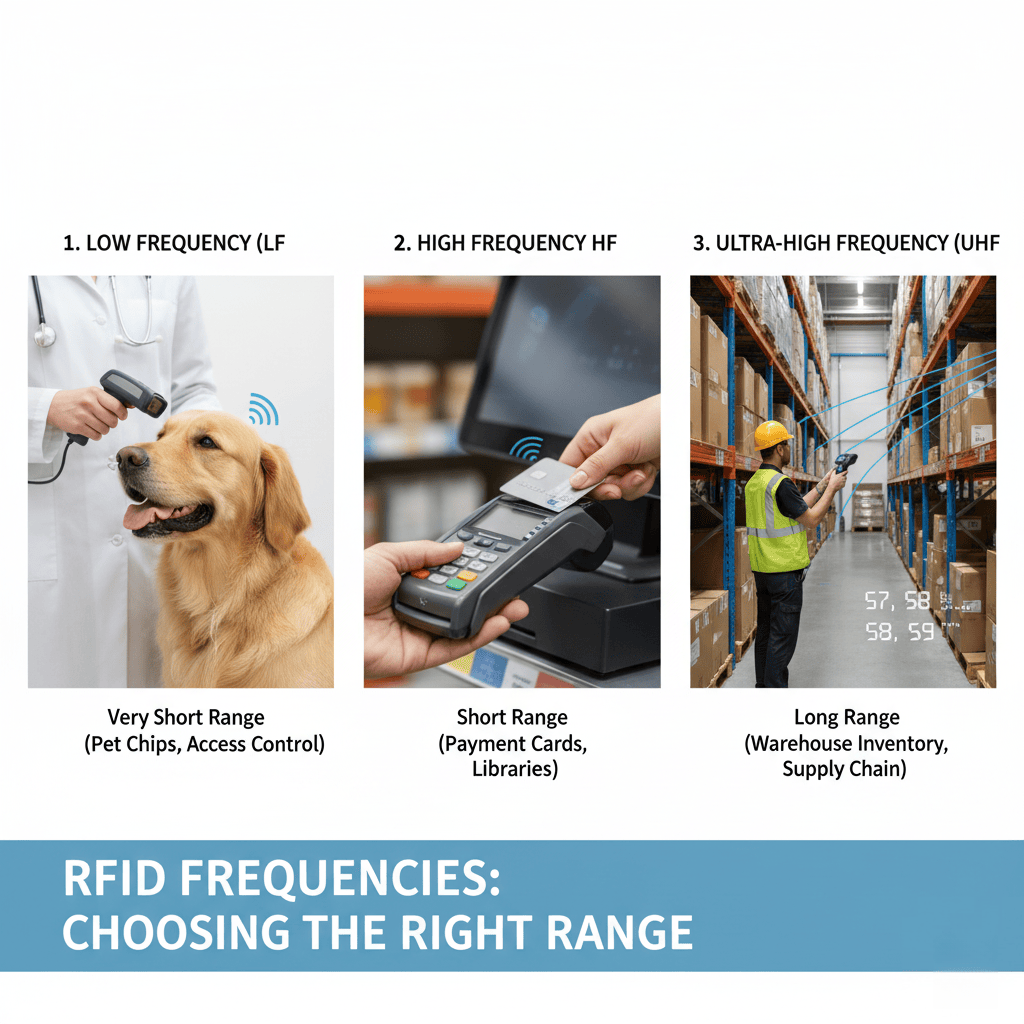
At Fongwah, this is the first question we always ask a new client. Their goal determines the technology we recommend. A customer once wanted to use UHF tags to track metal tools in a small toolbox. While UHF is powerful, it performs poorly when tags are very close together and surrounded by metal. We guided them to an HF solution instead. It had a shorter read range, but it was far more reliable for their specific use case. The best technology is the one that actually solves your problem, not just the one with the biggest numbers on the spec sheet.
Short-Range vs. Long-Range
The main difference between the frequencies is the read distance. LF and HF are considered proximity technologies. You need to be very close, from a few centimeters to about a meter. This is good for security applications like access control or payment systems where you don't want to accidentally read a card from far away. UHF is a vicinity technology. It can read tags from several meters away, which is perfect for portals, supply chains, and asset tracking where you need to scan many items at once without handling them individually.
Environmental Factors
Your operating environment also changes which frequency is best. LF signals work very well around liquids and animals, which is why they are used for livestock tracking. HF is also quite resistant to interference. UHF, however, can be affected by water and metal. While technology like anti-metal tags helps solve this, it's a critical factor to consider during the planning phase. Choosing the right frequency from the start saves a lot of time and money.
| Feature | LF (Low Frequency) | HF (High Frequency) | UHF (Ultra-High Frequency) |
|---|---|---|---|
| Read Range | Very short (up to 10 cm) | Short (up to 1 m) | Long (up to 12 m) |
| Data Rate | Low | Moderate | High |
| Interference | Good resistance | Good resistance | Sensitive to metal/liquid |
| Common Use | Access control, animal ID | Library systems, NFC, payments | Supply chain, race timing |
What key factors determine the success of an RFID project?
Even the best RFID hardware can fail. This happens when the system is not planned for its real-world environment. Let's cover the critical factors beyond just the technology.
Success isn't just about hardware. It depends on the physical environment, like interference from metal and liquids. Proper tag placement is also crucial. Most importantly, the collected data must integrate smoothly with your existing business software.
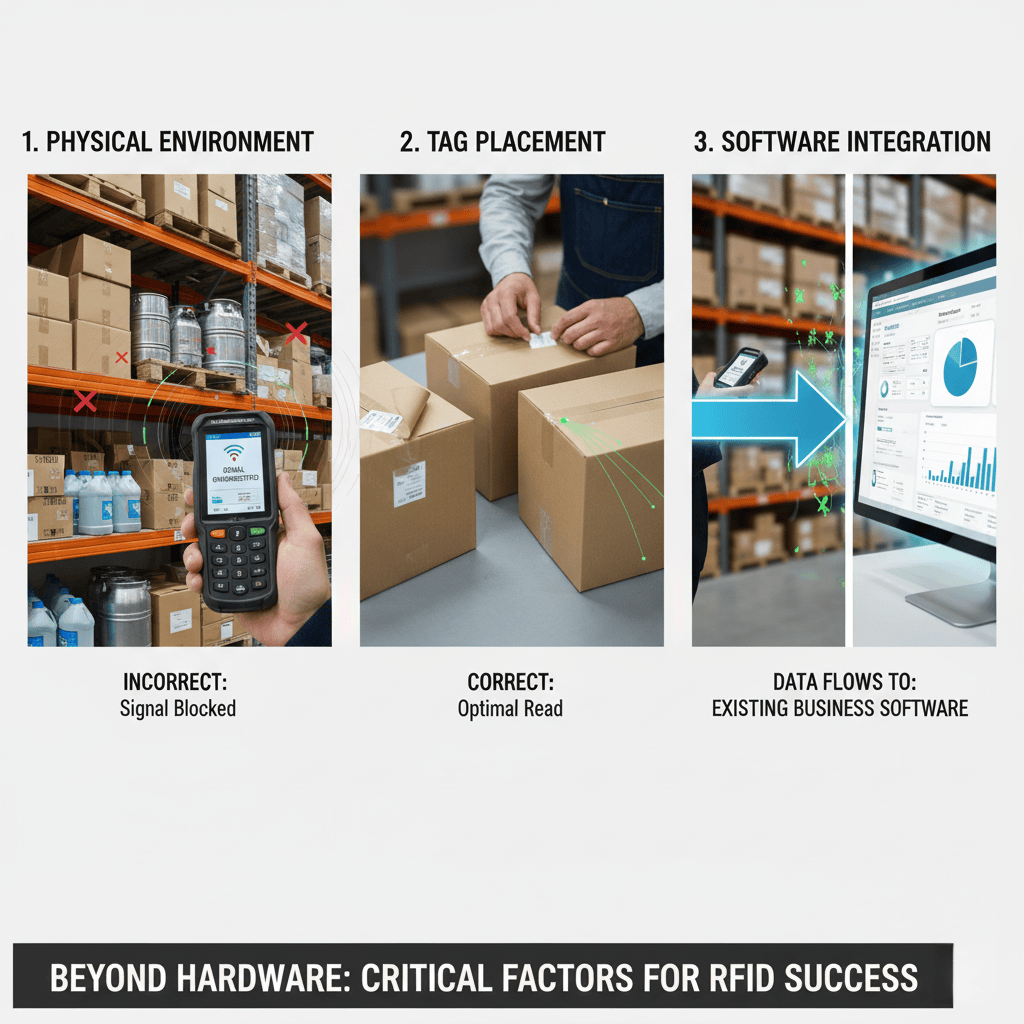
I remember a client in the logistics industry. They installed an expensive RFID gate system to track pallets leaving their warehouse. But the read rates were only around 80%. We investigated and found two issues. First, the tags were placed inconsistently on the pallets. Second, the forklift drivers were moving too fast through the gate. We helped them create a standard procedure for tag placement and set a speed limit for the forklifts. The read rate immediately jumped to over 99%. This shows that technology is only one part of the solution. The process and people using it are just as important.
The Physical Environment
You must test the system in the actual place it will be used. A warehouse full of metal shelves and a distribution center for liquids present very different challenges. These materials can reflect or absorb radio waves, creating dead zones where tags cannot be read. You need to identify these challenges early. It might mean using specific types of tags, like on-metal tags, or adjusting the position and power of your readers and antennas. A simple site survey can prevent major headaches later on.
Data Integration and Workflow
Capturing data is easy. Making that data useful is the hard part. Your RFID system will generate thousands of reads per second. This raw data needs to be filtered and sent to the right place. How will the RFID data connect with your Warehouse Management System (WMS) or Enterprise Resource Planning (ERP) software? You also need to consider how the technology will fit into your employees' daily work. A good system should make their jobs easier, not add extra steps. Planning for both the data and the human workflow is essential for success.
| Factor | Description | Why It Matters for a Buyer |
|---|---|---|
| Environment | The physical location, including metal, liquids, and interference. | Directly impacts read accuracy and hardware choices. A bad match leads to system failure. |
| Tag Placement | The position and orientation of the tag on the item. | Inconsistent placement is a top cause of missed reads. Standardization is key. |
| Software Integration | Connecting the RFID data to business systems like ERP or WMS. | Without proper integration, the RFID data is isolated and cannot provide business value. |
| Process Change | How the technology changes employee workflows and training. | User adoption is critical. If the system is hard to use, people won't use it correctly. |
Conclusion
Understanding the components, choosing the right frequency, and proper planning are the keys. This foundation ensures your RFID project will deliver real business value from day one.
---