You worry about wasting budget on the wrong tracking technology. Poor choices drain your funds and fail your operations. We must calculate the true return on investment1 today.
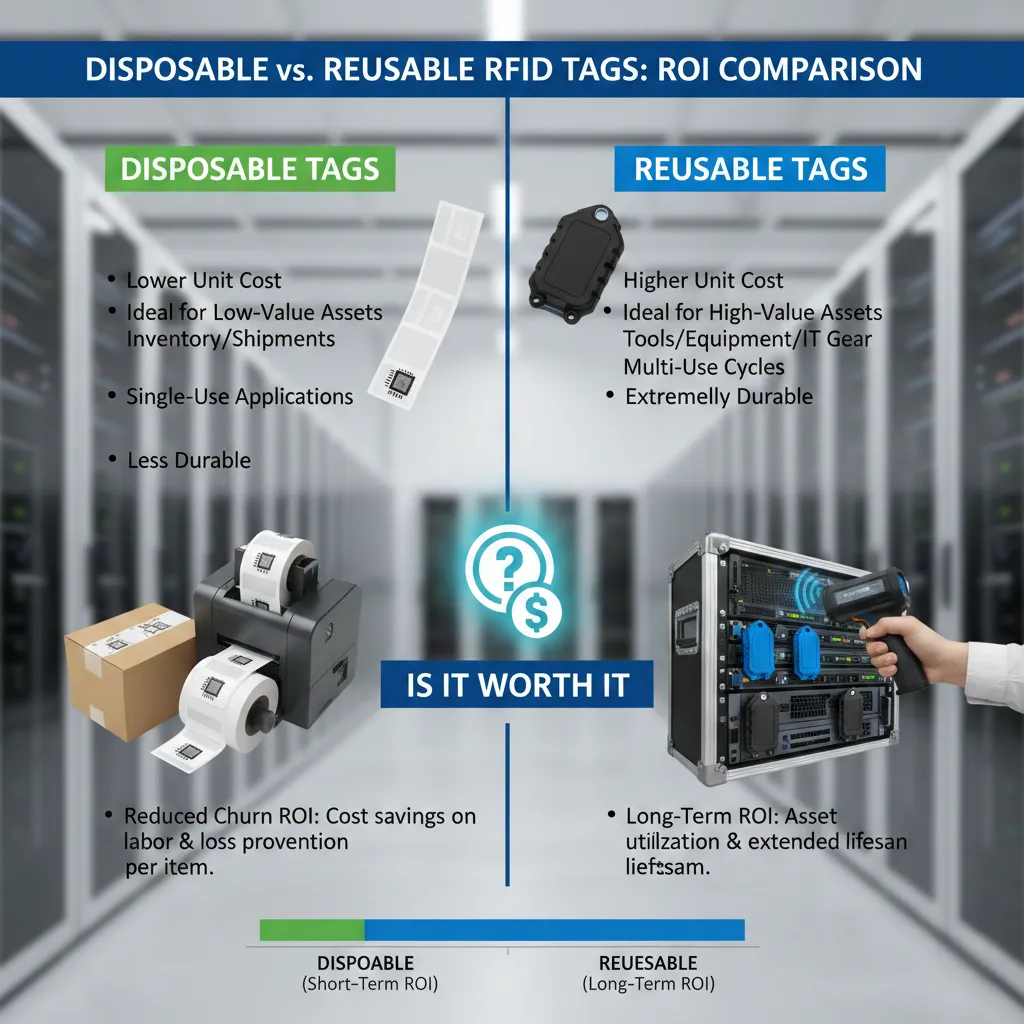
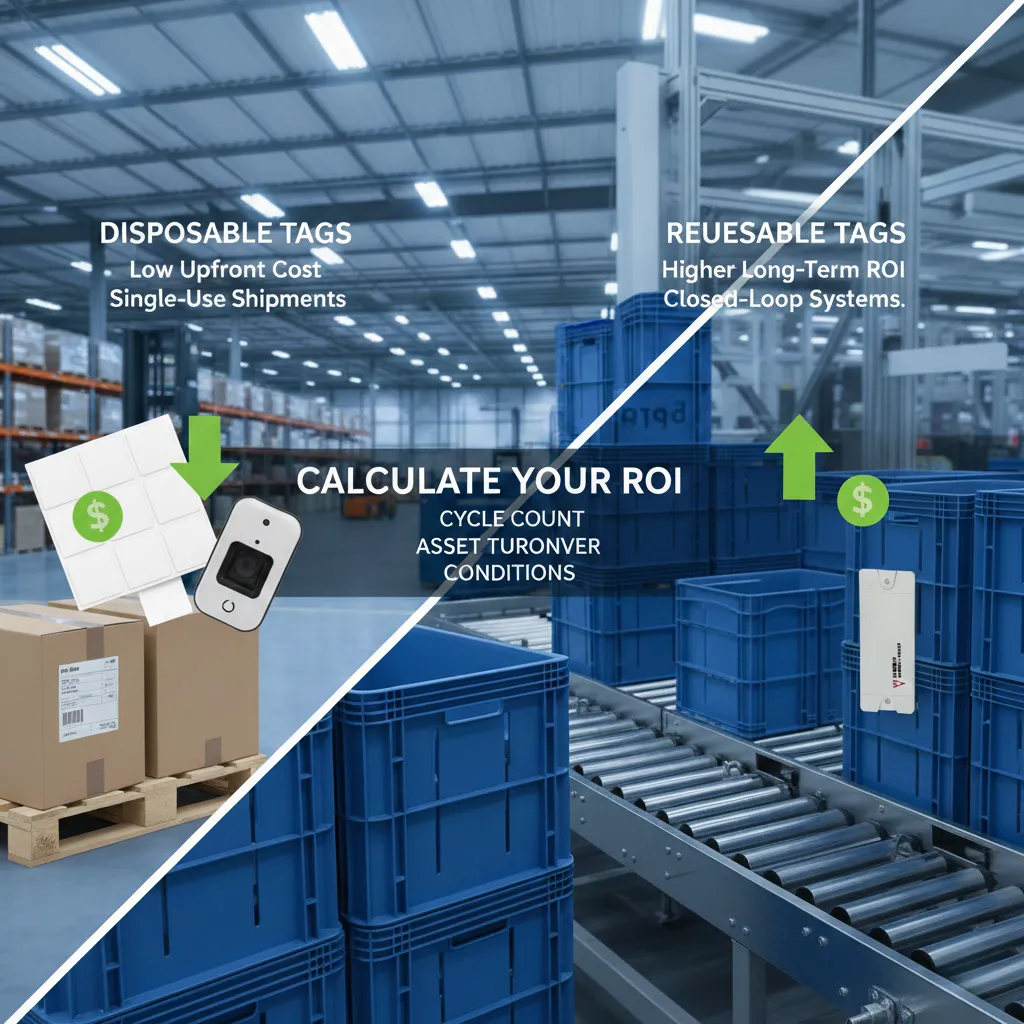
Disposable tags2 offer lower upfront costs suitable for one-time shipments, while reusable tags3 provide higher long-term ROI for closed-loop systems4 due to durability5. The best choice depends on your specific cycle count, total asset turnover6, and environmental conditions.
Many managers stop reading here because they only care about the lowest initial price. If you do not plan to look at the long-term operational picture, this article is not for you.
Why Do Initial Costs Deceive You About True Value?
Cheap tags look good on your purchase order. But replacing them constantly kills your budget over time. You need to look beyond the immediate price tag now.
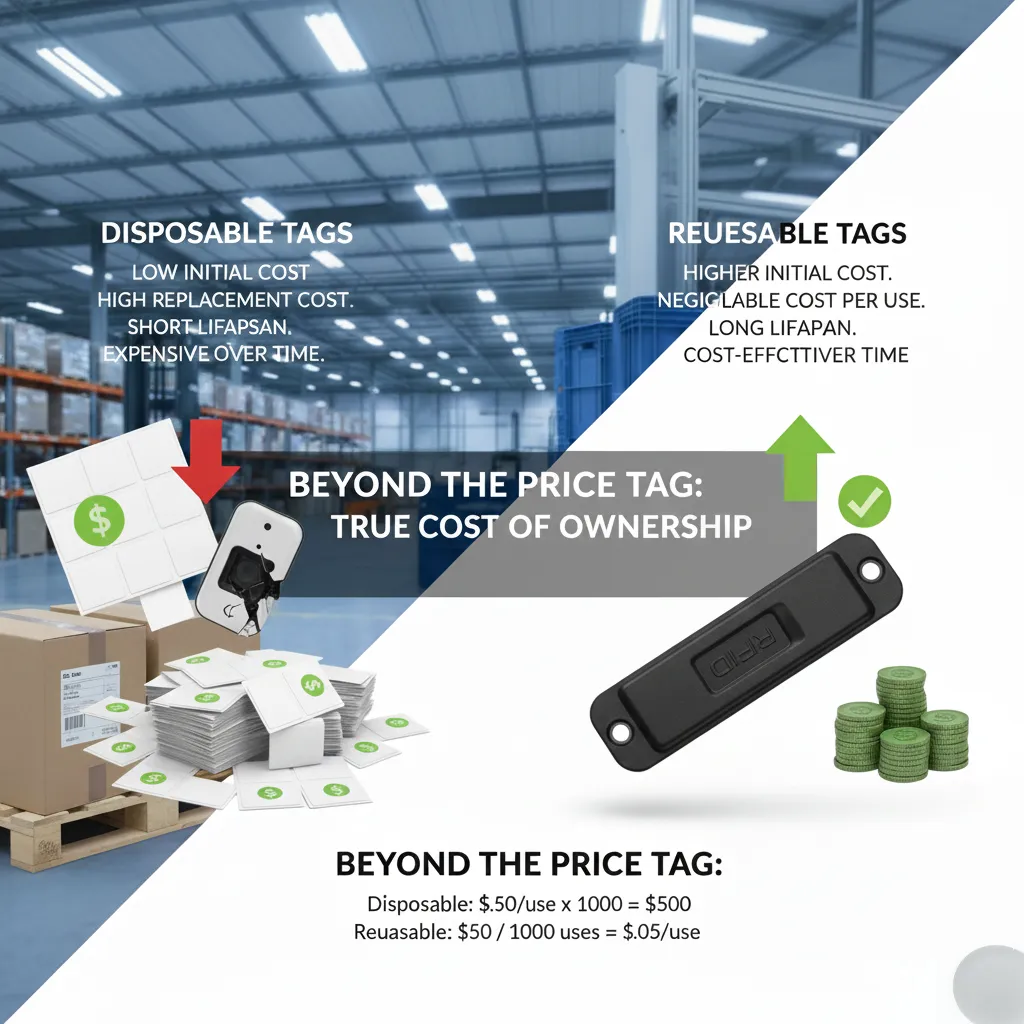
Initial low costs of disposable tags are misleading for long-term usage scenarios. Reusable tags, though distinctively more expensive initially, amortize over thousands of reads, ultimately costing fractions of a cent per use in rugged, recurring environments.
The Economics of Durability
I remember my early days as a production line operator at Fongwah. We often saw customers buying the cheapest paper labels for reusable plastic pallets. They thought they were saving money. Two weeks later, the labels were torn, and the pallets were lost. I saw their frustration firsthand. This taught me that the "sticker price" is a dangerous metric. You must analyze the Cost Per Use7 (CPU).
When you buy a disposable wet inlay, you pay maybe $0.10. You use it once. Your cost is $0.10. When you buy a rugged ABS hard tag, you might pay $1.00. This seems high. However, if that pallet cycles through your warehouse 100 times, the cost drops to $0.01 per use. The reusable tag becomes ten times cheaper than the disposable option.
Breakdown of Cost Structures
We need to look at this mathematically. Disposable tags2 have high recurring costs8 (OPEX). Reusable tags are a capital expense (CAPEX) with low maintenance.
| Feature | Disposable Tags (Smart Labels) | Reusable Tags (Hard Tags) |
|---|---|---|
| Initial Cost | Low ($0.05 - $0.20) | High ($0.80 - $5.00+) |
| Lifespan | Single use or short term | 3 to 10+ years |
| Hardware | Paper/PET face, simple antenna | ABS/PC housing, PCB antenna |
| Cost Model | High OPEX (Recurring Buy) | High CAPEX (One-time Buy) |
| ROI Horizon | Immediate | 6 to 18 months |
You must define your loop. If you ship to a customer and never see the pallet again, buy disposable. If the asset returns to you, reusable tags3 are the only logical financial choice.
Can Your RFID Tags Survive Your Supply Chain Environment?
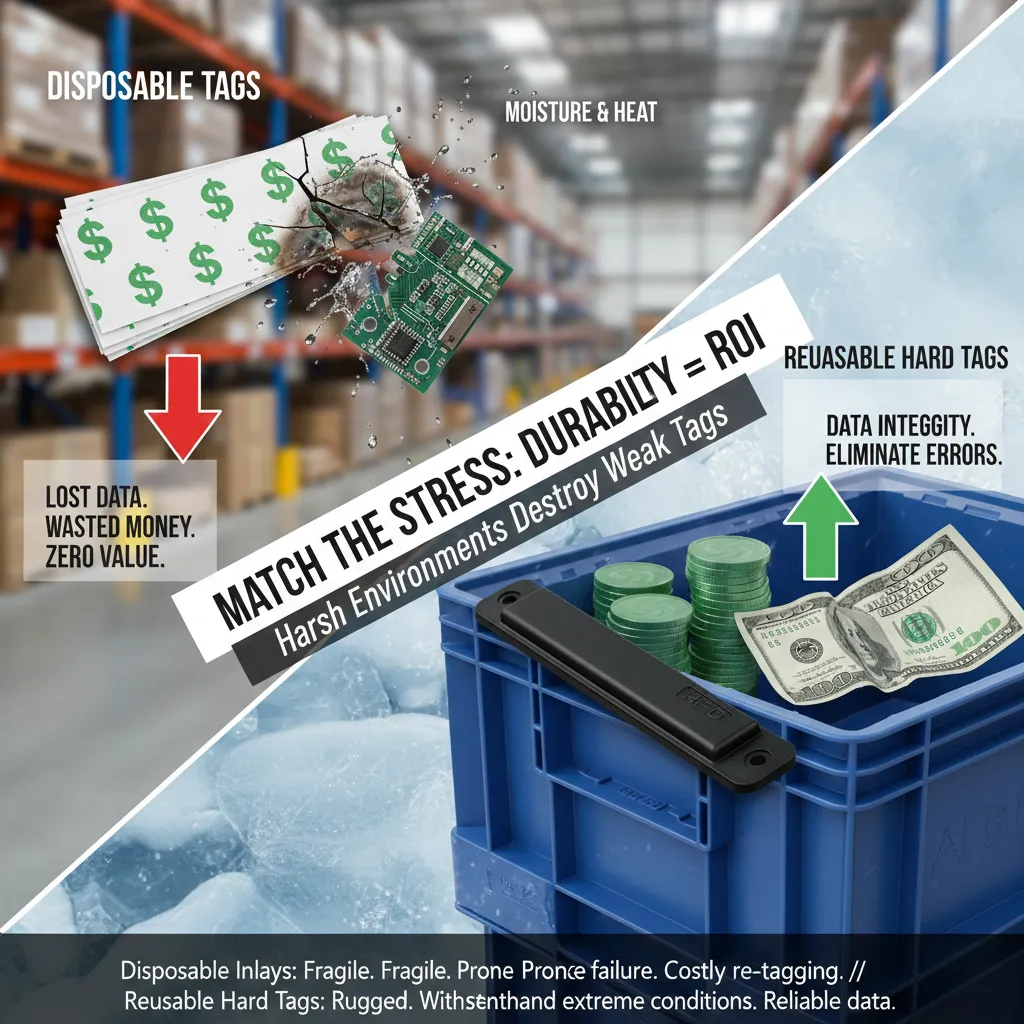
Harsh environments destroy weak tags instantly. A failed tag means lost data and wasted money. You must match the tag material9 to the physical stress.
Environmental stress determines ROI because a broken tag equals zero value. Disposable inlays fail in moisture or heat, requiring costly re-tagging. Reusable hard tags withstand extreme temperatures and impact, ensuring data integrity and eliminating zero-read errors in complex supply chains.
Physical Stress and Data Integrity
I once worked with a client managing frozen food logistics. They used standard paper labels. The condensation destroyed the adhesive, and the tags fell off in the freezer. They lost track of inventory worth thousands. This is why material science matters in RFID. You cannot ignore the physical reality of your warehouse.
Disposable tags2 usually consist of an antenna etched on PET (plastic) with a paper face. They are fragile. They cannot handle abrasion, high pressure, or chemical washes. If your assets go through a washing cycle, a disposable tag will die. This destroys your ROI because you have to buy the tag again and pay labor to apply it again.
Environmental Resistance Comparison
Reusable tags often use FR4 (PCB) material protected by ultrasonic-welded ABS plastic. Fongwah has spent 20 years perfecting these housings. They resist impact. They resist water (IP68 ratings). They work on metal surfaces. Metal detunes standard RFID frequencies. Reusable tags are often designed as "Mount-on-Metal" tags. This specific design maintains read range even on steel containers.
| Environment Factor | Disposable (Paper/Inlay) | Reusable (Hard Tag) |
|---|---|---|
| Moisture/Water | Low (Adhesive fails) | High (IP67/IP68 rated) |
| Impact/Abrasion | None (Tears easily) | High (Shock resistant) |
| Metal Surfaces | Poor (Signal detuned) | Excellent (Designed for metal) |
| Temperature | Limited range | -40°C to +85°C |
If you use a paper tag on a metal forklift, it will not read. You get zero data. Zero data means negative ROI.
How Does Tag Choice Impact Labor Costs and Efficiency?
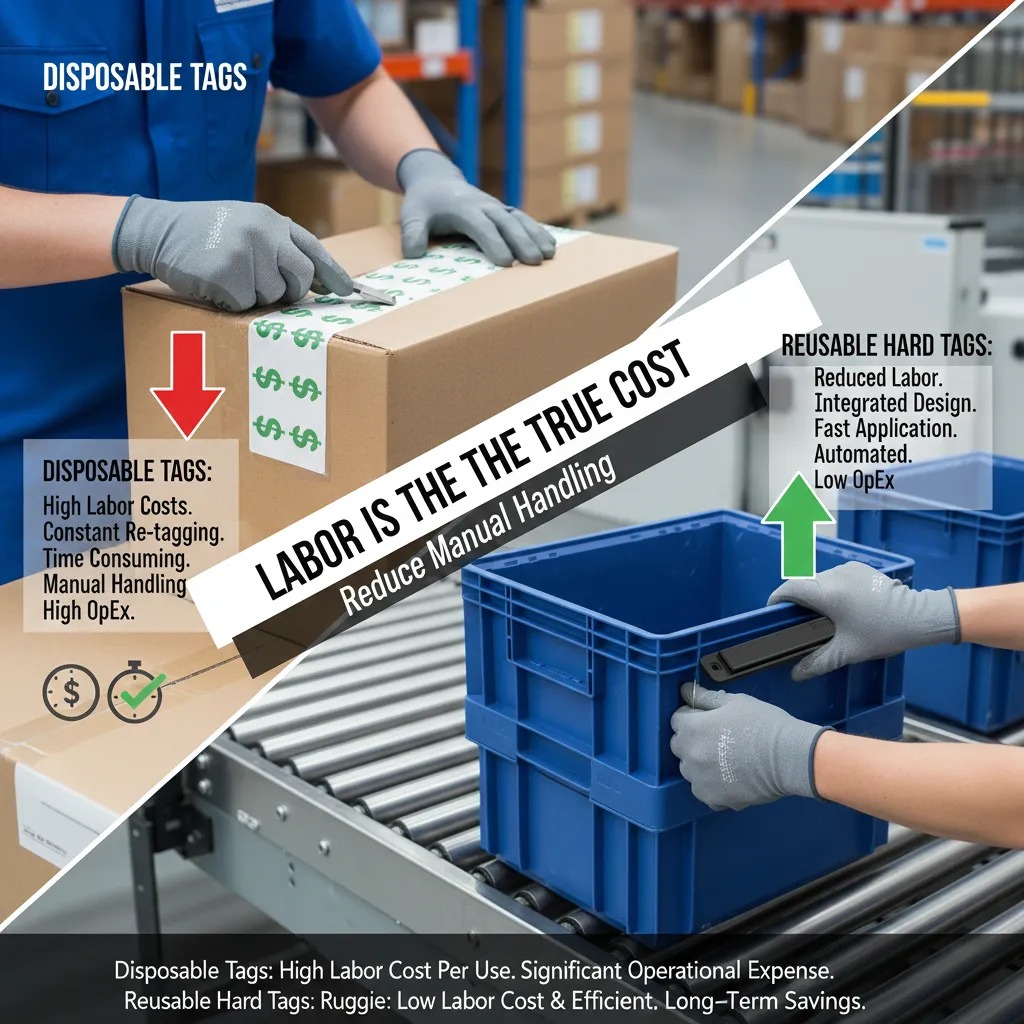
Applying tags takes precious operational time. Removing old glue and re-tagging is even worse. Your labor costs10 might be significantly higher than the tag costs.
Reusable tags reduce labor by eliminating the need to constantly re-apply labels. While disposable tags require labor for every shipment, reusable options in closed loops integrate into containers, significantly lowering manual handling time and operational expenses.
The Workflow Bottleneck
During my time as a team supervisor, I hated seeing my team scrape old barcodes off bins. It was slow. It was boring. It hurt morale. It was a waste of human potential. When we analyze ROI, we often forget the human element. Time is money.
Every time you apply a disposable tag, it takes 10 to 30 seconds. You have to print it, peel it, and stick it. If you do this 1,000 times a day, you lose huge amounts of labor hours. Reusable tags are installed once. You can use screws, rivets, or industrial epoxy. Once it is on, you do not touch it for years.
Labor Cost Analysis
Let is differentiate between "Soft Costs" and "Hard Costs". The tag price is a hard cost. The time to apply it is a soft cost. In high-volume operations, the soft costs kill your profit margins.
| Operation Step | Disposable Workflow | Reusable Workflow |
|---|---|---|
| Application | Every cycle | Once (Initial Setup) |
| Removal | Often required (Messy) | Never required |
| Encoding | Every shipment | Pre-encoded or rewritten |
| Labor Impact | High recurring labor | minimal maintenance |
Imagine a returnable transport item (RTI) pool of 10,000 crates.
- Disposable: Apply 10,000 tags every month. High labor.
- Reusable: Apply 10,000 tags once. Zero application labor for the next 5 years.
The ROI here is not just about the plastic tag. It is about freeing your workers to do more important tasks. This is how we at Fongwah help you optimize your process, not just sell you a product.
Conclusion
Disposable tags2 suit open loops; reusable tags3 rule closed loops. Choose based on your cycle life and environment to maximize your long-term profit.
---Understand the key factors that affect ROI in tracking technology for better decision-making. ↩
Explore the benefits of disposable tags for one-time shipments and their cost-effectiveness. ↩
Learn how reusable tags can enhance long-term ROI and reduce operational costs. ↩
Discover the advantages of closed-loop systems for maximizing asset utilization. ↩
Learn why choosing durable RFID tags is crucial for long-term operational success. ↩
Learn how asset turnover rates can guide your decisions on tracking technologies. ↩
Discover how Cost Per Use can help you evaluate the true value of tracking technologies. ↩
Understand the hidden costs of disposable tags that can affect your budget over time. ↩
Find out which materials are best suited for RFID tags in challenging environments. ↩
Explore strategies to minimize labor costs and improve efficiency in operations. ↩