
Missed scans ruin efficiency and create data gaps. Dead zones in your warehouse are frustrating. The right antenna setup solves this immediately by eliminating blind spots.
Increasing the number of RFID reader antennas1 expands coverage zones and creates spatial diversity2. This improves read rates in metal-heavy environments by overcoming multipath interference3. However, optimal performance requires calculating cable loss4 and preventing cross-channel interference between adjacent antennas.
I remember a project early in my career where we simply added more antennas to solve a read-rate problem. Surprisingly, the performance dropped. We created too much noise. This experience taught me that quantity is not the only answer. We must understand the technical balance.
Does adding antennas always guarantee 100% read accuracy?
Blind spots kill tracking systems quickly. Missing assets costs money and time. Multi-port readers eliminate these hidden gaps by viewing tags from multiple angles.
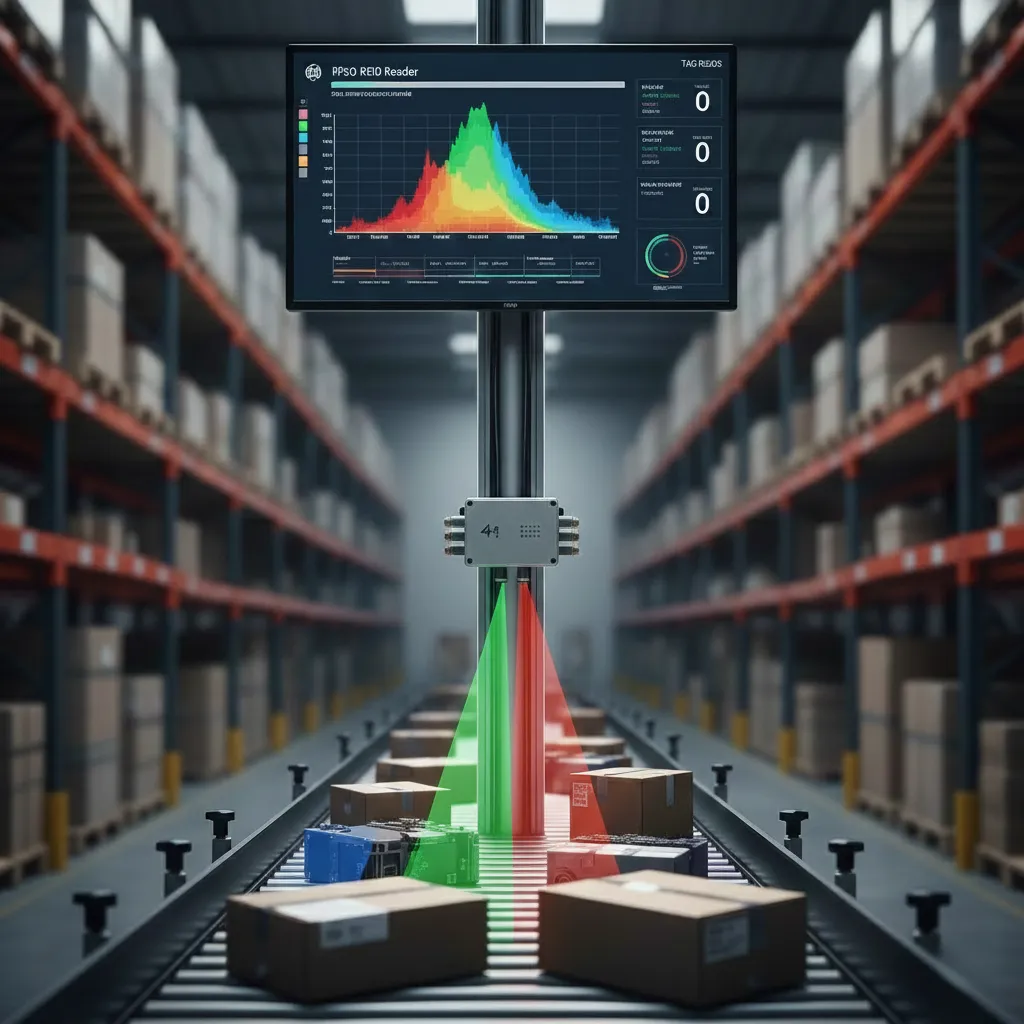
More antennas create overlapping fields, reducing null points where tags often hide. A 4-port reader covers different angles better than a single high-gain antenna, ensuring tags on irregular objects or metal surfaces are detected reliably.
Understanding Spatial Diversity
When I worked on the production line at Fongwah, I learned that radio waves behave uniquely. They bounce off metal and concrete. This bouncing creates "multipath interference3." In some spots, the waves cancel each other out. We call these "null spots5." A tag in a null spot becomes invisible to a single antenna. This is a nightmare for logistics managers.
Adding a second or third antenna changes the game. This is the concept of spatial diversity2. If Antenna A cannot see the tag because of interference, Antenna B is in a different physical position. It has a different signal path. Therefore, Antenna B reads the tag successfully. You do not always need more power. You need better angles.
In large-scale deployments, we often see pallets with random orientation. A single linear or circular polarized antenna might miss a tag facing the wrong way. By using four antennas connected to one reader, we create a "cage" of RF energy. This ensures that no matter how the object turns, one antenna makes contact.
| Configuration | Detection Probability | Risk of Null Spots | Complexity |
|---|---|---|---|
| Single Antenna | Low to Medium | High | Low |
| Dual Antenna | Medium to High | Medium | Moderate |
| 4-Antenna Array | Very High | Low | High |
Can multiple antennas handle high-density tag populations6 efficiently?
Slow reads bottleneck conveyor belts. Systems crash under heavy data load. Distributed antennas manage high traffic flow by splitting the reading work.
Multiple antennas allow dense reader mode operations, separating tag populations spatially to reduce collisions. This allows the reader to cycle through ports and process thousands of items packed together without suffering from buffer overflow or timeout errors.

optimizing Time Division Multiplexing7
Many users assume that a 4-port reader fires all four antennas at the exact same time. This is usually incorrect. Most UHF RFID readers use a technique called Time Division Multiplexing7. The reader switches very fast between Port 1, Port 2, Port 3, and Port 4. It cycles through them.
Why does this matter for high density? If you have 500 tags in a small box, a single antenna struggles. The "collision" rate of tags responding at once is too high. The signals jam each other. By using multiple antennas, we can physically segment the read zone. Antenna 1 reads the front. Antenna 2 reads the back.
I advise my clients to adjust the "dwell time" for each antenna. This is the time the reader stays active on one port. If Antenna 1 faces a high volume of tags, give it 500ms. If Antenna 2 is just for stragglers, give it 100ms. This logic improves throughput. It prevents the reader from wasting time on an empty zone.
Logic for Antenna Cycling
- Uniform Cycling: Equal time for all ports (Good for static storage).
- Dynamic Cycling: Reader skips ports with no tags (Good for smart shelves).
- Triggered Cycling: Sensors activate specific ports (Good for conveyor belts).
Is the cost of extra cabling and hardware worth the performance gain?
Budgets are tight in every project. Over-engineering wastes valuable resources. Finding the cable-length "sweet spot" saves your project profit and maintains signal integrity.
Long cables cause signal loss (attenuation8), negating the benefit of extra antennas. A distributed network of smaller readers often outperforms one massive centralized reader due to shorter cable runs and better signal integrity.
The Hidden Cost of Cabling
I often see a specific mistake in system integration. A customer buys a high-end 8-port reader. They place it in the center of the warehouse ceiling. Then, they run 10-meter or 15-meter coaxial cables to the antennas. This destroys performance.
Physics is strict about this. Every meter of cable reduces the signal power. This is called attenuation. A standard RG58 cable loses signal very fast at UHF frequencies (around 900 MHz). Even with better LMR-400 cable, you lose power. If you lose 3 dB of power in the cable, you have cut your power in half before it even hits the antenna. Your expensive reader is now performing like a cheap one.
At Fongwah, I suggest a decentralized approach. Instead of one big reader with long cables, use two smaller readers. Place the reader close to the antennas. Keep cables under 3 meters if possible. This maximizes the energy reaching the tag. It also saves money on expensive low-loss cabling. We must calculate the "Link Budget" carefully.
| Cable Type | Signal Loss (approx per 10m @ 900MHz) | Flexibility | Cost |
|---|---|---|---|
| RG-58 | ~5.0 dB (Very High Loss) | High | Low |
| LMR-240 | ~2.5 dB (Medium Loss) | Medium | Medium |
| LMR-400 | ~1.3 dB (Low Loss) | Low (Stiff) | High |
Conclusion
Balance antenna quantity with spatial positioning and short cable runs for optimal ROI.
---Explore how RFID reader antennas enhance tracking efficiency and reduce blind spots. ↩
Discover how spatial diversity can enhance tag detection in challenging environments. ↩
Learn about multipath interference and its impact on RFID performance. ↩
Learn about cable loss and its critical role in maintaining RFID signal integrity. ↩
Learn about null spots and their impact on RFID tag visibility. ↩
Find out how RFID systems manage high-density tag populations effectively. ↩
Understand how Time Division Multiplexing optimizes antenna performance in RFID systems. ↩
Explore the concept of attenuation and its effects on RFID signal strength. ↩